- Friday, 29 May 2026

UT-1 hydel hits milestone with weir gate operation
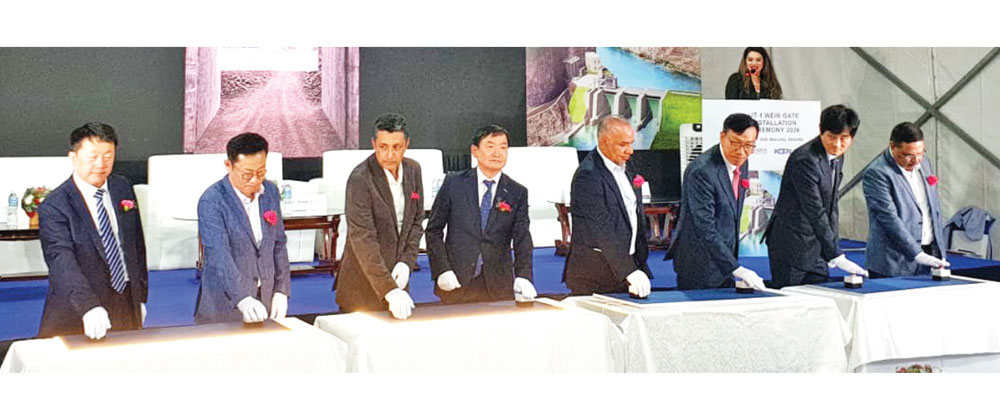

Kathmandu, May 29: The 216 MW Upper Tris huli-1 (UT-1) Hydropower Project achieved a major construction milestone with the successful operation of its newly installed weir gate in Rasuwa district on Thursday, signaling progress towards the final stage of the project’s development.
The successful operation ceremony of the upgraded weir gate, installed by Nepal Water and Energy Development Company Private Limited (NWEDC), was attended by Ambassador of the Republic of Korea to Nepal, Park Taeyoung, alongside government officials, project stakeholders and local residents.
According to the Embassy of the Republic of Korea in Nepal, the official inauguration of the newly upgraded weir gate marks a significant achievement in the construction of the Upper Trishuli-1 Hydropower Project.
Speaking at the event, Ambassador Park described the milestone as a reflection of strong cooperation and commitment among all stakeholders involved in the project. He said the UT-1 project stands as a landmark example of long-term energy collaboration between Nepal and Korea.
Highlighting broader bilateral cooperation, Ambassador Park said that the Korean government has remained a reliable development partner of Nepal for the past 52 years, supporting the country’s sustainable economic growth and prosperity.
He underscored Korea’s support in Nepal’s hydropower sector, including the construction of three hydropower plants and provision of necessary financing support.
The ambassador also stressed the significant potential for further Nepal-Korea collaboration in the energy sector.
The Upper Trishuli-1 Hydropower Project is being developed by Nepal Water and Energy Development Company Private Limited (NWEDC), with major two Korean Companies namely -- Korea South-East Power Co. (KOEN) and Korea Overseas Infrastructure & Urban Development Corporation (KIND) together with the International Finance Corporation (IFC) as Nepal's largest foreign direct investment hydro project.
More than 80 per cent of the construction work on the run-of-river project has been completed so far, and the project aims to begin commercial operation by mid-July 2027 after completing the remaining construction work.
The Koreans who came to Nepal with the agreement to invest in the UT-1 project in 2012 announced that the project would be completed in April 2019. But due to various reasons, Power Development Agreement (PDA) was done in 2016 and PPA was done with the project in 2018. In 2019, the financial management was completed.
The project is financed through a mix of 70 per cent debt and 30 per cent equity. The estimated cost of the project is USD 647.4 million, including interest during the construction period.
Major international financial institutions providing loans include the International Finance Corporation (IFC), Asian Development Bank (ADB), Asian Infrastructure Investment Bank (AIIB), and the Korean Exim Bank (K-EXIM).
The UT-1 is one of Nepal's largest hydroelectric projects under construction with foreign direct investment for domestic consumption. The concession period for the project is 35 years, including five years of construction period. The UT-1 is expected to generate up to 1,533 GWh of electricity.
Out of the total annual energy generated by the project, 38.75 per cent will be generated during the dry season, which is higher than most of the other run-of-the-river hydropower projects in Nepal, thus contributing significantly to managing the dry season electricity shortfall.
The project is very attractive for the country's power system as it is close to the Kathmandu load centre and will get 104 MW of electricity even in the dry season with high electricity demand.


-original-thumb.jpg)