- Sunday, 31 May 2026

PM Shah's expression is related to Cross-Border Occupation: Foreign Ministry

Kathmandu, May 31: The Ministry of Foreign Affairs has made it clear that Prime Minister Balendra Shah's remarks in today's Parliament on the Nepal-India boundary were related to encroachment of the no man's land and Cross-Border Occupation.
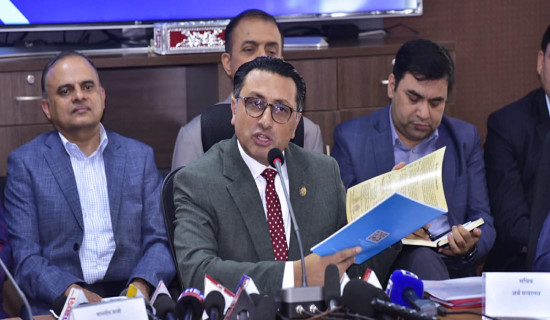
The Ministry made it clear regarding the remarks made by PM Shah in Parliament on the Nepal-India boundary stating a response of the Foreign Ministry Spokesperson to media queries.
"The adoption of the Fixed Boundary Principle in delineating the Nepal-India border along river boundary areas has led to 'Cross-Border Occupation' where the situation is that the citizens of one country farm and reside on land that falls within the territory of the other," according to the Ministry.
Likewise, the Ministry mentioned that border-related mechanisms and technical teams from both countries are active in collecting details of the Cross-Border Occupation, encroachment of no man's land, and construction and repair of border pillars in areas where mapping was done scientifically and systemically along the Nepal-India border.
The Ministry also stated that the job of the technical committee, which had remained pending for a long time, is active along the border area at present and details are being collected jointly.
The Foreign Ministry has clarified that PM Shah's recent remark in Parliament about land usage along the Nepal-India border that 'in some places, land currently used and occupied by Nepal may fall on the Indian side while land currently under India's use and occupation may lie on the Nepal's side', was made in the context of the technical findings identified by a study of the Technical Committee.
The findings had concluded that the issue is related to border management and 'cross-Border Occupation'.
The statement further explained that the Government of Nepal had already clarified its official position on India's operation of the Kailash Mansarovar pilgrimage route through the Nepali territory of the Lipulekh area on May 3 this year.
It also reminded Nepal's diplomatic note on the matter received a response from the Government of India through a diplomatic note as well.
The statement clarified that both countries have expressed their commitment to resolving border-related disputes through diplomatic channels and mutual dialogue.
The statement read, "It is evident that Nepal and India share a centuries-old, long, and open border. Nepal's current international boundary was demarcated and defined by the Treaty of Sugauli of 1816. Within the Nepal-India border, the areas of Susta and Limpiyadhura, Lipulekh and Kalapani remain to be demarcated."
The statement also noted that apart from these areas, the issues of 'cross-Border Occupation' and encroachment upon the no-man's land also persist in certain other locations." (RSS)



-square-thumb.jpg)


-original-thumb.jpg)