- Sunday, 31 May 2026

Prevent Violence Against Healthcare Workers

Healthcare institutions are for treatment, healing, compassion, and hope. These establishments care, comfort families, and save lives. The dedicated manpower often works under immense pressure for this goal. Unfortunately, in recent years, threats in terms of verbal and physical abuse and harassment have increasingly been occurring across many countries, including Nepal. It is, therefore, important to have urgent attention from all stakeholders to limit this from happening. The government, institutions, community, and individuals must act urgently to tackle misbehaviour towards healthcare workers.
The environment in healthcare institutions is often stressful, and all healthcare workers, from doctors and nurses to pharmacists and laboratory staff, have to cope with immense pressure. It is expected that they make immediate decisions, manage emergencies, and provide services to a large number of patients, frequently with limited resources. It is unfortunate that instead of getting praise and support for their dedicated and professional services, many face insults, intimidation, violence, and defamation from patients and their relatives.
Unrealistic expectations
Patients and their relatives have unrealistic expectations most of the time, and this is one of the major reasons behind such behaviour. Most of us believe that hospitals have a pill for every ill and expect positive outcomes in every case. We often forget that even with the best treatment, care and services, some patients may not recover owing to the severity of illness, delayed hospital visits, underlying conditions, and scarcity of essential resources, particularly in hospitals which are already overstretched. Frustration is often directed towards healthcare professionals when outcomes do not meet expectations.
The second most important factor for such behaviour is inadequate, oftentimes poor communication between healthcare providers and patients. Overstretched and busy hospitals in developing countries with limited manpower may not be able to provide information on medical conditions, treatment modalities, risks, and potential outcomes to family members. This communication gap raises misunderstandings, suspicion, and mistrust among healthcare providers and the patient party. The risk of confrontation increases when the communication gap creates misunderstandings and mistrust.
Nowadays, social media has provided an easy platform for propagating negative stories about hospitals that further worsen the problem. Medical negligence should always be investigated and addressed, but false accusations and sensationalised posts can denigrate the public image of hospitals. In some cases, misinformation can incite public anger and stimulate aggressive behaviour against healthcare professionals.
The misbehaviour may have severe and far-reaching consequences. The tremendous effect of violence and abuse on healthcare staff has been shown on their mental health. It has been seen that job satisfaction has reduced significantly due to constant fear, anxiety, and emotional exhaustion, which also led to depression and burnout. The problem of violence against healthcare workers in developing countries like Nepal has rather grave consequences of worsening the shortages of skilled manpower in the future.
Violence in hospitals not only affects public trust but also patient care. The constant fear and/or threat can distract from the ability, and the effect is a decline in quality of care. Consequently, emergency services are compromised, critical decisions delayed, and hospital functions severely hampered. Thus, it is the responsibility of all concerned to protect hospital workers against violence for their well-being to have better patient care and optimal functioning of the healthcare system.
The news of violence against healthcare workers has even broader social implications. On the one hand, medical negligence should be properly investigated and addressed, but the unwanted violence sends a dangerous message that violence is acceptable when people are dissatisfied. It is, therefore, essential to keep respect for institutions intact and discourage a culture of aggression through dialogue and accountability.
Similarly, healthcare institutions must also have proper standard operating protocols and policies to safeguard their staff as well as patients. The incidents of violence against healthcare staff arise mainly when patients feel neglected, treated disrespectfully, and uninformed. Therefore, healthcare institutions need to invest in behavioural training, patient counselling services, and grievance handling systems. Proper communication about treatment, cost, waiting time, and possible outcomes can increase trust, which is oftentimes as important as treatment itself.
The government should also have a crucial role in formulating and implementing strict laws to protect healthcare workers from harassment and violence. It is wise to invest in security systems, standard operating protocols, surveillance mechanisms, and grievance handling. Having laws alone are not sufficient and broader public awareness campaigns are needed to educate the public on the challenges being faced by healthcare workers in pressured situations and the importance of mutual understanding and respect.
Media
Media should also act responsibly. It has been shown that negative stories get more audience and target rating points (TRPs), so balanced reporting is essential. We should not forget the role and sacrifice of healthcare professionals during the COVID-19 pandemic when they risked their lives to protect society. Patients and families visiting hospitals are often under tremendous emotional stress, but at the same time, it is essential to acknowledge that anger and violence cannot solve the problems.
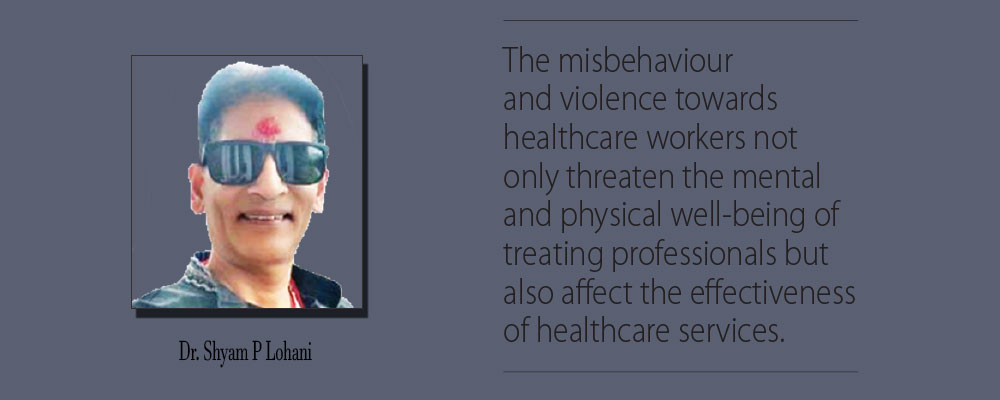
The misbehaviour and violence towards healthcare workers not only threaten the mental and physical well-being of treating professionals but also affect the effectiveness of healthcare services. On the one hand, professionalism, empathy, and ethical behaviour are essential for healthcare professionals; on the other hand, families should be well informed about the treatment process, cost, and possible outcome. Therefore, for building a safer, stronger, and more humane healthcare system, respecting healthcare workers is not merely a moral obligation but also essential.
(Dr. Lohani is the clinical director at the Nepal Poison Information Centre. lohanis@gmail.com)