- Sunday, 31 May 2026

UML Leadership Transition Stalls
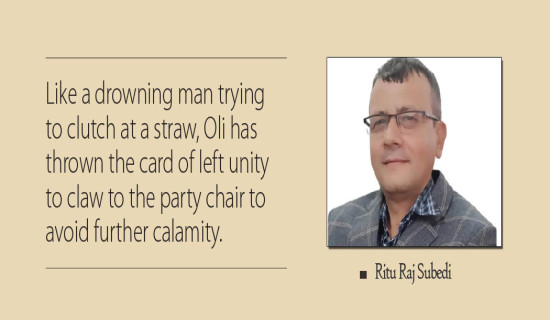
The recent meeting of the CPN-UML secretariat has ended in a deadlock. Most of its members had sought a graceful exit of chairman and former prime minister KP Sharma Oli from the top party position. Oli might have been shocked to hear his own loyalists, like vice-chair Bishnu Paudel and general secretary Shankar Pokharel, demanding his resignation. Much to his chagrin, Oli and the vice-chairs had heated arguments after the former tried to silence them during the meeting. The argy-bargy suggests how weak Oli has become in the party. This is perhaps his last battle to save his own political future.
All the office-bearers except for senior vice chair Ram Bahadur Thapa Badal and secretary Mahesh Basnet reportedly called for restructuring of the party in the wake of its humiliating defeat in the March 5 snap polls. They used the words ‘restructuring’ and ‘reorganisation’ that were euphemisms for the leadership change. But Oli resisted the growing demands for his removal from the party chair. Apparently, Oli succeeded in drawing a line in the sand and agreed to take the matter to the upcoming party central committee meeting.
All the office-bearers are Oli's hand-picks who backed him to consolidate his power within the party. Following the party's vertical split and the ousters of some of his harshest critics, Oli tightened his grip on the party. But his position has continuously weakened, especially in the aftermath of Gen Z, which effectively sealed his political fate. Then, the March 5 elections dealt a final blow to his political career. The election outcomes were the worst for the party since the restoration of multiparty democracy in 1990. It just bagged 9 seats in the elections under the first-past-the post (FPTP) category. In the first Constituent Assembly elections held in 2008, the party suffered a similar fate as it secured only 33 seats under the FPTP electoral system. That time, its voters switched to the then CPN-Maoist, which had become the largest party in the historic polls. But in recent polls, the people did not prefer any left forces that had maintained a strong support base for decades.
The UML has been the largest communist group but its support base significantly diminished in the March elections. All office-bearers lost elections. This naturally puts moral pressure on the leadership to pave the way for the new party head. Madhav Kumar Nepal resigned as the general secretary of UML following the party’s embarrassing drubbing in the 2008 CA election but Oli refused to follow suit, which will further damage the party in the coming days. When other leaders urged Oli to quit, he told them: ‘Do not try to convince me.’ ‘I will not be persuaded into resigning from the post.’ These answers were perhaps unexpected for the secretariat members. In order to sidestep the demand for his resignation, Oli succeeded in forming a committee under vice chair Badal, which will assess the party’s defeat in the elections and collect suggestions on the party restructuring. It will submit a report to the party in a month.
However, the 15-member panel is unlikely to come up with bold suggestions that will put Oli in the soup. Badal and Oli are now on the same page when it comes to analysing the Gen Z revolt and electoral rout. There has been a tendency among the communist leaders to create imaginary enemies to hide their own malfeasance and ideological and moral deviations. They often blame external forces for electoral loss or ouster from the government, undermining the domestic factors and people’s new consciousness and changing priorities. Terms such as ‘capitalist class,’ ‘comprador class’ and bichauliyas (middlemen) are commonly mentioned in the official documents of communist parties but there are ample examples wherein the top communist leaders often hobnob with the so-called bourgeois parties for electoral alliance, government formation and sharing of the spoils of the state.
Interestingly, Badal, a former Maoist military commander, has become Oli’s trusted lieutenant in the party. But Badal has courted controversy over his extremist views that hardly match the ideas of late Madan Bhandari, who gave ideological shape to the UML at a time when the international communist movement suffered a huge setback in the early 1990s. In a farcical scenario, Badal, who himself came to shelter in the UML for some mysterious reasons, is trying to protect Oli from political adversity. One reason Oli sticks to the post is to pretend that he still has power to shape the national political discourse, which he can use to blunt the state’s action against him. Oli is now under investigation for his alleged role in the killing of scores of youths in the Gen Z movement and in the case of money laundering.
Double whammy
Meanwhile, Oli has faced a double whammy. The Gauri Bahadur Karki-led investigation commission has already recommended that the government take action against him for his role in the violent suppression of the Gen Z uprising. Now the National Human Rights Commission (NHRC), in its report, has also held him accountable for the grave human rights violations in the Gen Z protest. Along with Oli, former home minister Ramesh Lekhak, former communication and information technology minister Prithvi Subba Gurung and the then chief of security agencies have been implicated in it. The government's failure has been cited as the main reason behind the severity of casualties and large-scale destruction of public and private property.
Shorn of state’s powers and perks, Oli does not want to hand over the party leadership for fear of further political seclusion that will weaken his position in dealing with criminal charges leveled against him. But the UML, already deflated by the elections, can hardly restructure its organisation and reshuffle its leadership with Oli at the helm. This really puts the UML functionaries between the devil and the deep blue sea. The deepening dilemma, frustration and anger within the UML are only contributing to its steady decline in the Nepali political landscape.
(The author is the Managing Editor of this daily.)
(The author is Managing Editor of this daily.)