- Monday, 1 June 2026

Nepal’s Green Success ?
 Prashanta Niraula
Prashanta Niraula
Prashanta Niraula
In the 1970s, the World Bank and global observers predicted that the accessible forests of the Nepali hills would disappear completely by the 1990s due to rampant deforestation. However, the economic survey of fiscal year 2082/83 unveiled that Nepal’s forest-covered land area has increased to 46.08 per cent from 39.6 per cent in 1990, which is the second highest in South Asia after Bhutan. This has posed a question of whether massive forestation is a green success for the nation, or does it need a second look?
The increase in forest area has undoubtedly many benefits. For a country rich in biodiversity and its protection challenging, forests are a boon. They play a major role in carbon sequestration, playing a huge role in climate protection as well. A total of 23.4 per cent of the country's forest area is protected, which has been contributing significantly to the tourism sector. However, the opportunity cost of having more forests cannot be neglected.
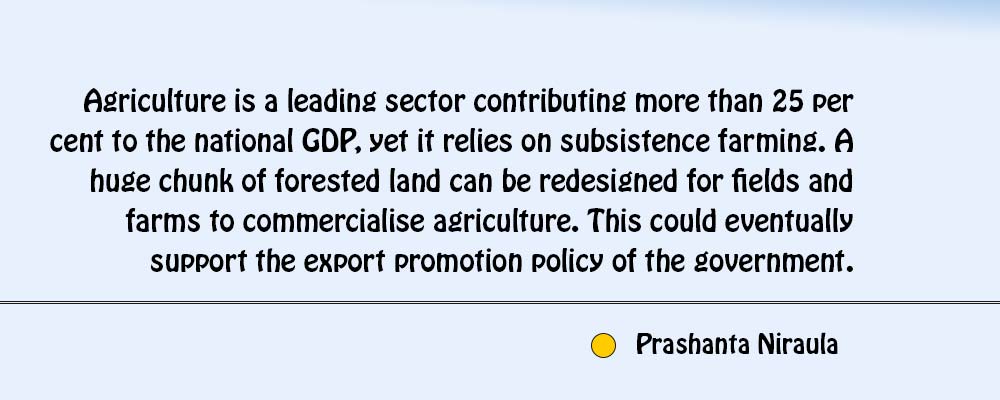
Agriculture is a leading sector contributing more than 25 per cent to the national GDP, yet it relies on subsistence farming. A huge chunk of forested land can be redesigned for fields and farms to commercialise agriculture. This could eventually support the export promotion policy of the government. Manufacturing plants can be opened by eliminating overly forested areas through proper fieldwork. Increasing forest area has delayed industrialisation and infrastructure development too. Large deposits of ores and minerals are often buried under such areas. Overall, economic value generated from extraction and refinement of such minerals is greater than the benefit gained from over-protection of forests. Developed lands generate property taxes, business taxes, and similar revenue that outweighs the revenue generated from just forested lands.
Another important aspect is the human-wildlife conflict. With rising forests, Nepal’s tiger population has also tripled to 355. However, as per the Department of National Parks and Wildlife Conservation (DNPWC), overall prey density has declined from 92.6 animals per sq. km to 77.51. This decline has posed a direct threat to the human population near forests. Monkeys are devastating agricultural livelihoods across Nepal’s mid-hills, which is driven mainly by an increase in forested areas. Although the UN’s REDD+ (Reducing emissions from deforestation and forest degradation) framework requires industrialised nations to compensate developing nations for keeping the forests standing, it is not practiced extensively. The concept of carbon-financing, however, is a rising topic these days.
The growth of forested area is not only the result of the development of the community forest concept and Nepal’s mindfulness towards climate change. Those dense forests hide within them a painful story of migration of people and their disdain towards countryside life. It also showcases the failure of the system in providing its people with basic needs of life so that they’re forced to leave behind their ancestral land. Hillside people are compelled to move towards the Tarai due to lack of basic health and other infrastructure. So, forested areas of hilly regions have increased but population density in the Tarai region is increasing rapidly. This will have an overall negative impact on the living standards of people in the long run.
On average, 30-40 per cent of the total land area of a country must be covered by forests as per the international practice. Given this, Nepal’s forested area is well above the standard and is increasing rapidly. The government should focus on a balanced land use policy rather than blind forest maximization, as forest resources can be used for accelerating development works. Otherwise, forests would increase without adding value to the lives of common people.