- Wednesday, 27 May 2026

Bhrikuti not in list of national luminaries
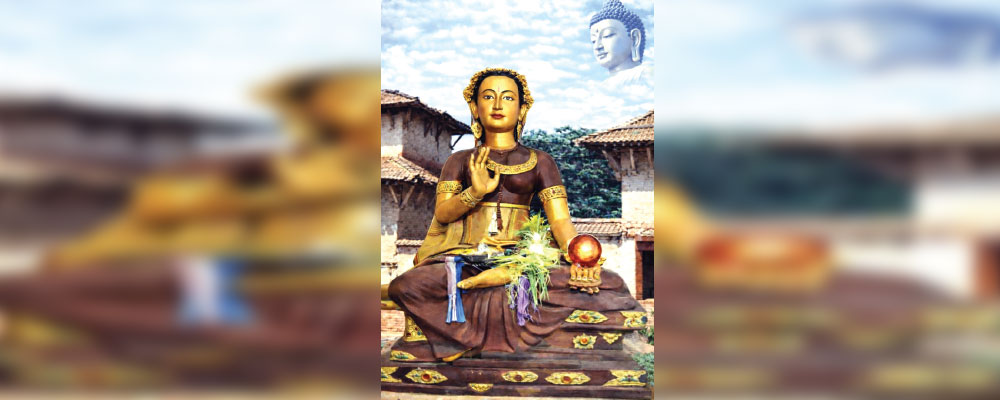

Kathmandu, Jan. 21: Many of us may still not be aware that Bhrikuti is no longer listed among the country’s national luminaries.
Bhrikuti was removed from the list of national luminaries in 2017 (2074 BS). Recognising her importance as a bearer of Nepal’s Buddhist culture and a symbol of peace, the Government of Nepal had honoured her as a national figure in 1955 (2012 BS). It is unfortunate that the government, in what appears to be a hasty decision, removed Bhrikuti’s name from the list of national luminaries.
The Study Report on National Luminary Princess Bhrikuti, published by the Bhrikuti Memorial Academy in July 2023 and prepared under the Ministry of Culture, Tourism and Civil Aviation, states that in Chinese history there is no single, unified account of Bhrikuti’s life in Nepal, and Nepal’s historical records also lack detailed information. After the First World Buddhist Conference, recognising the importance of peace, the Nepal government in the 2020 BS allocated significant funds to study Bhrikuti’s life in both Nepal and China.
Unfortunately, proper research and study were not conducted. As a result, Nepali historians and writers produced accounts that included hypothetical narratives, claims of adoption by Anshu Barma, and even fictional elements. Based on such writings by recent historians and official writers, the responsible government body removed Bhrikuti from the list of national luminaries without conducting a thorough research.
Subsequent studies revealed that Princess Bhrikuti was in Kurpasi (Khopasi) in the 7th century, on Maghe Sankranti in 624 AD (680 BS).
The report states that Bhrikuti was the daughter of King Udaya Deva and Queen Bhadrawati Devi, and the brother of Narendra Deva. The study further mentions that historical evidence dating back approximately 1,387 years has been found, in which (W)Srong (W)Tsan (S)Gampo himself authored the Tibetan text Mani Kabum, Volume Ka. In this text, King Udaya Deva is identified as Bhrikuti’s father.
During the Lichhivi period in the 7th century, after King Udaya Deva was defeated in a power struggle by his brother Dhruva Deva, Udaya Deva took refuge at his in-laws’ home in Manjushree Tole of Lagan, Kathmandu, along with Queen Bhadrawati and his 10-year-old son, Narendra Deva. It was here that Bhrikuti was conceived. For security reasons, the family travelled through Patan and Bhaktapur before settling at Anshu Varma’s residence in Pajentol, Khopasi, where Bhrikuti was born in 624 AD.
Bhrikuti later played a significant role in spreading Buddhism and Nepali art in Tibet. In 633 AD, she married the Tibetan King Songtsen Gampo of Lhasa. She took with her Buddhist statues and scriptures when she went to Tibet. Following this, Udaya Deva and his family also moved to Lhasa. Today, Bhrikuti is venerated as the ‘Green Star’ both in Nepal and China. After arriving in Lhasa, Bhrikuti carried Buddhist philosophy, political diplomacy, culture, and civilisation from Nepal to Tibet. She was a Nepali princess who brought Buddhism as part of her dowry.
"Thirteen hundred years ago, there was a king named Anshu Varma in Nepal. Anshu Varma had a beautiful daughter. Bhrikuti was a daughter of such high character," (Janak Education Materials Centre 2031:102). The Ministry of Education’s Janak Education Materials Centre has clearly written that she was Anshu Varma's daughter in a write-up titled Bhrikuti of the Mahendramala textbook for Class 7. Due to the carelessness of responsible officers, the honour of "National Luminary" awarded in 1955 (2012 BS) was devalued by removing her from the list without proper study, the report states.Biswo Ulak, President of the Bhrikuti Memorial Academy, said that Bhrikuti’s name was removed after the country became a republic. Among the other 17 national luminaries, her name was removed in 2017 without any definitive reason.
Even though figures like Shiva Deva, Udaya Deva, Narendra Deva, and Bhrikuti are no longer among us, their political, diplomatic, moral, religious, economic, and cultural contributions remain historical sources of inspiration, the report said.
Nepali Buddhism was preserved through Bhrikuti’s dowry in China, which helped China organise the first World Buddhist Conference. Nepal would be able to organise the 3rd World Conference, he said.
Now, the Ministry of Physical Infrastructure Development of Bagmati Province is going to reconstruct Bhrikuti’s historic birthplace in a Lichhivi style in Khopasi, Panauti Municipality-10, Kavre. Under the multiyear programme, Rs. 10 million has been allocated from the Rs. 30 million budget for the fiscal year 2025/26. The Urban Development and Housing Office of Dhulikhel under the provincial ministry will carry out the reconstruction of Bhrikuti’s birth home.
Ulak said that the project is being executed using local resources, avoiding concrete, rods, and even Chuna Surki. “The style and materials for construction have been finalised. The two-storied building’s final design features modern mortar on the exterior-backed brick, unpacked brick inside, and stone foundation work,” said Ulak.
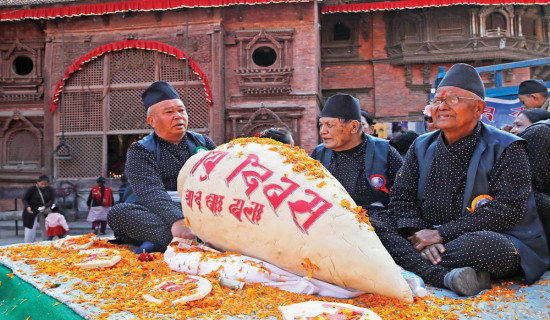
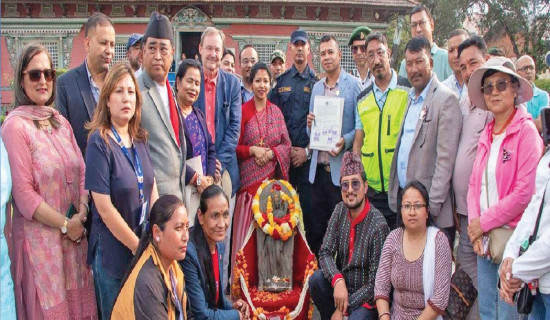
Recently, on Magh 1 (January 15), 1402nd birth anniversary of Bhrikuti was celebrated in Panauti 10, Khopasi at the joint initiative of Khopasi Youth Club, and Nara Singh Math.