- Saturday, 9 May 2026

Mysteries Of March Cosmos
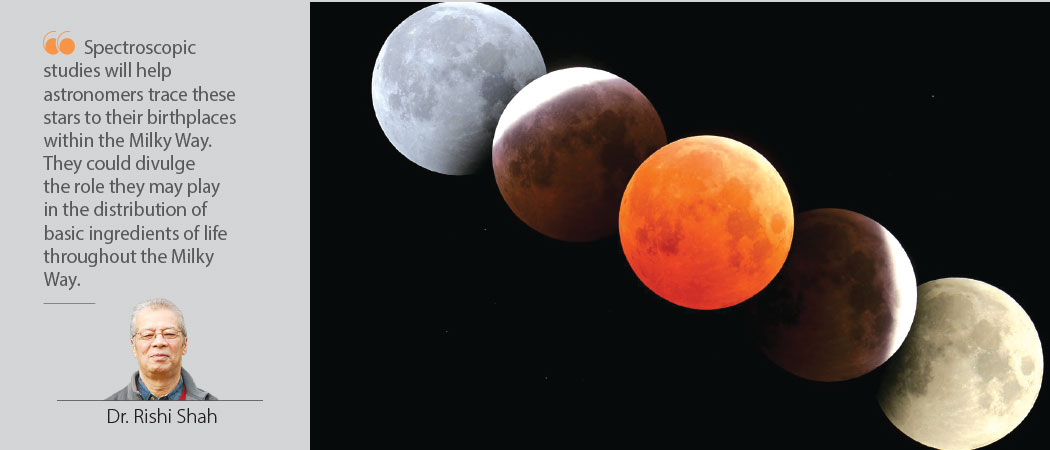

The crisp spring night skies invite sky-gazers to marvel at the mysterious planets, stars and constellations along with numerous extraordinary entities that are sprinkling the heavens. Planets Mercury and Mars would not be observable this month. It would be marching near the sun during daytime across the constellations Aquarius (water bearer) and Pisces (fishes). On 30 March fleeting Mercury would shine brightly from the highest emplacement in the sky in its March–May 2026 morning apparition. One should never attempt to squint through binoculars or telescopes at objects in the Sun's neighbourhood. Doing so may result in immediate and permanent blindness.
Planet Venus can be viewed shortly in the western sky after dusk fades to darkness after sunset. It would be shimmering and stand out as a spot of light in the constellation Pisces. Planet Jupiter and its mesmerising Jovian moons can be joyfully picked up in the eastern sky after dusk descends. It would climb the western sky till the wee hours of the night. It would then sag towards the southern horizon very late at night and be evanescent. It could be fancied as a fabulous fulgent flare of fire in the constellation Gemini (twins). The ringed planet Saturn cannot be readily seen this time since it is sailing in the sun's vicinity across Pisces. The greyish gas giant planet Uranus can be glimpsed gloriously in the western sky after sundown in the charming constellation Taurus (bull). It would be soon dipping towards the horizon by midnight. Its extreme axial tilt forces it to roll on its side. Bluish planet Neptune would be lost in solar glare due to its proximity to the Sun. It is navigating through Pisces.
The full moon announcing the colourful Holi festival would betide on 03 March. This full moon is popularly tagged as the worm moon because during this time of the year the ground would begin to soften and the earthworms would reappear. On this day a terrific total lunar eclipse would transpire, when the moon soars completely through the earth's dark shadow (dubbed 'umbra'). During this type of eclipse, the moon gets gradually darker and then turns rusty or blood red in colour. The eclipse can be appreciated from most of eastern Asia, Australia, the Pacific Ocean and North America.
Although the eclipse commences in the afternoon at 02:30 PM and ends at 08:08 PM, we can cherish the chic last phase of the partial eclipse only after moonrise at 06:18 PM. Eclipses of the moon are easy to watch with the unaided eye. Unlike solar eclipses, lunar eclipses are entirely safe to look at without the need to peer through any kind of filter.
Each time the moon zooms around Earth, it ambles almost opposite to the sun as it reaches full moon. If the moon tumbled around the earth in exactly the same plane that the earth scoots around the sun, the earth would slip between the sun and moon and create a lunar eclipse at full moon every month. However, the moon's path is tipped up by a petty five degrees relative to the earth's track around the sun. Lunar eclipses are witnessed only at full moon, when the moon is adjacent to the Earth–Sun plane at peculiar points designated as the moon's nodes. The moon passes this plane twice each month, but node crossings crop up roughly once every six months, usually two weeks before or after a solar eclipse. The moon during mid-eclipse is relaxing in the constellation Leo (lion).
This eclipse is a member of Saros series 133. The new moon befalls on 19 March. On 20 March the equinox can be greeted gleefully when the sun will rest directly on the equator and be in Pisces. There will be nearly equal amounts of day and night throughout the world. This incident heralds the first day of spring (vernal equinox) in the Northern Hemisphere and the first day of fall (autumnal equinox) in the Southern Hemisphere. Ghode Jatra will be boisterously be-lauded on 18 March. Chaitaya Dashain and Ram Navami are celebrated with veneration on 26 and 27 March.
Arcane asteroid 20 Massalia arrives at opposition on 21 March. We can relish this event through a good four-inch telescope in the conjuring constellation Virgo (maiden) that houses the sparkling star Spica (Chitra). Asteroid 20 Massalia will be well placed above the horizon for much of the night and loiter at its loftiest location in the southern sky around midnight local time. It could be admired awesomely in the eastern sky after evening hours. It will blur away very late before sunup as it slowly sinks towards the western horizon. Virgo unfurls between Leo and Libra (scales). Its lambent binary star Spica (Chitra) is actually two tightly revolving stars separated by merely 18 million kilometres. Spica is a mere 250 light-years away. At around the same time, Massalia also creeps closest to earth (termed 'perigee'), emerging as the most coruscating dot drifting in the night. This happens because when 20 Massalia stays converse to the Sun, it is lined up so that 20 Massalia, Earth and the Sun lie straight with Earth in the middle on the same section of the Sun as Massalia. On this occasion, 20 Massalia will skirt Earth from within 1.291 AU.
Nonetheless, the luminous asteroid Massalia would depict a faintly flickering object even through modern binoculars or a telescope of moderate aperture. The three-day-old waxing crescent moon, 12 per cent gleaming, would not disturb Messilina’s sighting. 20 Massalia is a significant S-type asteroid dwelling in the inner asteroid belt with most copious members of the Massalia family and indicating a decent diameter of circa 145 kilometres.
Massalia was detected in September 1852 by Italian astronomer Annibale de Gasparis. It was named after the Latin sobriquet for the city of Marseille, France, where the French expert Jean Chacornac identified it the following night. It lumbers around the Sun in the inner main belt at a distance of 2.1–2.8 AU once every three years and nine months. Its trajectory has an eccentricity of fairly 0.14 with an inclination of a scant one degree with respect to the so-called ecliptic. It possesses a solid, unfractured body. Apart from the few huge ones over 400 kilometres in diameter, such as the iconic asteroids 1 Ceres and 4 Vesta, most asteroids are weirdly crackled and broken, even rubble piles. Its mass is estimated to be a whopping 5.2×10 to the power of 18 kilograms. 20 Massalia was the first asteroid with non-mythological nomenclature. The circled number 20 was explicitly proposed to it instead. One astronomical unit is defined as the mean span between the Sun and Earth. It measures approximately 150 million kilometres.
A meticulous survey of strange and queer runaway stars reveals a surprise about their origin. The positions and circuits of hypervelocity stars were reconstructed from data acquired by the European Space Agency (ESA)’s Gaia satellite. In the early 1960s Dutch astronomer Adriaan Blaauw had scrutinised the quirky phenomenon of startling stars whizzing at high speeds through the Milky Way. These stars were allegedly unbound and had been kicked out of the Milky Way. These stars started in binary systems and were ejected when the companion star collapsed and exploded off its outer layers in a supernova. Researchers have reported the completion of the most extensive observational analysis to date of runaway O-type stars, the most effulgent and most massive class of stars in the galaxy.
These stellar runaways influence the evolution of galaxies. By escaping their cradles, they irradiate gas and dust in the interstellar medium (ISM), eventually seeding it with heavy elements after they go supernova, affecting how future stars and planets will form in the ISM. Understanding them will lead to refined models of how binary systems, star clusters and supernovae stimulate galactic evolution. Hot blue star HE-0437-5439 was thrown away violently from the centre of the Milky Way with enough speed to break away from the galaxy's gravitational clutches.
Unprecedented constraints on how these runaway stars are concocted and virtually no stars exhibiting high velocities and rapid rotation were the strongest evidence that multiple mechanisms are responsible for spouted stars. Spectroscopic studies will help astronomers trace these stars to their birthplaces within the Milky Way. They could divulge the role they may play in the distribution of basic ingredients of life throughout the Milky Way.
(Dr. Shah is an academician at NAST and patron of NASO.)




-square-thumb.jpg)
-square-thumb.jpg)