- Tuesday, 14 April 2026

Women Beyond Silent Compliance
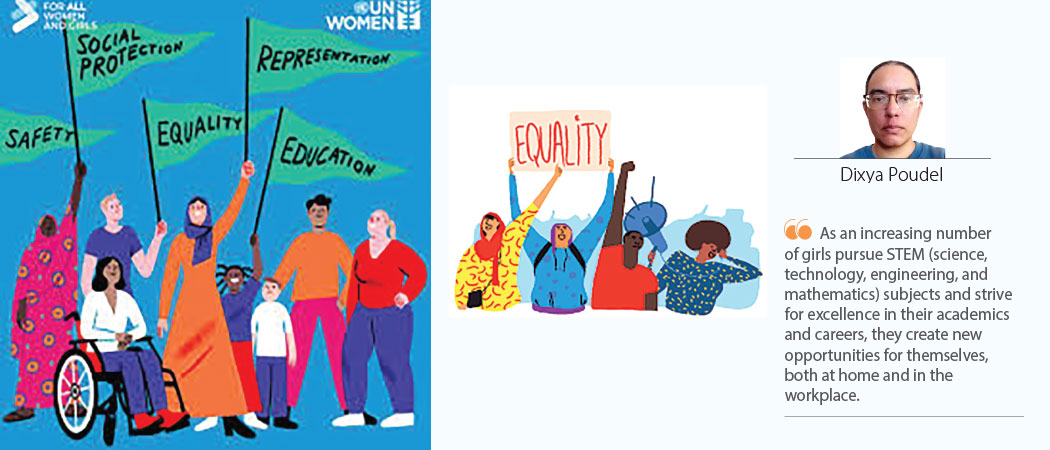

Picture a young woman. You would automatically imagine glossy hair, oval-shaped eyes, a demure smile and a polite and respectable attitude. You would suppose that the woman would be friendly, compliant and acquiescent while also being aesthetically pleasing. There is thus a typical stereotype that one would impose on an image of a woman, which inadvertently adds to the strain of societal standards for the females.
It is a bitter truth that patriarchy determines the status quo of the females as it shapes the image of what an ideal woman should be. God forbid if a woman should be boyish with masculine tendencies, if she were to break the norms of ideal femininity that society has constructed, or if she were to embrace her ambitions that exceed those of a man.
The latter is reflected in a Taylor Swift song where Swift sings that she would be the ‘alpha type’ if she were a man. And as a career woman, she wonders if she ‘would get there quicker’ if she were a man.
The fact is the world is biased towards girls and women, despite the huge achievements of females in most aspects of the world. If you think of a successful woman in world history, the images of Marie Curie, Indira Gandhi, Florence Nightingale, Princess Diana, and so on would emerge in your mind. And if you think of the present day, you would recall Malala Yousafzai (the 2014 Nobel Peace Prize laureate), Greta Thunberg (climate activist), Han Kang (the 2024 Nobel laureate in literature), Bidya Bhandari (former president of Nepal), Simone Biles (US athlete), and so on.
They have become role models for young girls who aspire to break barriers. But the fact remains that they live in a man’s world and their actions are judged and dictated by the rules laid down by patriarchal societies centuries ago. Today, girls and women might enjoy more freedom and opportunities than their predecessors, but they still have to abide by the rules formulated by patriarchy, even in the most developed nations. Even as the global movements shift towards female empowerment, the world remains lesser for the females, who are half the sky.
Human societies haven’t always been patriarchal, especially in tribal communities. Even today, some of the surviving tribal people practise egalitarianism, where girls and women play an equal role to that of the males. The Native American tribes in North America are known to hold women with a special spiritual role in the form of healers. If the European settlers in North America in the 15th century hadn’t invaded the Native Americans, the world perhaps would have had a different trajectory. But this is all just conjecture, and sadly, as capitalism took root in the West, where it keeps on thriving with patriarchy only changing its outer veneer, the inherent stereotypes and restrictions remain for the females. It is particularly adverse in the third-world countries. And one of the worst consequences of patriarchy is the violence against women.
Nearly 1 in 4 women worldwide have experienced some sort of violence against them at the hands of the men. It is a sobering statistic that chills the bones.
As young girls play house, the notions of what it is to be a woman take root in their minds. At home, they see their mothers, aunts, and sisters toil at household chores while being belittled by society. They see them put considerable effort into being presentable while preening before a mirror. Outside of home, they see men taking the lead roles in offices while the females are relegated to lesser roles.
They thus grow up seeing gender stereotypes, even though they might be quite subtle. Many experience violence against them perpetuated by the men they trust, which results in trauma that could last generations. As women keep being taken as possessions, the violence inflicted upon them continues to rise.
There has thus been a growing call to protect girls and women globally, but this questions the very foundation of societies that require such protection for females. Aren’t females rightful partners at home, whether it is as a wife, mother, grandmother, aunt or sister? And aren’t they able supporters of their family as working individuals? Don’t they have their personal dreams, rights and aspirations? Often at the cost of their own ambitions, women prioritise the ambitions of other members of their families, as seen in underprivileged societies like that of Nepal.
But things are looking up, as there seems to be a shifting of attitudes among the elite which could move the gears in favour of Nepali girls and women.
As an increasing number of girls pursue STEM (science, technology, engineering, and mathematics) subjects and strive for excellence in their academics and careers, they create new opportunities for themselves, both at home and in the workplace. But it isn’t only the fight of the females. Female empowerment can only take place when the society as a whole supports girls and women with equal stature.
(Poudel is a freelance writer pursuing a master's degree in English literature at Tribhuvan University.)