- Tuesday, 2 June 2026

Assurance Of Recovery

Amidst concerns from different quarters about the current economic crisis in Nepal, the federal government is determined to bring the national economy on track by dealing with all the problems and challenges. It needs no mention that the nation’s economic scenario is not so encouraging. The Banks and Financial Institutions (BFIs) have been reeling from a liquidity crunch for months. They are still unable to meet the growing demand for loans, leading to a significant rise in interest rates. As per the Nepal Rastra Bank (NRB), the interest rate on lending increased to 11.62 per cent in July last year while it exceeded 13 per cent in February this year. Due to this, the business community has failed to increase their investments in productive sectors. This has exacerbated the problem of unemployment within the country. With less investment and production, the nation has also continued to suffer a rising level of trade deficit.
The nation has been unable to achieve the target of economic growth owing to various factors. Capital expenditure has also been very low. It stood only at 25 per cent by the end of March this year. Economists and businessmen have called for increasing the capital expenditure. This could help ease the existing liquidity crisis, to some extent. What is more alarming aspect is that the federal government’s budget in the first eight months of the current fiscal year has been in deficit. It may create an additional challenge for the government to meet its recurrent expenses. And the government might be forced to take more external loans to manage the problem. A ban imposed on the import of luxury goods such as vehicles, liquors and expensive electronic devices for several months was one of the reasons behind the government’s inability to realise the target of revenue collection. The government had to take that measure in view of the growing depletion of the foreign exchange reserve. However, the government lifted such a ban a few months ago when the country began witnessing an increase in the foreign currency reserve with gradual revival of tourism.
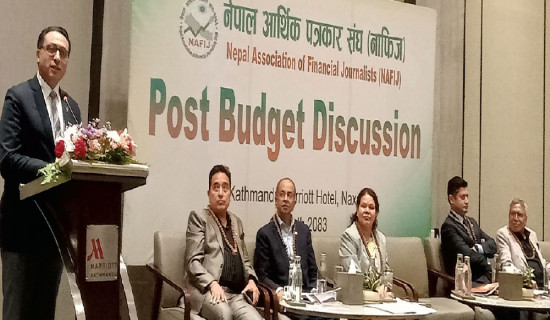
Considering all this, Prime Minister Pushpa Kamal Dahal Prachanda has said time and again that the government would make every effort possible for the revival of the national economy. Newly appointed Finance Minister Dr. Prakash Sharan Mahat has also followed suit. Talking with a delegation of the Federation of Nepali Chambers of Commerce and Industry (FNCCI) on Sunday, Dr. Mahat said that improving the national economy was his topmost priority. Since assuming his office last Friday, Dr. Mahat has been holding consultations with concerned officials like the Governor of the Nepal Rastra Bank (NRB) and representatives of the business community in regard to addressing all the issues roiling the national economy. He has sought necessary support and cooperation from the private sector in order to give a boost to the economy. He vowed to move ahead with the suggestions of the business community to free the economy from problems.
The representatives of the business community's umbrella organisation emphasised the need for the central bank and the government to take a combined initiative to reduce the interest rate and increase cash flow into the market. They also drew the government's attention towards controlling illegal imports from the border. As the private sector has a vital role to play to kee the economy running, the government needs to create more business-friendly environment and adopt policies that help boost their morale.