- Tuesday, 2 June 2026

Budget to build strong foundation for long-term development: FM Wagle
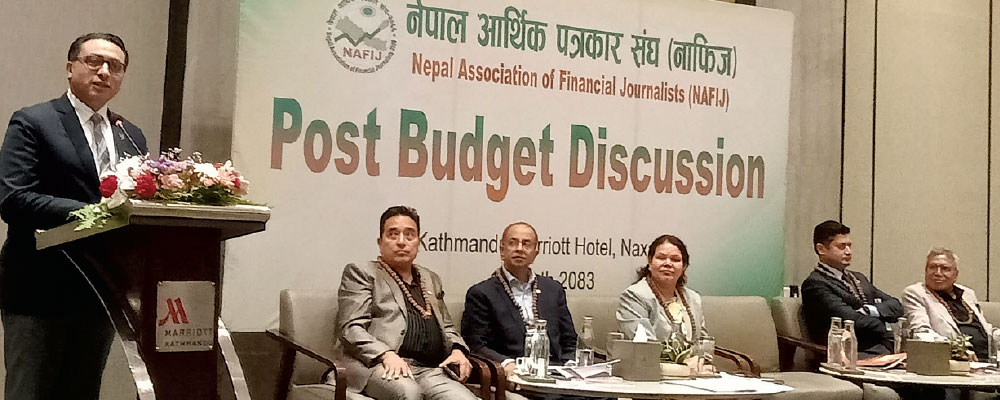

By A Staff Reporter, Kathmandu, Jun 2: Finance Minister Dr. Swarnim Wagle has said that the government has presented the budget with a five-year horizon aimed at laying a strong foundation for long-term economic development.
Addressing the post-budget discussion organised by the Nepal Association of Financial Journalists (NAFIJ) on Monday, Finance Minister Dr. Wagle said the current budget is not only focused on immediate priorities but is designed within a broader framework of planning over the next five years.
“We have prepared a five-year horizon for now. We have planned what will be done in the second, third, fourth and fifth year,” he said.
Dr. Wagle added that, due to time constraints, the current year’s budget has prioritised policies and institutional arrangements that are easier to implement and already discussed issues and less likely to face controversy.
He further indicated that more complex and sophisticated policy measures would be introduced in the coming years as part of the long-term reform strategy.
“There was a resource constraint. So, we have presented a budget of Rs. 2,124 billion, taking resource availability into account. We have to view the budget in relation to its share of GDP. The budget’s share of GDP is the lowest in the last 10 years,” he clarified.
The budget has set a target of collecting revenue of Rs. 1,580 billion, he said and added the budget has focused on mobilising domestic resources instead of relying only on loans,” he said.
He clarified that the government has introduced various policy reforms in the budget to encourage the private sector to increase investment and accelerate economic activities.
Executive director and spokesperson of Nepal Rastra Bank Guru Prasad Paudel said monetary policy introduced by the government for the next fiscal year will be focused to support achieving the targeted 7 per cent economic growth while keeping inflation within 6 per cent maintained in the budget.
He said that budget reflects current economic needs and emphasises governance reforms, digitalisation, and electrification to create stronger economic synergy.
"The budget has included a proposal to measure small loans based on financial transactions, track records, and credit scores," he said. "The central bank will move forward on this."
According to him, the budget’s provision for hire-purchase lending on consumer goods could help stimulate consumption and support middle-income households.
He also welcomed the plan to establish an asset management company within a fixed timeline, saying it would help address rising non-performing loans and growing non-banking assets in the financial system.
On the occasion, president of Nepal Chamber of Commerce Kamlesh Kumar Agrawal said that the budget presented by the government marks a starting point for entering a new era of economic development.
Agrawal noted that although the budget for fiscal year 2026/27 is ambitious, its successful implementation would boost confidence in the private sector.
He described the budget as an initial foundation for Nepal’s economic revival and said it could help accelerate the long-stagnant economy if effectively executed.
The President of the Confederation of Nepalese Industries, Birendra Raj Pandey, expressed his hope that the policy reforms adopted by the government would help further improve the business environment in the country.
He praised measures aimed at simplifying the tax system, including lower customs duties on 273 types of industrial raw materials compared to finished goods, a reduction in customs duty slabs, and the abolition of excise duties on 360 items. He said this provision would help promote domestic industries, reduce the cost of production, and make them competitive in the international market as well.
Vice President of the Federation of Nepalese Chambers of Commerce and Industry (FNCCI), Naresh Lal Shrestha, described the upcoming fiscal year’s budget as ambitious, noting that it faces significant challenges in resource management.
“Only 20 per cent is allocated for capital expenditure,” he said, “and the budget includes a financial deficit of more than Rs. 600 billion.”
He welcomed the plan to build the country’s first AI computing centre in Syuchatar.
He said that the 5 per cent VAT imposed on consumers using more than 50 units of electricity, as well as taxes on education and health, should be reconsidered.
He stressed that these measures would increase the burden on the private sector and consumers and therefore should be revised.