- Tuesday, 2 June 2026

Insurance suspension hits govt hospitals
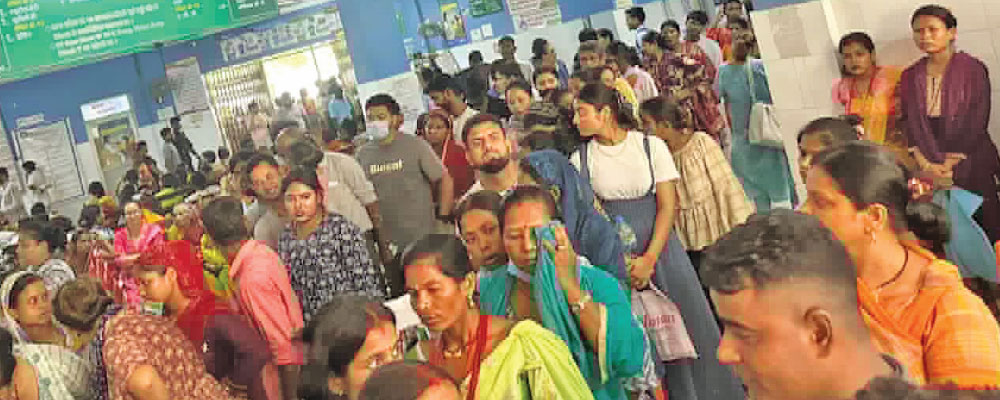
Photo: TRN Patients forced to receive services amid a chaotic hospital environment.

By Shashidhar Parajuli, Biratnagar, June 2: Following the government’s decision to discontinue the health insurance programme in private health institutions, its negative impact has begun to surface in public hospitals, which are already struggling with inadequate infrastructure and workforce.
The effects have been particularly visible at Koshi Hospital, the largest hospital in Koshi Province, where an influx of patients on Monday severely disrupted service delivery. With private hospitals and medical colleges no longer providing services under the insurance scheme, the entire patient load has shifted to government hospitals.
As a result, more than 2,000 patients registered at Koshi Hospital alone on Monday. Previously, the hospital used to receive around 1,000 to 1,200 patients daily. By 1 p.m. on Monday, around 1,800 patients had already obtained registration slips. By 3 p.m., the number had exceeded 2,000, leaving hospital administration struggling to manage patient flow.
Medical Superintendent Dr. Ram Narayan Chaudhary said that the suspension of insurance services in private facilities has directly increased pressure on the public health system. He said, “The infrastructure and human resources remain the same, but the number of patients has doubled. In such a situation, it has become extremely challenging to provide timely and effective care.”
According to him, the excessive patient load has made it difficult to operate services effectively, from outpatient departments to laboratory services. After the Health Insurance Board suspended insurance services in private and medical college hospitals from May 30, patients who would previously visit 21 major private hospitals in Koshi Province are now forced to queue at government hospitals.
Apan Mia, a local of Biratnagar, arrived at the hospital at 8 a.m. on Monday but was able to see a doctor only after a five-hour wait. “It took five hours to see the doctor, and now I am in the queue for billing,” he said, exhausted.
“After insurance stopped working in private hospitals, the long queues at government hospitals are making ordinary people feel even more unwell,” said Mia.
In Koshi Province, 52 per cent of citizens, more than 2.5 million people, are enrolled in the insurance scheme.
A large number of them, including senior citizens, persons with disabilities, and extremely poor households, are now facing the inconvenience of overcrowding and long queues in government hospitals.
According to Arjun Pandit, Chief of the Insurance Board in Koshi, the suspension of services in private facilities has also restricted citizens’ right to healthcare.
Dr. Gyanendra Man Singh Karki, president of the organisation of private medical colleges, described the government’s decision as ‘short-sighted’.
He said, “By stopping billions in payments and bypassing private institutions, not only has the burden on government hospitals increased, but citizens’ right to quality treatment has also been compromised.”
He further noted that around 99 per cent of government hospitals lack adequate MRI, CT scan facilities, or equipment for complex treatments, and restricting private hospitals has created an even greater crisis in the public health system.
Without sufficient preparation and expansion of infrastructure, such sudden and repeated decisions have created management challenges for public hospitals, including institutions like Koshi Hospital.
On Monday, Koshi Hospital did not resemble a hospital; rather, it appeared like a crowded fairground, where patients were forced to endure more hardship than care.
-square-thumb.jpg)