- Tuesday, 2 June 2026

Initiatives For Governance Reform

The unique mass movement led by the young generation (Gen Z) in September 2025 created a decisive turning point in Nepal's governance system. The movement's demands were corruption control, good governance, civic supremacy, absolute accountability, and structural transformation, among others.
This wave of youth movement paved the way for the successful general elections on March 5, 2026, with a clear public mandate for the current ruling party. As per the Commitment Paper, the current government is determined to dismantle systemic stagnation, enforce the rule of law, promote good governance and aggressively control corruption. The current government focuses on promoting good governance and effective public service delivery through rapid digitisation, working under an explicit directive to elevate public trust in government. To achieve this objective, the government aims at institutionalising an accountable, transparent, and result-oriented administrative and economic framework across all tiers of the state.
Policies and Programmes
The government introduced its Policies and Programmes for the fiscal year 2026/27 with priorities in structural economic transformation, rapid infrastructure development, and the institutionalisation of good governance, in addition to overhauling deep-seated development barriers through sweeping amendments to the Public Procurement Act and associated infrastructure-related regulations designed to eliminate the bureaucratic delays resulting in overruns of national priority projects for years. Innovative funding modalities for large-scale strategic infrastructure projects such as alternative finance, private sector equity, and diaspora capital have been envisioned to fulfil the resource gap in addition to FDI and domestic resources. The policy document proposes strict fiscal discipline by consolidating fragmented fees, charges, and duties into an integrated Green Tax system. The budget, as an implementing tool to achieve the policy objective, shall explore methods such as digitising customs clearances, expanding the scope of the tax, among others, to maximize state revenue. The government is upgrading anti-money laundering frameworks, adopting extreme corruption control measures to come out of the FATF grey list as early as possible.
The government rolled out its specific "100-Day Governance Reform Action Plan" to drive rapid, measurable service delivery to convert long-term policy goals into immediate, time-bound deliverables. The heart of this action plan is the operationalisation of Delivery-Based Governance requiring all ministries to implement localised action plans outlining their top ten priority targets with performance indicators and rigid deadlines to be tracked directly by the Prime Minister Delivery Unit (PDU). The action plan also aims to resolve urgent financial grievances affecting ordinary citizens and small depositors affected by widespread cooperative fund scams within the 100 days. The action plan provisions depoliticisation of public institutions and actors to restore professional meritocracy, which is already implemented through the enactment of some ordinances. The government has already initiated independent, criteria-based competitive examinations to fill the vacant positions in SOEs and universities created by the dismissal of previously appointed leaders under the newly introduced legal framework. The government is actively pursuing a result-oriented, motivated and neutral bureaucracy through the enactment of the long-awaited Civil Service Act to enhance meritocracy, making civil service a highly professional instrument of public service delivery with fair provisions of rewards, transfers, and promotions.
The government is executing a dual strategy focused on rigorous investigation and technology-driven administrative oversight to dismantle systematic delays and accountability loopholes. As part of this, the National Vigilance Centre has transitioned from a passive technical auditor into an assertive watchdog operating under the oversight of the Office of the Prime Minister to institutionalise preventive anti-corruption measures and strengthen financial transparency. Similarly, investigations into land scams, large-scale revenue leakages, and cooperative fund embezzlements are proceeding without political interference. By establishing an independent Property Inquiry Commission mandated to investigate all public office holders, including politicians, public officials, and security personnel from FY 2006 to the present, the government is determined to send a clear message that those involved in misusing public funds or property will face prosecution according to the law.
The most visible structural shift within the government offices is the implementation of the 'Zero File' campaign. The Nepali civil service has struggled with a slow-moving file culture and red tape. Vital public service-related decisions, land and forest clearances for the construction of infrastructure, and business licenses generally remained undecided for months, breeding opportunities for rent-seeking and administrative anomalies. Under the campaign, the physical movement of files is being made rapid with a non-negotiable time frame and introducing an office automation system to eliminate bureaucratic delays, with the provisions of publicising regular reports of file clearance to a large audience.
Good governance is the totality of socio-economic and cultural upliftment and cannot exist in a vacuum. It must translate directly into tangible economic security, quality infrastructure, and sustainable growth. The government has prioritised sweeping amendments to infrastructure and procurement-related laws and other legal instruments by identifying the delaying provisions of existing legal frameworks that cause project cost and time overruns. The revised framework introduces strict engineering standards, performance-linked mobilisation advances, and simplified bidding processes for technologically advanced projects. The government is planning to use alternative development finance, private sector equity, and diaspora capital for strategic infrastructure projects in mission mode featuring milestones, automated land acquisition and forestry approval to prevent structural delays.
Structural reforms
The Finance Ministry is committed to structural reforms to ensure fiscal sustainability, modernise revenue collection, and curb financial crimes. Introduction of the Integrated Green Tax System will consolidate fragmented fees and duties into a transparent, unified architecture designed to drive corporate compliance while simplifying revenue structures, and DRMS is being introduced to eliminate under-invoicing and associated fiscal irregularities. The state is determined to crush financial crime and to safeguard small depositors of BFI and cooperatives.
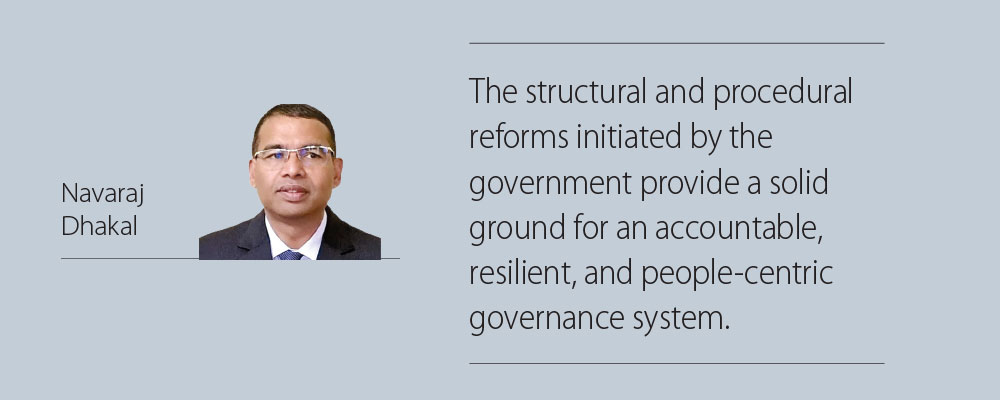
The government is working to finalise proper legal arrangements within a short timeframe to ensure these governance initiatives become permanent features of the state rather than temporary actions. Despite deep political will, Nepal’s governance reforms face entrenched structural challenges demanding long-term strategic management. There is a need for additional backup to transform process-oriented public service into digital governance. The stick-and-carrot principle with strict performance consequences for non-compliance and meaningful motivation for high performers will accelerate the reforms. Technical divides, including intermittent rural connectivity and digital literacy across provinces, are major concerns for operational bottlenecks to complete the mission of "Digital Nepal". The structural and procedural reforms initiated by the government provide a solid ground for an accountable, resilient, and people-centric governance system.
(The author is Joint Secretary of the Government of Nepal.)