- Saturday, 9 May 2026

Magnificent Meeting Of Seven Planets

Dr. Rishi Shah
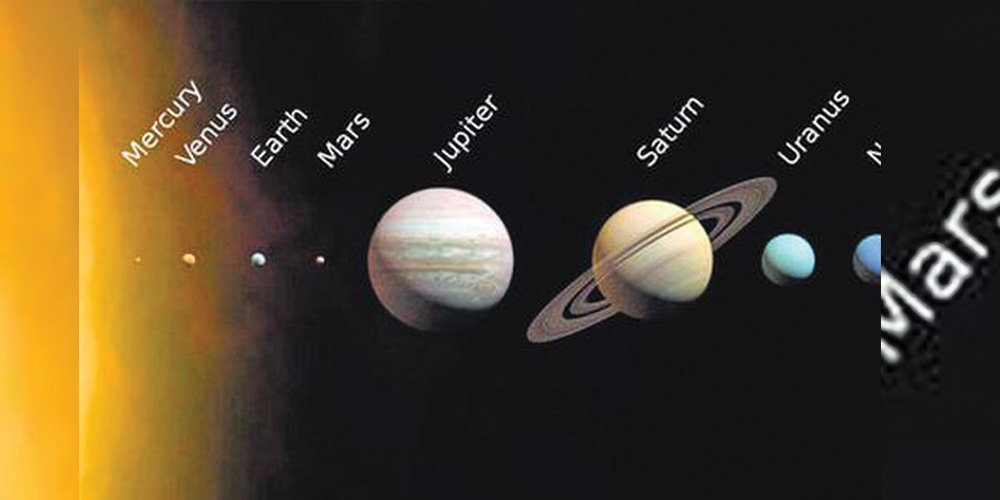
This month's night skies will exhibit exquisitely magnificent meetings of seven planets as they line up in the eastern morning sky before daybreak on 24 June. Additionally, the spectacular sights of confounding constellations sketched splendidly by stunning stars would inspire avid sky-gazers to understand and comprehend the conundrums and mysteries of our universe.
The elusive fleet-footed planet Mercury could be marvelled at in the eastern sky before sunrise from the third week of the month. It would be mixing with the shining stars describing the constellation Taurus (bull). The alluring star Aldebaran (Rohini) will glow below Mercury, which will be at its greatest western elongation on 16 June. It would hover highest above the eastern horizon. Aldebaran would be approximately sixty-five light-years from the Sun.
Mars Marches Around Sun
Planet Venus could be viewed venerably in the eastern sky a few hours before day-begin. It would be venturing valiantly through the star-field located in the constellations Aries (ram) and Taurus. The red planet Mars could manifest merrily in the eastern sky before dawn. It would be mingling with the stars shimmering below the charming circle of asterism belonging to the constellation Pisces (fishes). As Mars would march around the sun on its elliptical trajectory, it would require sheer 687 days. On 21 June Mars will arrive at its closest point (perihelion) measuring merely 1.38 AU (206.45 million kilometres) to the Sun.
Unlike most planets that follow fairly circular circuits around the sun, Mars' span from the sun would sway scantly. Its furthest inter-space from the Sun would be 1.67 AU (249.84 million kilometres) at Aphelion. One astronomical unit (AU) has been defined as the mean distance between the Sun and earth computing circa 150 million kilometres.
Planet Jupiter can be cherished cheerfully from late midnight until early morning twilight before daybreak in the south-eastern sky. It could be noticed nonchalantly among the stars occupying the southern segment of Pisces. Mars could be marked in its vicinity. The ringed planet Saturn could be seen serenely from a late night in the eastern sky until early morning before sunrise in the south-eastern sky. It could be appreciated adorably in the eastern corner of the triangle-mirroring constellation Capricornus (sea goat). Two exotic eerie stars, Deneb Algedi and Nashira, would be gleaming gently below Saturn.
Delta Capricorni will be a mind-boggling multi-star system with an eclipsing binary star, Delta Capricorni A, and two charismatic companion stars. They have been designated formally with the traditional nomenclature Deneb Algedi meaning the tail of the goat, referring roughly to the fish-like appendage of the celestial sea goat as derived from the Arabic. It would be sparsely thirty-nine light-years away. The giant star Gamma Capricorni with fluctuating brightness will be adequately 157 light-years away. Its long-established name Nashira originated from the Arabic language and would signify the lucky one. Its mass and radius would express to be three times that of our Sun.
The far-flung greenish planet Uranus could be glimpsed in the south-eastern sky shortly towards the end of the month. It could be recognized as a glistening dot of light on the barren-akin expanse unfurling across the southern sector of constellation Aries. The polygon-asterism portraying the head of constellation Cetus (sea monster) could be appraised below Uranus. The distant blue planet Neptune could be perceived briefly in the south-eastern sky before the Sun would ascend to the sky. It could be glinting gracefully among the stars of Pisces in the neighbourhoods of planets Jupiter and Mars.
Full Moon
The full moon will fall on 14 June. Its popular sobriquet of the strawberry full moon would coincide with the peak of the strawberry harvesting season and would signal time for gathering and relishing the ripening fruit. Furthermore, this full moon has been deemed as the first of three super-moons for 2022. The moon will creep to its nearest station (at skimpy 0.0024 AU or 359 thousand kilometres) from earth and seemingly look slightly bigger and more resplendent than usual.
This month, the moon would come to its full phase at around the same time that its elliptical orbit would bring it to the nearest spot from earth (called perigee). It would be visible for much of the night, rising at around dusk and setting at dawn. The moon's separation from earth would vary because its course has not been perfectly circle-mimicking, but oval-resembling, tracing out a trail called an ellipse.
As the moon would traverse along this elliptical track around the earth each month, its gap would swing between 356.5 thousand kilometres at perigee and supposedly 406.7 thousand kilometres at apogee (the farthest place from the earth).
Its angular size would alter. If the full moon were to betide with perigee, it would ostensibly appear more fulgent than at other times, but the difference would be so small and be imperceptible to untrained eyes. Although the angular size of the moon would change by a modest amount, quirky and contradicting common optical apparition would make the moon allegedly much larger than it really would be in reality, when it would be comfortably close to the horizon. This peculiar phenomenon has been called the moon illusion.
Any photographs would paradoxically reveal that the moon would be the same size regardless of whether it would be on the horizon or directly overhead. The full moon will be sliding across the curiously broad constellation Ophiuchus (serpent bearer alias Bhujakdhari), which has been controversially contemplated to represent the thirteenth zodiacal constellation.
Ophiuchus would be depicted as a man holding a strange snake coiled around his waist. Its neighbouring constellation Serpens (serpent) has been divided distinctly into two parts by Ophiuchus as Serpens Caput (snake’s head) and Serpens Cauda (snake’s tail).
The June solstice will occur on June 21. The North Pole of the earth would be tilted tangibly toward the Sun, which would have reached its northernmost position in the sky and dramatically be directly over the Tropic of Cancer at 23.5 degrees north latitude. It would herald the first and longest day of summer (summer solstice) in the Northern Hemisphere and the first and shortest day of winter (winter solstice) in the Southern Hemisphere.
Solstices would transpire because the axis of the earth's spin has been tilted at an angle of 23.5 degrees to the plane of its route around the Sun.
The direction of the earth's spin axis would remain fixed in space as it would revolve around the Sun, while the earth's sight-line to the Sun would shift steadily through the constellations of the zodiac. Consequently, the earth's the North Pole would be inclined towards the Sun (in June) and be leaning away from Sun (in December) giving rise to the earth's predominating four seasons.
At the solstice, the sun would be overhead at noon when observed from locations on the Tropic of Cancer. The Sun would be dwelling in constellation Taurus on this day. The ecliptic has been envisaged as the path that the Sun would sweep supremely through the conventional constellations each year as the earth's seasons would change. This baffling belt-shaped region is also known as the zodiac.
Quaint Star Castor
The new moon would befall on 29 June. When the moon would pass close to the Sun, it would become lost in its glare for a few days. On the new moon, the earth, moon and Sun would lie in one straight line with the moon in the middle and linger leisurely in front of the Sun. In this configuration, we would witness just the opposite half of the moon which is illuminated by the Sun, thus making it unobservable because the side we stare at would not be lit up.
At the moment of this event, the moon would be gliding through the zodiacal constellation Gemini (twins). It would be meagre 403 thousand kilometres from earth. Two iconic stars, Castor (Kasturi) and Pollux (Punerbasu) could be astounded in Gemini. Superbly quaint star Castor would be a sextuple star system consisting of three bizarre binary stars.
It would be queerly fifty-one light-years away. Orange-hued, puzzling star Pollux, with an extrasolar planet rushing around, would be paltry thirty-four light-years away.
(Dr Shah is an academician at NAST and Patron, Nepal Astronomical Society, NASO)