- Saturday, 30 May 2026

Disasters Demand Responsive System

When the disaster enters, it does not knock on the door. It strikes abruptly without prior notice. The capacity of a state – its bureaucracy and institutions – to anticipate and respond decisively makes a great difference in managing when adversity hits. Generally, crises occur at the time of natural or man-made disasters, such as earthquakes, landslides, pandemics, economic shocks, and security threats. In such critical situations, effective governance should act as a bulwark, preventing a crisis from escalating into a catastrophe.
At this point in time, governance is no longer viewed as a mere routine administrative function but rather as a pivotal force in preventing crises from snowballing into larger tragedies. It should be understood that tough times during crises test the effectiveness of good governance. Good governance in disaster management follows the principles of responsiveness, accountability, transparency, participation and effectiveness. Nepal lies within the vulnerable bracket of disaster-prone countries, where crises often trigger a spiral effect across the national economy, society and infrastructural systems.
While understanding a disaster, it should always be kept in mind that there is a subtle difference between a disaster and a crisis. From the perspective of severity and impact, a crisis is serious but manageable, disruptive but limited in scope. In contrast, a disaster is extreme and large-scale, often difficult to manage. But in practice, these two terms are often used interchangeably because of their interwoven relationship – if a crisis is not managed timely, it may escalate into a disaster, and a disaster, in turn, invites further crises.
Preparedness
Ten years have passed since 25 April 2015, when a devastating earthquake hit Nepal, killing around 9,000 people and injuring over 22,000. It was a dreadful moment for both the government and the public. At that time, widespread chaos prevailed among government institutions, leadership and officials about how to respond to such an intense crisis and how to build resilient systems capable of withstanding and adapting to shocks. Despite limited resources and equipment, security forces and civil personnel – working together with the private sector and civil society – managed to carry out rescue and relief operations effectively. Even today, the trauma of that disaster is visible in the faces of people, in damaged infrastructure, and in the nation's historical heritage.
The earthquake and tsunami triggered a nuclear catastrophe in Fukushima, Japan, in 2011. Although the disaster was profoundly devastating, the government's handling of the crisis was outstanding and offers a valuable lesson for all. The core principles of disaster management in Japan are discipline, preparedness, coordination, transparency and effective governance, which were vividly demonstrated in its response.
Comparing these two separate distinct incidents, it becomes clear that Nepal must follow a set of guiding principles to respond when disaster strikes. First and foremost, preparedness is the name of the game. It demands adequate logistics, modern equipment, well-trained human resources, and strong capacities in data analysis and prediction. Ultimately a robust governance system is the linchpin that holds these elements unbroken. Disaster management carries multifaceted tasks and dynamic processes that demand careful planning and well-coordinated implementation. In the past, the Home Ministry had to take the lead, steering the entire disaster management cycle – from preparedness to response and eventual reintegration. With the establishment of the National Disaster Risk Reduction and Management Authority in 2076, the legal framework has shifted the centre of gravity, empowering it to act as a major government agency for disaster management.
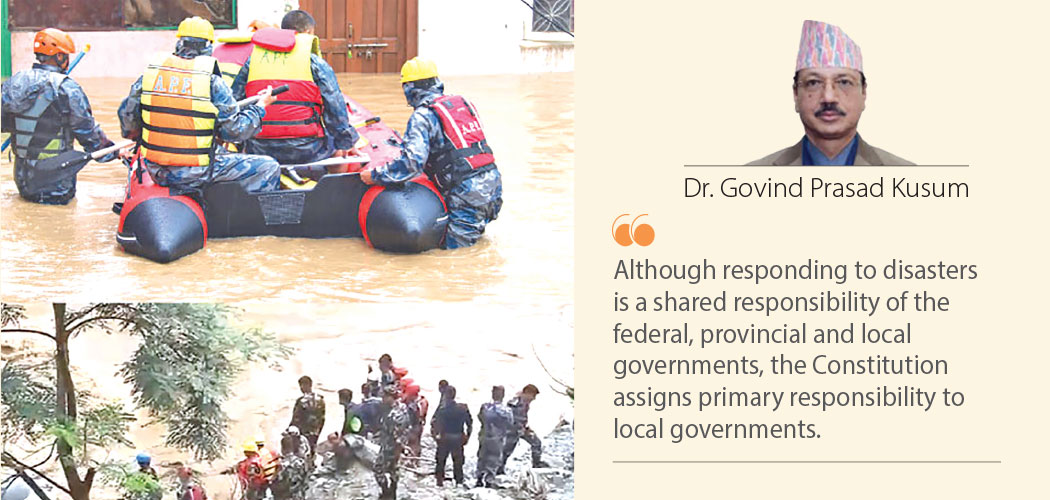
In practice, people generally tend to place the Home Ministry at the centre of disaster response at the time of dealing with floods, landslides, earthquakes, fires, heatwaves, and similar hazards. Although responding to disasters is a shared responsibility of the federal, provincial and local governments, the Constitution assigns primary responsibility to local governments.
In doing so, local governments must remain well-prepared and well-equipped with concrete plans, adequate resources, and effective response mechanisms to handle disasters at the local level. However, not all local governments possess sufficient resources and technical capacity to manage disasters independently; the federal government must step in to provide all necessary resources enabling them to respond efficiently and minimise the impact of disasters. In managing disaster, use indigenous knowledge and technologies along with active public participation and transparency.
Hidden lesson
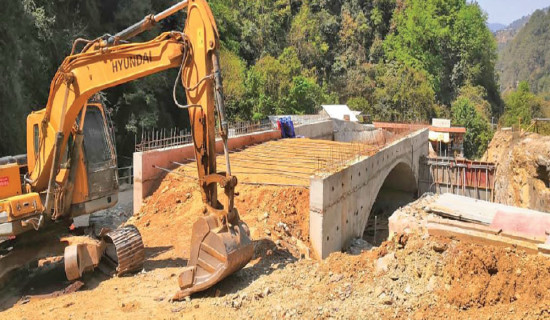
Monsoon, being a natural and essential climatic system, is set to arrive within one month. Last year, the Sunkoshi River overflowed, and the resulting floods severely damaged the B.P. Highway, which is still under repair and maintenance. Non-engineered, bulldozer-built hill roads, along with overexploitation of riverbeds and hillside materials, have increased vulnerability to floods and landslides. In the Tarai-Madhes plains, several villages remained under submergence for days a couple of years ago. To survive, some villagers spent hours in trees until they were air-lifted. Due to an inadequate blend of preparedness, responsiveness and resilience, the government's rescue and relief efforts failed to satisfy the flood sufferers.
Strong and decisive leadership in governance counts a lot to make things happen meaningfully. It instills confidence among the people and fosters unity and mobilises shared action. From the centre to local levels, organisational and political leaders should be serious and sensitive, not only in preparing plans but also in effective execution, which determines success. At present, the Nepali people harbour high expectations and repose deep trust in the government, owing to its commitment to establish good governance. Crisis management defines the credibility of institutions, and institutional efficiency minimises bureaucratic delays. During disasters, time becomes decisively valuable. Concerned authorities must make quick decisions and mobilise resources without unnecessary procedural hurdles.
(The author is the former secretary of the Nepal government.)