- Saturday, 30 May 2026

Gorkhapatra Chronicles Nepal’s Governance Shifts
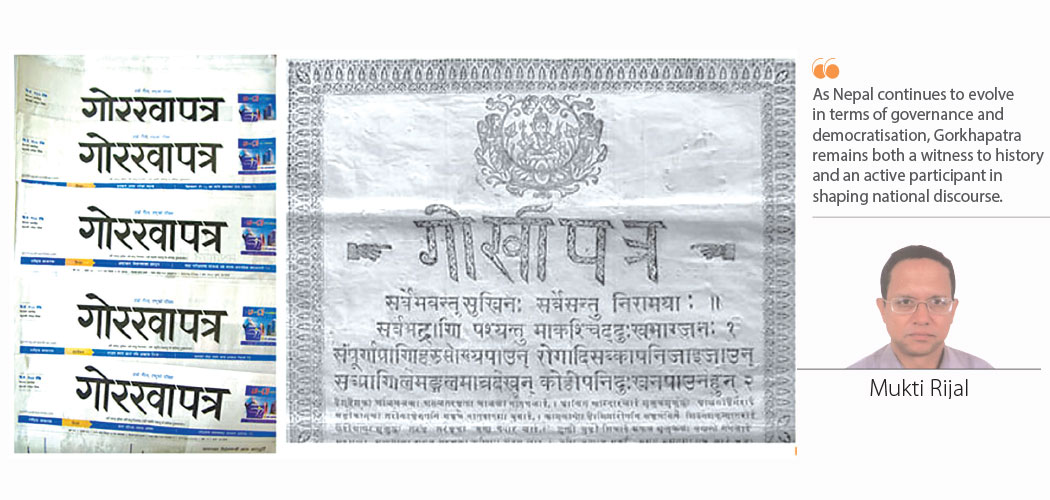

I had been associated with The Rising Nepal daily for over two decades before I got retired from its responsibility a decade and a half ago. Since the Rising Nepal has been a sister publication of the historic Gorkhapatra daily, I have been a witness to the Gorkhapatra's enduring trysts with tumultuous changes in the political and governance realms of Nepal for a longer period of time. As an insider of Gorkhapatra for several years in the past, I have particularly noticed the role and contribution of its publications towards enhancing effective governance and the democratisation process of Nepal. Though Gorkhapatra was founded by Rana prime minister Dev Shumsher over a century ago, it has weathered the stormy changes and served the nation as a bearer of ideas to cultivate good governance and the welfare of the citizens.
Gorkhapatra Daily is not Nepal’s oldest newspaper; it is said to be one of South Asia’s longest-running state-owned dailies. Over its remarkable journey of more than 125 years, Gorkhapatra has not merely reported history but survived the turns and twists of time and circumstances. It has advocated for the welfare of the people by strengthening good governance and citizen participation. Moreover, it has evolved alongside Nepal’s tectonic political changes and transitions. The sequence of transitions has moved progressively onwards from the autocratic Rana oligarchy to the federal democratic republic. The resilience and adaptability of Gorkhapatra and The Rising Nepal co-exist with changes have made them both a mirror of Nepal’s political governance shifts and a repository of national memory.
Gorkhapatra was initially launched as a weekly publication during the Rana regime. At that time, Gorkhapatra’s primary function was to disseminate government notices, official decrees, and state-sanctioned information for the sake of good governance and delivery of services. Under the tightly controlled Rana administration, freedom of expression could not be imagined. Gorkhapatra had to function more as a publicity instrument of government than as independent media. Despite these limitations, it played a pioneering role in introducing print journalism to Nepal and made a contribution to the promotion of good governance within the limitations Gorkhapatra was mandated to function. It created a formal platform for written public communication in the Nepali language and disseminated ideas and experiences for the purpose of good governance and development of the country. Gorkhapatra reflected the centralised and autocratic authority of the ruling Rana elite. Despite these difficult political and social conditions, Gorkhapatra is credited with having preserved valuable records of Nepal’s social, cultural, and administrative governance.
The overthrow of the Rana regime in 1951 was a watershed event in the history of Nepal. This led to the dawn of plural democracy and a genuine institutional environment for good governance and development. As Nepal began opening to democratic ideals, Gorkhapatra gradually expanded its editorial scope beyond official notices, decrees, and announcements to include broader national governance themes and issues. For those seeking to improve their writing in the Nepali language, Gorkhapatra was an important source material.
Although from its founding to this date, it has remained state-owned, and it has successfully adapted to the changing political environment by incorporating more diverse content, including public affairs, education, socio-economic and governance issues. This transition demonstrated its capacity to survive political upheaval while remaining relevant to evolving governance contexts. In 1961, it became a daily newspaper, symbolising modernisation in both publication frequency and technological capacity. However, editorially it continued to serve the ruling establishment, promoting nationalism and good governance. While critics often describe this era as one of restricted press freedom, Gorkhapatra maintained its significance and relevance by chronicling national events and state priorities. Its ability to remain operational and institutionally important during authoritarian shifts reflects strategic adaptation and flexibility rather than ideological rigidity. The People’s Movement of 1990 restored multiparty democracy and constitutional monarchy, ushering Nepal into a more open political landscape. Gorkhapatra responded by modernising its editorial practices, expanding coverage, and cautiously embracing broader journalistic responsibilities. Especially following the democratic change of 1990, new broadsheet dailies, both Nepali and English, were started in the private sector. Gorkhapatra faced increasing competition from private media outlets, which challenged its longstanding dominance, particularly as these outlets offered diverse perspectives and innovative reporting styles that attracted a younger audience. Yet, instead of fading, Gorkhapatra reinvented itself as a national institution, balancing public service journalism with state affiliation. This period saw greater emphasis on development reporting, public policy, and inclusive national narratives. The Rising Nepal, its sister publication, has published content that is often time critical of the government policies to serve public interest.
The abolition of the traditional monarchic institution in 2008 and Nepal’s transition to a federal democratic republic presented a radical political governance reconfiguration. In the republican era, Gorkhapatra adapted once more, aligning itself with new constitutional values such as federalism, inclusivity, and democratic governance. Its role as a state-owned daily remained intact, but its editorial tone increasingly reflected the priorities of a democratic republican governance ethos. The expansion of multilingual publications and digital platforms further demonstrated its efforts to stay relevant in a rapidly changing media environment and governance context. The launch of online editions and modernisation of printing technology underscored its willingness to embrace technological, societal and governance transformations. Despite criticism over government influence and questions regarding editorial independence, Gorkhapatra’s historical significance has remained profound in terms of governance and development. It has functioned as Nepal’s newspaper of record, documenting political transitions, social reforms, economic changes, and democratic governance. Scholars and historians frequently rely on its archives to understand Nepal’s past because of its unparalleled continuity and historic importance. Gorkhapatra is a living institution that encapsulates Nepal’s own struggle with governance, identity, and modernisation. Today, in an era dominated by digital journalism and social media, Gorkhapatra faces new challenges, including maintaining credibility, attracting younger audiences, and balancing state ownership with the ethos of media governance. Yet its survival across monarchy, autocracy, democracy, and republicanism speaks volumes about its adaptive strength and responsive capacity to adjust to new governing milieus. Its journey reflects not only the story of Nepali journalism but also the broader narrative of Nepal as a nation itself. Gorkhapatra’s enduring legacy lies in its extraordinary ability to navigate shifting political landscapes while preserving its institutional presence. As Nepal continues to evolve in terms of governance and democratisation, Gorkhapatra remains both a witness to history and an active participant in shaping national discourse.
(The author is presently associated with Policy Research Institute (PRI) as a senior research fellow. rijalmukti@gmail.com)