- Saturday, 30 May 2026

Good Governance: A Shared National Aspiration
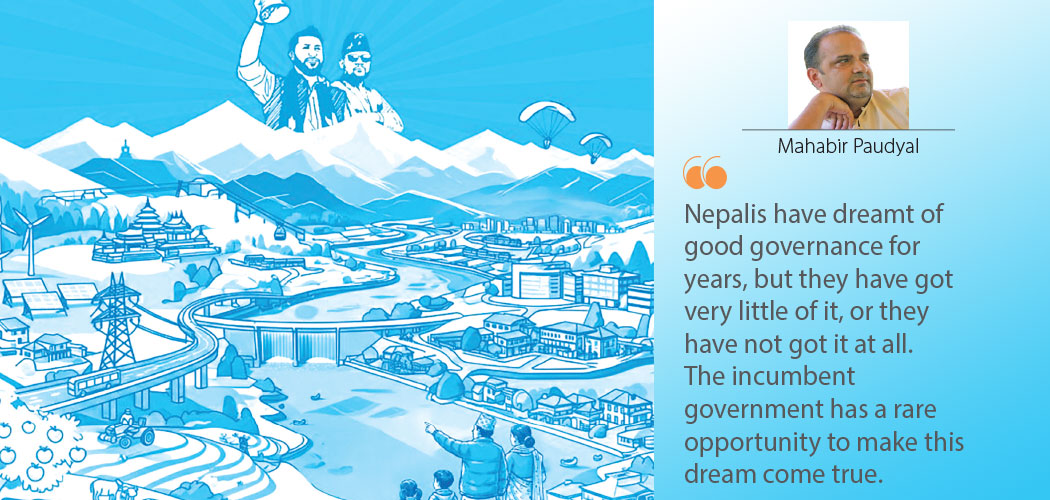

Start with the life of a man, call him Lochan. He lives in a small town with largely cool and pleasing weather conditions. It’s a place where people don’t care much to lock their doors before they leave home because there is no fear of somebody breaking into the house, or even if that happens (very rarely), the police system is so robust and responsive it takes no time to nab the culprits.
His children go to school, which provides the education they need. Last month, his wife fell ill critically and had to be taken to the hospital. The bill amounted to over one hundred thousand, but the hospital said it had been covered by the health insurance scheme. Water was not regular in his tap, but after he visited the municipality office and complained about it, it started to be regular. Though he can afford to buy them, he wishes the daily essentials were less costly. He can pay taxes online without having to visit the tax offices. He can get a driving licence, passport, and land ownership document without any hassles. He does not own a car, but that’s not much to fuss about because the public transport is affordable and reliable. There is nothing like delayed justice in his town. Laws are predictable, injustice has no room, police and courts treat all equally. He works hard, he is paid, he pays taxes, and he trusts the state and the government.
One thing bogs him down. He is not able to save enough to go on holiday with his kids and wife. Somehow whatever he earns is drained before he receives another pay cheque. But, again, he does not mind much about it because he has heard stories of distant towns in distant countries where what he enjoys as the givens – job, quality education, health care, public services, etc. – are unimagined luxuries.
Dream deferred
The story of Lochan (meant to be read as an allegory) is what probably describes what Nepalis have dreamt of for years and years but which they have either got a very little of or have not got at all. They have found themselves in the situation faced by people of distant countries that Lochan has heard of.
I am not trivialising good governance here. This concept covers a broad range of issues such as rule of law, transparency, human rights, accountability, equity, inclusiveness and so on and so forth. But when we think of good governance at its basics, this is what generally comes to our mind: hassle-free public services, access to health and education, good roads, security, justice, jobs and the public goods that the state is obliged to ensure for the citizens.
The unrealised hope and dream for good governance remain an unchanged story in the political evolution of Nepal. The Maoist’s war against the state, for example, was premised on the context that the state was failing to provide for the basic needs of the citizens – quality and affordable health care, education, basic livelihood, and administrative services, among others. Likewise, the quest for a federal polity was premised on the idea that once we get there, good governance will now become a reality. What crippled this hope were cases of corruption, with people in power not being accountable enough to taxpayers; the rule of law becoming rule by law; scarce job prospects driving many people out of the country; extreme politicisation; and the ills of partisan politics ripping our institutions to the core, so on and so forth.
One major reason for massive frustration that brought youths to the streets during the Gen Z revolt in September 2025 was not with the existing political system but because they were sick and tired of bad governance.
Righting the wrongs
Fairly speaking, low performance in good governance has earned Nepal an international disgrace. Year after year, Transparency International’s corruption perception survey mocks us to our faces. We are featured as a corrupt country nearly every year. This reflects in other good governance index reports too. For example, in the Chandler Good Government Index (CGGI), which measures the effectiveness of 120 national governments, Nepal stands at 101 out of 120 countries in 2025. CGGI is measured against ethical leadership, long-term vision, rule of law, quality of judiciary, transparency, regulatory governance, education, health, satisfaction with public services, employment, gender gap, non-discrimination, among others.
The incumbent government led by the Rastriya Swatantra Party (RSP), in which the majority of ministers are youth and which came to power riding on an anti-corruption movement, has an immense opportunity to salvage the image by getting the country out of the mess of bad governance. In fact, they have this rare opportunity to right the wrongs of the past, set a new precedence and benchmark for the future and prove with action that all they care about is the welfare of the common people.
Positively, some changes have been reported after the formation of this government in March: service providers reporting to their offices on time and providing services to the people without hassles; efforts being made to digitalise services and free public institutions from partisan politics; and establishing meritocracy in public sectors, among others. With sustained efforts, such measures can gain greater momentum.
Often when the new government takes office, there is so much enthusiasm for doing something different and tangible. Goals are announced, promises are made, and it feels like the new government is really up to something. But as months pass, either there is a slow return to the status quo ante or there is clear perceivable slackening. Any government is basically judged, and rightly so, on the basis of how much it could or could not do to ensure good governance. The current government has no room for failure in this regard. Bad governance has become Nepal’s stigma. Nepalis deserve to live like Lochan.
(The author is a Kathmandu-based educator and journalist.)