- Sunday, 3 May 2026

Subedi's 'Paridhi' creates distinct periphery
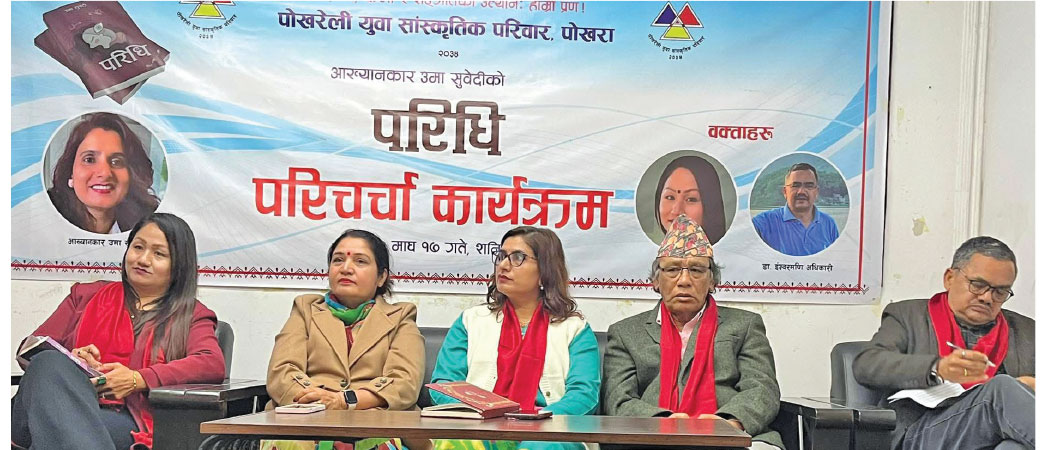

By A Staff Reporter,Kathmandu, Feb. 3: Litterateurs have praised the powerful voice in Paridhi, a novel penned by Uma Subedi, at an interaction held in Pokhara.
The event, organised by Pokhareli Youth Cultural Family, featured reviews by Ishwar Mani Adhikari and Gauri Tamu.
Adhikari remarked that the work constructs a mysterious centre formed by confused mental states, melancholy, imbalance, and characters who mostly wear deceptive masks.
"Around this centre, stories and sub-stories—painted in surreal colours—continuously emerge, dissolve, and re-emerge, creating a distinct narrative periphery," he shared.”
He added that in terms of structure, texture, thematic experimentation, and style, Paridhi stands as a more accomplished novel than Subedi’s earlier works in many respects.
Highlighting that the novel attempts to explore the human mind, brain, and consciousness, he noted that the experiences and thoughts of its characters are vastly different from those of ordinary people.
"For this reason, the work remains vibrant with mystery, curiosity, suspense, and possibilities throughout," he commented. Overall, he described Paridhi as an engaging read, where even narratives of sorrow and grief do not feel tedious. "Rather, the reader often feels thrilled, as if watching a suspenseful South Indian thriller film," said Adhikari.
He further observed that the plot sometimes moves towards the centre and at other times towards the periphery. However, he expressed that the novel does not leave behind many long-lasting themes and carries an excessive focus on melancholy and sorrowful souls.
Poet Gauri Tamu stated that Paridhi addresses various dimensions of women’s lives through its narratives.
Speaking at the programme, novelist Uma Subedi shared insights into the creative process behind Paridhi. She expressed her happiness at having her work discussed under the banner of such a historic institution in Pokhara and pledged to engage even more responsibly in literary service in the days ahead.
Veteran novelist Sarubhakta reflected on the various phases and turning points of Nepali fiction writing, beginning from Girish Ballabh Joshi’s Bir Charitra. He elaborated on the aesthetics and challenges of magical realism and surreal writing while shedding light on the contemporary dimensions of literature.
In the interaction chaired by Rita Adhikari 'Ritu', vice-president of the institution, Laxman Thapa, secretary MD Kafle and others expressed their views on the novel.


-original-thumb.jpg)