- Friday, 29 May 2026

Women's Equality Still Has Long Way To Go

Much has been talked and written about women's empowerment. Over the years, new laws have been passed to enhance their empowerment, and they have been rightfully celebrated for their invaluable contributions to society. However, when it comes to reality, very little has been accomplished. Even the holy scriptures speak highly of women and honour them sincerely. In a Hindu society, a woman is regarded as Devi and Shakti, the most cherished symbol of love and creation. She has therefore been installed on the highest pedestal of reverence in our society.
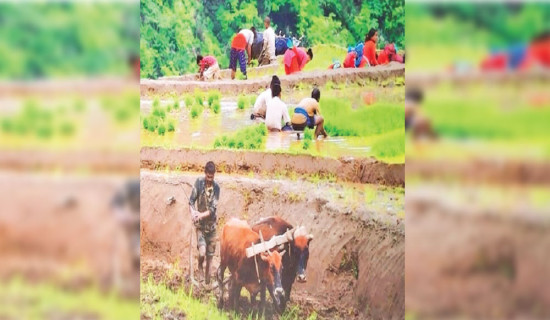
If all this is true, then there should not be anything wrong with the women of our society. But the reality is entirely different. From the early on, she has remained under the command or control of a man. He may be her father, brother or husband. Hence, the reality is that a woman has occupied an inferior position to men. She is subjected to living a routine life of childbearing, cooking, cleaning, washing clothes and serving the family members. She can hardly be able to free herself from such household tasks.
Significant role
The status of women in today's Nepal can't be overlooked. All efforts should be made to establish the significant role that she can play in the progression of oneself and the society at large. Literacy alone will make women realise their potential and equip them for better wages and employment. International Women's Day focuses on equal rights, equal opportunities and progress for all. The event is celebrated all over the world with much excitement and hope. However, a bitter reality is that millions of women all over the world do not enjoy equal rights.
Legal equality is not all that is sufficient. The women must be recognised as free individuals like their counterparts in every domain. This may be the right beginning towards the equal status of women vis-à-vis their male counterparts. Nepali women, who constitute over 50 per cent of the total population, are still backward and underprivileged in many fields. Poverty, illiteracy and superstition are much to blame for their miserable condition.
At the same time, the age-old patriarchal social structure and gender discrimination are equally responsible for keeping them behind and backward. Hence, the darkness of ignorance could be repelled only through the light of education. However, there has been an improvement in the status of Nepali women. As per the 2021 census, the female literacy rate stands at 69.4 per cent, an increase from 57.4 per cent in 2011. Still, it is lower than the male literacy rate, which is 83.6 per cent.
Nepali women are highly prone to domestic violence. They are restricted to standing equal to their male counterparts. They are not allowed to participate in many religious rituals. They are treated like untouchables during the menstruation period. They are thrashed or even killed for dowry. The majority of girls are made to work much longer than boys. Despite this, girls' school enrollment in primary schools reached over 93 per cent by 2017, while secondary enrollment was 90.9 per cent in 2024. The challenges remain in checking the drop-out rate, particularly in rural areas.
Quite disappointingly, organisations like the Human Rights Commission, National Women's Commission, National Dalit Commission and several NGOs and INGOs have performed poorly. Nepal had ratified the bill on domestic violence and several other international legal instruments relating to gender equality, but the majority of women continue to confront discrimination in jobs, and their voices go unheard.
All-round progress
Nevertheless, over the last decade, Nepal has made significant progress in improving the overall status of women in the country. But a lot more has to be done. Owing to legal equality, women got the chance to make all-around progress in various professions. Today, they are working outside homes in various capacities. But this has become possible only for some privileged women of our society who live in urban areas. Life has still not changed for many rural women in Nepal.
Let's not forget that poverty and illiteracy are the two most devilish social evils that keep women backward. Poverty eradication can be possible through the participation of women in the campaign of compulsory education. Technical and vocational education must be made a compulsory subject in the course for women. The poverty rate will go down when more and more women receive vocational education. Last but not least, women's participation in policymaking is utmost necessary. Only making new legal provisions is not enough, their proper implementation is even more important.
(Thapa is a Pokhara-based writer. writerlbthapa@gmail.com.)