- Saturday, 6 June 2026

Overcoming Politics Of Cognitive Dissonance

ognition pertains to a psychological process of individual thinking, feeling and motivation to do something just and crave for recognition from others. Its consistency is marked by a harmonious process of acquiring knowledge, cultivating passion and a fine attitude of persons. Cognitive dissonance, by contrast, indicates a condition of stress, contradiction, discrepancy and inconsistency between leaders’ preconceived beliefs and reality. Leon Festinger, innovator of this concept, argues that individuals seek to cut their psychological anxiety by reducing inconsistency, revising rationalising tendency and even overlooking opposite information.
The central challenge of Nepali political leaders is to bridge the gap among constitutional ideals, their inflated electoral promises, capricious attitude and conduct and formulation of policies congruous to the spirit of the Nepali constitution. Their need to win elections prompts them to blow up their promises, if not fulfill even the legitimate ones. But the limits of resources at the disposal of the state constrains in realising them. They give implausible reasons for their disability in fulfilling them and indulge in rationalisation of conduct rather than remaining true to what they say publicly.
Evolving social context
Nepali leaders have to learn from the evolving social context of the nation, where the life of people, their health and happiness are connected, despite the political party and leadership boom, which find themselves disconnected from each other, trying to stratify the population in partisan lines and indulging in the survival game of politics. They need to evolve cognitive consistency, assuming that their common ground condition enables them to collectively achieve constitutional goals, which is not possible by singular effort. Ownership in the national constitution and broad-based acceptability and consonance of means and ends are vital to achieve coherence and political stability.
Shared interests can overcome the malaises faced by the nation. This also reflects the fundamental aspect of strengthening Nepali nationality and finding consistency of leadership in matters of satisfying the public and national interests. The regulatory bodies, the courts and the Election Commission cannot control these discrepancies. National media expose the gaps between norms and facts of political life in Nepal, evoking their rationality and credibility deficits. Have the new generations of leaders learned from the consequences of this attitude and hewed a safe path? Or habitually follow the old route to power when they are socialised and habituated?
Such a pattern makes the purpose of politics vacuous, not public in cognition, beliefs, values and orientation and naturally breeds cognitive dissonance. They shape a soiled political culture in the nation less attuned to democratic practice. Modern politics entails a culture of responsibility to the people who are the sources of it. They are the source of sovereignty and their expected behaviour resolves the impulsive nature of politics that stokes cognitive dissonance. Modern legitimacy flows from public opinion, consent, ownership and participation. Cognitive consonance motivates Nepali leaders and people to transcend their primordial differences as they are tied by common constitutional rights, shared responsibilities to the nation and duty to attain performance.
The link between the national core, Kathmandu, and the peripheries can fortify the connecting forces of society for nation-building. The whole, the state, is superior to its several parts and their apt functioning rests on its overall health, power and authority to create order in society where all Nepalis can have freedom to pursue their innovative pursuits. This, however, requires the media, civil society, professional groups and the institutions of enlightenment to balance the socialization of people into both positive and negative rights.
Nepali media often expose the credibility gap of leaders and instigate people to ask skeptical questions challenging their stand and promises -- ideological and empirical and their real performance. Democracy requires rational and humanitarian education, not only pre-rational or emotional one that utilises and tribalise the people, stratify them along party lines, strengthen excessive party-mindedness and become a source of disunity, not civic integration, which democracy purports to promote. The conception of cognitive dissonance of politics has made the Nepali state, political system and parties weak.
Despite the pluralistic design of the Nepali state, the other poles of power are not mutually accountable to the people but only practice as autonomous power units for their own profits. The countervailing power of business, civil society, the public and critical mass have not been able to enforce the spirit of the constitution. They are habituated to exercise negative liberties against the already weak state. As a result, Nepali leaders continue to face the psychological discomfort and tensions and struggle to distort the interpretation of facts rather than acknowledging that it is their fault for not steering the nation in a smooth democratic course.
The evaluating capacities of Nepali people have increased and new information and knowledge have helped them to challenge the beliefs and attitudes of leaders. Letters to the editors, articles, opinions and critical views in the newspapers and social media platforms are indicators of growing interest of the public in politics and their faith in reforming it. Leaders’ remorse about not adequately addressing the well-being of people can heal their tension and start a fresh opening to avoid the situation they themselves have created. Remorse also provides an ability to learn new reflective insight, acquire drive and make their behaviour compatible with the principles and practice of democratic politics and ideals and articles of the constitution.
Politics can be an act of cognitive liberation if political leaders, as educators of society, can build a habit to live with the truth and admit their follies arising out of prejudice, ignorance or arrogance and are unable to solve the nation’s myriad of problems, including meeting the essential needs of people. True acknowledgement of the state of the nation can reform Nepal’s political process, build a sane environment promised by tradition and constitution and lead the nation forward on a better path of governance. Justifying one’s own conduct, no matter whether it is good or bad, can breed a phony political culture and loss of the trust of people in politicians.
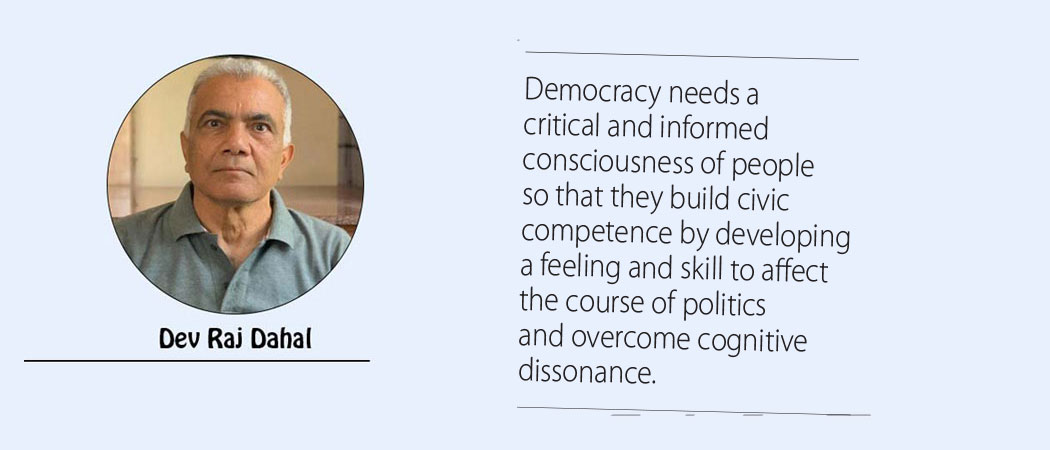
Hannah Arendt has formulated the term “banality of evil” to describe how ordinary people, indoctrinated cadres or voters, become accomplices of evil by blindly following orders of powerful leaders conforming to the norms of corrupt practices, rather than reforming them. Democracy needs a critical and informed consciousness of people so that they build civic competence by developing a feeling and skill to affect the course of politics and overcome cognitive dissonance. Transformational leaders often change their behaviour as per the aspirations and needs of people and the changing spirit of the time, rather than justifying their deeds and actions as unpalatable to people.
Acquiring new knowledge and habits of heart is important to keep abreast with the transformation of values and ecological, social, economic and political shifts occurring under the pressure of political consciousness and technological change. The information revolution has challenged the old-style politics of Nepal built on party hierarchy, patriarchy, a leader for life and hereditary succession of leadership that supports political status without caring for performance and respecting the social contract.
Nepali leaders and attentive citizens can overcome the prevailing cognitive dissonance of politics by promoting civic education and enabling leaders to act according to their experience, preference, choices and needs of people in the light of democracy. It is praxis that can help enlighten oneself, becoming sensitive to the living conditions of people and mindfulness to the poor, weak and nature. It can intellectually emancipate them from the irrationality of rationalisers, thus helping themselves and people to acquire democratic values. It can conform to the core spirit of sane tradition, constitution and human rights that promote socially desirable and feasible collective goods.
It can equally hone the capacity of public institutions and people to dispense with the costs, resources and benefits, thus connecting their privileges to the woes of the poor. If the poor and weak band together, build an organisation, organise collective presence and concert action for their demands, they can become successful. Trust building in a world of powerful interest groups is very important. What matters is the realisation of positive constitutional rights of the poor and weak, which are promotional to their wellbeing, while the negative rights about freedom from state intervention are useful for elites, leaders, professionals, business and civil society who prefer autonomy from it.
Inequalities
Inequalities of Nepalis arising out of caste, class, gender, religion or geography can be a common focus of policy attention. A change in the circumstances of living can be uplifting for them. There are some elemental ways in which Nepali leaders and people can reduce cognitive dissonance in politics — attitude change with the changing values, realities and the spirit of time driven by virtual world where the ability of elites to associate for collective action is growing but it is poorly integrated to the visual world of majority of people, reduce discrepancy in one’s own conduct, shore up creditworthiness and drop off habit-driven attitude that favours status quo and fails to adapt to the zeitgeist.
This enables them to keep the habits of social learning and equips leaders with the requisite dexterity to resolve conflicts by peaceful dialogue, negotiation and compromise of interests. Cognitive dissonance occurs when powerful elites seek to monopolise power and resources while interest groups, free riders and deep state agents insidiously bargain for disproportional profits from politics and economics, depriving the rights of those at the bottom of the social, economic and political pyramid and do not take responsibility for their actions. Cognitive consonance is vital to make leaders and authorities abide by their oath of office and uphold the existential integrity and progress of this nation.
(Former Reader at the Department of Political Science, TU, Dahal writes on political and social issues.)