- Saturday, 9 May 2026

Untapped Tourism Potential


People travel from one location to another, crossing borders, to escape from the tedious and hectic life. They achieve satisfaction by observing and appreciating unique natural, cultural, and historical legacies. Nepal has been abundantly blessed with such riches, making it a popular destination for travellers. Despite its popularity, Nepal has failed to earn from tourism.
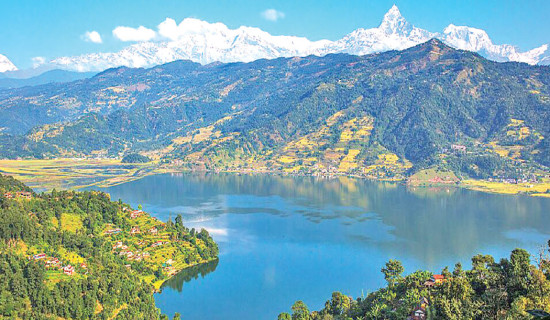
Nepal is renowned worldwide for Mount Everest, Lumbini, the birthplace of Gautam Budhha, its wealth of temples, and its status as a prime stop on the hippie trail back in the 1970s. These unique identities and Nepal’s contemporary history are the major selling points of the tourism sector. Acknowledging the presence of such a plethora of touristic points of interest, it was said that “Heaven is a myth, but Nepal is real.”
Now, you might think, and rightly so, that a country that boasts of being more beautiful than heaven earns the highest share of its revenue from tourism. But you would be wrong. The tourism sector doesn’t even contribute to one-tenth of the national income. That is the reason I claim that Nepal has failed to earn from tourism. The gravity of Nepal's situation becomes even more apparent when contrasting its tourism contribution to Gross Domestic Product (GDP) with that of a country like the Maldives. Despite being a much smaller nation, with its primary attraction being the surrounding ocean, the Maldives derives more than twice the GDP contribution from tourism compared to Nepal.
Furthermore, there is another reason why I deem tourism’s contribution to the economy insignificant. Nepal earns more than 20 per cent of its GDP from remittances. Foreign employment is the trend in the country. If all people involved in the tourism industry leave the country and go work in a foreign country, that will make virtually no difference to the economy. The share it lost in tourism will make up for even more with remittance.
One might argue that recently, a million tourists have entered Nepal, and this might be evidence that it is on its way to making a positive contribution to the economy. But I would beg to differ: The statistics that one million tourists have entered Nepal are good news only to the foreign airline companies that fly the people here. The reason it is a gloomy reminder of wasted potential for the tourism industry is that tourists don’t spend all that much money in Nepal. Put simply, our tourism industry doesn’t provide opportunities for tourists to spend their money. On average, a tourist spends less than $40 a day in Nepal. The government has failed to increase this spending to almost $100 a day.
This also nullifies all the employment that the tourism industry creates. What is the point of having thousands of workers working in the tourism industry if their work doesn’t tempt tourists to spend more money?
This sombre condition of the tourism industry occurred not due to a lack of tourism potential but because of the indifference of the government towards the industry.
Enhancing government support and subsidies for the tourism sector can encourage tourists to spend an extra 50 or 60 dollars, significantly bolstering its contribution. This targeted assistance has the potential to inject over $60 million into the economy, amplifying the industry's economic impact. Such initiatives could yield substantial benefits for both the tourism sector and the broader economy.
A-Level, Rato Bangala School


-original-thumb.jpg)