- Monday, 6 April 2026

Prativa’s Poems Hit Right Chord

Tribhuvan Chandra Wagle
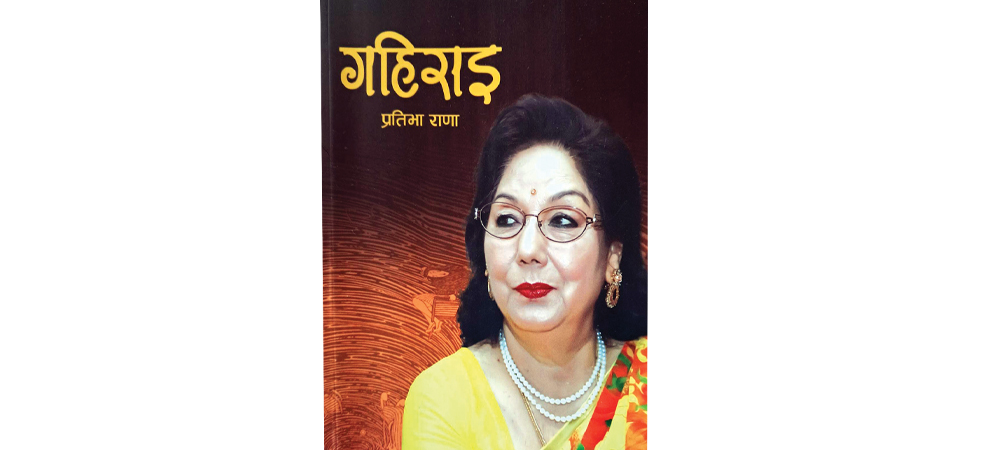
Each individual is a poet in his or her own capacity or right. Poems may be written down and published by certain individuals, or they can be drafted in the mind's imagination. I started to perceive everyone as a poet after reading Prativa Rana's two collections of poetry, Gahirai in Nepali and Curtain of Maya in English.
I think that everyone has the soul, heart, and sight needed to produce and perceive poetry. According to well-known British writer EM Foster, "the human soul does not have enough space to store anything if we like something too much." Some individuals, in my opinion, are so consumed with politics, business, wealth, power, and pride that they don't even have room in their hearts to store a single poem.
If my first impression is accurate, Prativa Rana is the kind of person who, in addition to being a major political figure, a member of a constitutional assembly, a diplomat, a poet, and a housewife, has a lot of spaces in her heart where she can retain politics, diplomacy, and poetry.
There are 65 poems by Rana in the collection, Gahirai (the Depth), which is written in Nepali. The following anthology of poetry in English, the "Curtain of Maya," has 52 pieces. Both were released in 2079 (2022). Both poetry collections convey Rana's thoughts on patriotism, sympathy, physical and spiritual love, the country's natural beauty, and the pain of the communities in the loud voice of the ordinary people.
In these poetry anthologies, poet Rana portrays society through the viewpoints of its citizens and captures the suffering and lack of resources through the eyes of the victim. She runs beneath the broad sky of love while carrying a strong sense of destitution. She sings like a cuckoo
about nature.
It is often believed that poet Rana, a descendant of a wealthy family, may not be exposed to societal ills like suffering, poverty, difficulties, or shortages, but she has the sensitive vision to see them. The average individual who reads anthologies feels connection to all of Rania's poetry. It's mostly because Rana, the poet, uses her own words and voice to describe people's emotions.
Although Rana used the pronoun "me and I" in the first person, her poetry represents the experiences, emotions, understandings, and sentiments of a great number of individuals.
As a consequence, we may claim that her poetry was influenced by both contemporary culture and the neighbourhood where she was raised. Numerous poetic devices may be found in Rana's poem. Simple language, basic structure, speaker (opinion), metre, rhythm, etc. are all features shared by both anthologies. depicts the cloud as her true love; she uses words to create a picture of a river and shows an example of a couple's gaze, some of which use idiom or sibling tone to convey her feelings:
Because of my own respiration, I could not hear anything else.
It appeared as though the whole world was sleeping snugly in the beloved's arms.
Curtain Of Maya
The poetry lines described above include a few hand gestures or colourful language. These two lines are fragments of a poem because of this.
Other words like love or affection might be used by poet Rana to describe Maya, but in eastern philosophy, Maya is more than simply love. Due to the usage of the Nepali term "Maya," the opening poem of the anthology "Curtain of Maya" is philosophical. Oriental philosophy's core idea is maya, without which no living thing in the world is possible.
Using the lines of poetry, poet Rana has been flying the flag for protection and the advancement of nationhood with a heart full of patriotism. While some poems promote the preservation and advancement of societal values, customs, and folkways, others express patriotism. Some poetry are pity and love ballads.
Some poems are soothing tunes for the mind concerning the flora and animals. Some poems are influenced by the poet's political prejudices, as well as by personal beliefs, emotions, and dissatisfaction.
Some poems include various expressions of silent rage, but a good poet must be cautious to express their rage in words. In this regard, a poet must explain their viewpoint while using a sarcastic term, metaphor, symbol, gesture, or signal.
Nepal has become a nation robbed of its dignity.
My country Nepal is in a state of utter shock. (Mero Rastra, Gahirai)
The poem's first two lines are a straightforward recital devoid of any clues or humour.
Because of this, these two phrases may not be found in a poem but rather in a tale, an essay, or another work of literature.
With the publication of two poetry collections, the poet Rana has made a magnificent contribution to Nepali literature.
She also acquires various other identities, including a unique one as a poet. She gave birth to two novels at once, much as she did with two children. Only a few Nepalese women have engaged in the creative writing field.
Rana has the ability to alter the country's current situation regarding women's writing culture. Her two poetry collections have been published after she began composing poems at the age of 25.
(Wagle is a Gorkhapatra journalist)
How did you feel after reading this news?

-original-thumb.jpg)
-original-thumb.jpg)