- Thursday, 21 May 2026

WTO Facing Structural Challenges
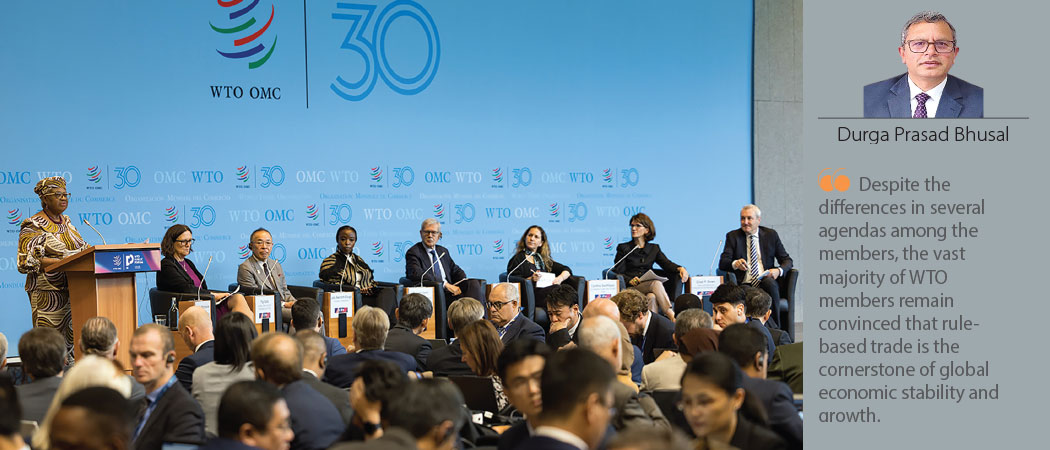

In 2025, the World Trade Organization (WTO) marked its 30th anniversary of its establishment. The creation of the WTO significantly expanded the multilateral trading system beyond the General Agreement on Tariffs and Trade to the General Agreement on Trade in Services, Intellectual Property (TRIPS) and a Binding Dispute Settlement Mechanism (DSU).
The WTO was founded as a single, rules-based multilateral trading system, with the overarching objective of raising living standards, creating employment, and promoting sustainable development. Its core principles such as non-discrimination, trade liberalisation, reciprocity, transparency, fairness, and inclusivity remain central to its mandate. The preamble to the Marrakesh Agreement explicitly acknowledges the need to integrate developing countries, including LDCs, into global trade through special and differential treatment, technical assistance, and capacity-building support.
Proponents of the multilateral trading system often argue that expanded global trade has helped lift over 1.5 billion people out of extreme poverty. Around 98 per cent of trade takes place under WTO architecture, while the share of trade under Most Favoured Nations is still around 72 per cent. The TRIPS Agreement has supported innovation and public health, while agreements on trade facilitation and customs valuation have contributed to reducing trade costs.
The Trade Policy Review Mechanism has enhanced transparency by enabling peer review of members' trade policies and practices and their consistency with WTO rules and ministerial decisions. Furthermore, the WTO has delivered extensive technical assistance and capacity-building programmes aimed at enabling developing members and LDCs to implement WTO obligations under several agreements and integrate their trade into the global economy.
The WTO's dispute settlement mechanism has handled over 600 disputes, successfully resolving the majority of them. However, developing countries and LDCs may continue to struggle with meaningful integration into global trade and with meeting domestic needs through imports of goods and services. LDCs' share in the global trade is around one per cent. Furthermore, the onerous implementation costs of the TRIPS agreement, coupled with stringent TBT and SPS requirements, impose disproportionate burdens on weaker economies such as Nepal.
Despite its accomplishments, the WTO is currently facing severe challenges in its history. Questions appear large over its ability to sustain a fair, open, transparent, and predictable trading system in the 21st century. Are three-decade-old rules still fit for purpose? Do WTO members need some rules to address the era defined by e-commerce, digital trade, artificial intelligence, and digitally delivered services?
The paralysis of the appellate body since 2019, alongside the resurgence of unilateral reciprocal tariff measures, has further escalated tensions among members and undermined confidence in the system. At the same time, long-standing frustration over the slow progress of the Doha Development Agenda, launched in 2001, continues to erode trust, particularly among developing members, including LDCs. Adding to these problems is the increasing demand to include multiple-country agreements, like the Investment Facilitation for Development Agreement and the Agreement on E-commerce, in the rules set by the Marrakesh Agreement. In 30 years, only two multilateral agreements, named the Trade Facilitation Agreement and the Fisheries Subsidies Agreement, have been concluded; views are around the idea that consensus-based decision-making has become excessively cumbersome.
Trade ministers in the 12th session of the Ministerial Conference committed to work towards necessary reform of the WTO. They also envisioned reforms to improve all its functions while reaffirming the foundational principles of the WTO. In addition, ministers instructed the General Council and its subsidiary bodies to conduct the work, review progress, and consider decisions, as appropriate, to be submitted to the next Ministerial Conference. With this mandate, WTO bodies initiated reforms in the functioning of the committees and councils, focusing on agenda setting, the use of digital tools, and meeting management, among others. In MC13, trade ministers again instructed the General Council and its subsidiary bodies to continue to conduct this work and report progress as appropriate to the next ministerial conference while acknowledging the progress made. However, the reform initiative taken during the period failed to meet the expectations of today's needs.
Despite the differences in several agendas among the members, the vast majority of WTO members remain convinced that rule-based trade is the cornerstone of global economic stability and growth. Members also acknowledge that without deep, comprehensive, and credible reform, the WTO will remain unable to overcome its current impasse or meet 21st-century expectations.
A careful look at the WTO's structure is needed so it can be more flexible, faster, and stronger, supported by quick talks on current issues and new rules that can address unfair trade practices and major problems that have led to frustration and a loss of trust. Thus, WTO reform is widely expected to feature prominently at the 14th WTO Ministerial Conference scheduled to take place in Cameroon from 26 to 29 March 2026. The reform agenda identifies and considers decision-making, development, special and differential treatment, and levelling the playing field, including transparency, while leaving the DS reform aside.
In the WTO, consensus-based decision-making has been the norm, although voting remains legally possible in limited circumstances. Each member has one vote, which makes the WTO different from the World Bank and IMF because it treats all members equally, no matter how big or small their economy or trade volume is. Some members argue that the paralysis surrounding the appellate body and the resistance to incorporating plurilateral agreements reflect the shortcomings of consensus decision-making.
While rule-making has undoubtedly slowed, attributing the WTO’s challenges solely to consensus would be misguided and does not bring a positive result for the future. Consensus remains fundamental to the WTO’s legitimacy, inclusivity, and equity, particularly for small economies and LDCs. There is collective frustration over the organisation's inability to make decisions; however, the core problem lies not in the mechanism itself but in political will, trust deficits, and insufficient engagement. Replacing consensus with majority voting risks undermining implementation and deepening divisions. This current practice provides each member a veto to protect their interests, and it works very well for a smaller economy like Nepal.
WTO rules should enable growth, structural transformation, and the integration of developing members, including LDCs, into global value chains.
However, development needs vary widely, encompassing industrialisation, trade diversification, digital inclusion, food security, SMEs’ development, women’s participation, environmental sustainability, and technology transfers, among others. More than 150 S&DT provisions exist across WTO agreements, primarily offering flexibility in implementation. Many of these provisions were time-bound and have expired.
Current reform debates focus on making S&DT more precise, targeted, effective, and needs-based while grappling with contentious issues of differentiation and eligibility. In this regard, first, S&DT should not be viewed as a panacea that would address all the trade- and investment-related challenges of developing members, including LDCs. Second, how to define what S&DT is need-based and whom, and how to differentiate among the similar set of the members while members take S&DT as treaty-embedded rights. Third, there is not a clear and objective framework within the WTO to distinguish between developed and developing members, as self-designation persists. While China has announced that it will not seek S&DT in future negotiations, it retains its developing-country status.
Disparities exist between founding and acceding Members, as well as between developed countries and developing Members, particularly in areas such as industrial subsidies and agricultural domestic support.
Many WTO agreements, negotiated three decades ago, are increasingly misaligned with today’s realities. Transparency obligations remain weak and formal, notification compliance seems uneven.
The provision of Annex VII of ASCM does not address the challenges of graduated countries from the LDC status. The reform agenda should address this discrimination. Furthermore, changes in this area need to tackle deep-rooted unfairness, especially the greater responsibilities placed on new members and the limited options for industrial growth in developing countries.
In conclusion, trade ministers in the MC14 in Cameroon will utilise this opportunity to have open and frank discussions on all the reform agendas, including dispute settlement reform, and will be able to present a clear roadmap ahead to revitalise the WTO, making it more relevant for the future generation. This time ministers will translate the rhetoric of WTO reforms into reality while addressing the difficulties of developing countries and redefining their status.
(The author is an undersecretary at the Ministry of Industry, Commerce and Supplies.)
-original-thumb.jpg)