- Thursday, 30 April 2026

A General's Posthumous Autobiography
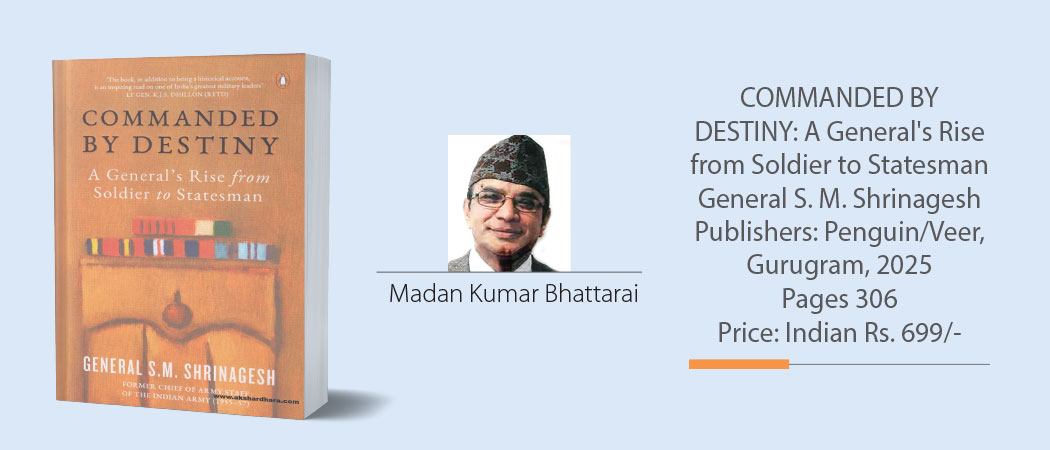

A new book with an attractive cover showing the insignia of positions the writer held in the force has been published to serve as the autobiography of General S. M. (Satyawant Mallannah) Shrinagesh, Chief of Staff of the Indian Army, during the crucial period of 1955–1957 and a celebrity combining the triple roles of a dedicated soldier, a strategist and a statesman. The author, born in Kolhapur, now in Maharashtra, died in 1977 but left a valuable collection of notes and records preserved by the family, who published the account recently in an interesting book, with his grandson Gaurav Shrinagesh writing the foreword.
General Shrinagesh was the son of a renowned bacteriologist of his time with a distinguished scholastic record at Edinburgh and Germany, Dr Shrinagesh Mallannah, and Ahalyabai Mallannah Shrinagesh, who was also educated at Edinburgh. The book is dedicated to her. General Shrinagesh is indirectly connected to Nepal, as his younger brother, Jayawant Mallannah (J.M.) Shrinagesh, an ICS (Indian Civil Service) officer of the 1928 batch, had served in Nepal as a member of the three-member group of Indian administrative advisers who came to Nepal to advise the government in the post-1951 era. The comprehensive study popularly called the Buch Commission report, after the name of the team leader, N.M. Buch, ICS, is the first of its kind with extensive coverage of Nepal's administrative milieu and recommendations. The report is readily available on the internet.
It is a queer coincidence that even the manuscript depicting life and accomplishments was prepared by his second younger brother, J.M., who has a connection to Nepal. His relatives also discovered the manuscript depicting life and accomplishments, prepared by his second younger brother with a Nepal connection, J.M. Shrinagesh, long after the writer's death. It is also interesting that all three brothers of Shrinagesh and the son of the general went to Cambridge for higher studies.
The youngest brother, Madhukar Mallannah Shrinagesh, followed the footsteps of his father and belonged to the Indian Medical Service with specialisation in the field of aviation medicine, becoming the first medico to opt for service in the Indian Air Force, ultimately rising to the level of Air Vice-Marshal.
It may be recalled that in those days, Oxford and Cambridge attracted the attention of upper-class and middle-level Indians and those who were meritorious and got scholarships during colonial days. There were no British colleges in India, while there were a number of renowned public schools like Doon, Mayo and Lawrence even if we just counted such institutions in our more comparatively familiar area of North India alone.
The new publication portrays events in India during which he served as Chief of Staff, a role that evolved from his earlier and more widely recognised position as Commander-in-Chief of the Indian Army and as the founding President of the Administrative Staff College of India in the post-retirement period. The writer puts two attributes—training and discipline—at the core of an officer in the defence forces. He later took over as Governor of Assam and Andhra Pradesh under the premiership of Pandit Jawaharlal Nehru and Mysore (now incorporated in the state of Karnataka) during the time of Lal Bahadur Shastri, making him the first army officer to be entrusted with such gubernatorial positions. Later years replicated the experiment of appointing service chiefs as governors of states.
In his active service, Shrinagesh had the unique experience of serving in both the British Indian Army and the Indian Army after the country's formal independence, including various assignments outside the country during the Second World War and post-war missions to Japan, Germany and Burma (now Myanmar).
Divided into sixteen chapters besides the introduction and epilogue, the highly readable book has 12 chapters relating to the author's life and period spent with the Indian Army in various forms, including as the fifth and third Indian incumbent to hold the position of Chief of the Army Staff following the independence of the country from the British colonial rule on August 15, 1947.
The thirteenth chapter dwells on his stint as the first-ever Principal of the Administrative College of India, and three subsequent chapters deal with the periods that General Shrinagesh spent in three different states, Assam, Andhra Pradesh and Mysore, respectively.
The author, who was in Cambridge before his formal induction into the Indian Army, has given a very lucid account of his Sandhurst days, including important information on people who joined civil services. The list included the newly created Indian Foreign Service (IFS). The IFS was rather hastily constituted through multi-faceted inductions from both the Indian Political Service, a somewhat hybrid arrangement under which Indian Civil Service officers, army people and even some police officers, and other sources, including absorption of members of the armed forces as emergency recruits, got demobilised after the conclusion of the Second World War.
The Nepali readers of the book will be disappointed at least on two counts. First, the author mentions what he calls the unenviable assignment of his younger brother J.M. Shrinagesh served as border commissioner during the sensitive period of the country's partition into India and Pakistan, but he does not mention his duties in Nepal.
The second point is that he does not refer to the sensitive military mission to Nepal that involved one of the highly decorated officers of the Indian Army, S.P.P. Thorat, who led the team, leading to the stationing of the Indian Military Mission in Nepal for quite some years. Thorat is believed to have been denied the position of chief of the Indian Army due to the intervention of V.K. Krishna Menon, a powerful but controversial Defence Minister of the country. As a post-retirement assignment, Thorat was, however, made chairman of the Bombay Public Service Commission.
On the whole, General Shrinagesh deserves tributes for the publication of the wonderful book that apparently sheds light both on the status of the army as seen by its chief and the position of the governor of three Indian states that has increasingly become a contentious and controversial position in the realm of centre-state relations in India after the rise of Indira Gandhi and especially when differing parties or combinations hold positions in the union government and states.
(Dr. Bhattarai is a former foreign secretary, ambassador and author. kutniti@gmail.com)

-original-thumb.jpg)