- Tuesday, 9 June 2026

Lightning Disasters Demand Urgent Action
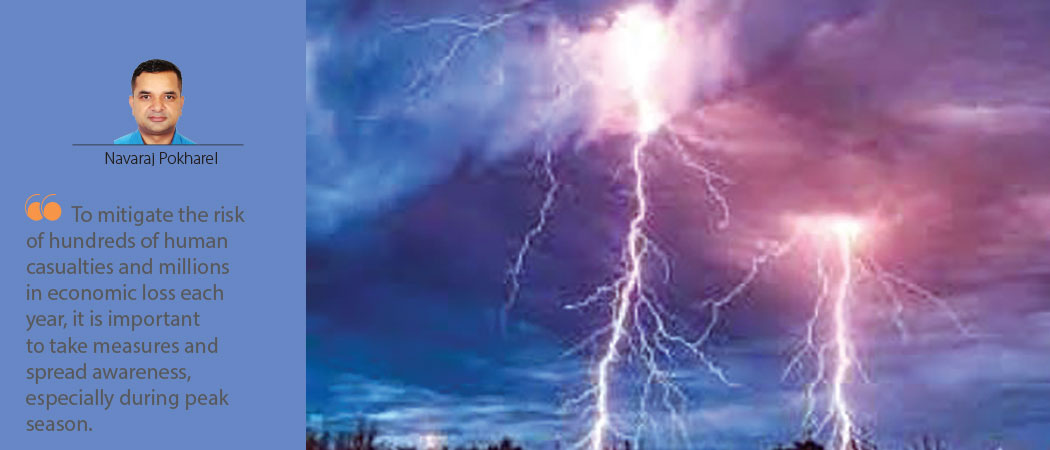

Lightning is one of the many forms of climate-related natural disasters. It creates a shock wave heard as thunder, causing massive, rapid heating of the air that expands explosively. It usually creates fewer human casualties at once than other disasters, making it less discussed. At the same time, lightning damage often occurs in forests and rural areas, and due to the lack of immediate data and detailed incident reporting, its recurring impacts receive limited attention. Most of the news reports on lightning focused on the damage caused, with no attention given to timely awareness and response. People often take such incidents lightly as a result. The vulnerable communities have limited discussions on lightning prevention, control, and protection measures.
During a lightning strike, the electrical energy involved can reach temperatures of up to 90,000 degrees Celsius—about three times hotter than the surface of the sun. The interaction between two or more charged clouds generates this immense energy.
According to meteorological data, the months of Chaitra, Baisakh, Jestha and Asar experienced the highest number of lightning strikes. Between 2019 and 2024, 372 people lost their lives, and property worth millions of rupees was damaged due to lightning, according to the National Disaster Risk Reduction and Mitigation Authority.
A 2021 study published in an American journal analysed 2,501 lightning incidents from 1971 to 2019, resulting in 1,927 deaths and 20,596 people directly or indirectly affected. In the past ten years alone, more than 800 people have died due to lightning, and the trend continues.
Lightning hazard
The scientific basis of lightning is electric current. This phenomenon is the process of electricity colliding with positively and negatively charged clouds. Such electric current that occurs regularly in the atmosphere causes damage only when it reaches the ground. The electrical current emitted in the atmosphere causes damage when it reaches the ground or settlements. Generally, the height of clouds in the atmosphere ranges from a few metres to ten kilometres. 'Human-made' means it can also be a method of bringing the electrical current in the atmosphere to the ground. If there is a human settlement near buildings, trees, towers or electric poles, then such a current can take people's lives and affect other human comforts and facilities. Additionally, reports indicate that lightning has struck some aircraft flying in the sky. When lightning strikes electrical transformers and telecommunication towers, it can also damage the towers and personal electrical equipment connected to them.
The electric current from such a collision may not harm the atmosphere, but it can harm people and damage property when it reaches the ground. This type of lightning strike is known as a cumulonimbus cloud. It collides in the atmosphere and can only be seen by humans. Lightning caused by the collision between clouds and the ground causes human damage.
Nowadays, the frequency of lightning has increased. According to the Ministry of Home Affairs, more than 100 people die annually due to lightning. There is no exact information about the damage apart from death.
A fully reliable real-time lightning prediction system has not yet been developed. However, short-term forecasting sensors are available. The Department of Hydrology and Meteorology has begun monitoring lightning by installing sensors in nine locations across the country, with support from the World Bank. These include Tumlingtar, Biratnagar, Simara, Bhairahawa, Kathmandu, Pokhara, Nepalgunj, Surkhet and Dhangadhi. This sensor monitors lightning statistics. Such sensor devices help adopt awareness by monitoring lightning.
A systematic settlement system and the construction of tall buildings, poles, and towers are essential for electrical or nuclear safety to avoid the effects of lightning. To avoid lightning scientifically, an earthing system should be established.
For this, a conductor is used from the top of the building or tower or pole to conduct and discharge the positive and negative charged electric current to the ground. For the earthing system, engineers develop a system of conductive wires, conductors, and surrounding conductive solid objects that neutralise the electric current before it is discharged into the ground. It discharges the excess electric current in the atmosphere.
In rural areas, take precautions like avoiding building houses or living near tall trees. Avoid travelling through forests or areas with tall trees when there is lightning or thunder.
At the same time, it is preferable not to build houses or settlements near forests and forest areas. During rainy weather and lightning, citizens should stay away from metal poles and objects, electrical appliances, and other electronic devices. During lightning, one should stay away from tall and metal objects. Sometimes lightning also causes large natural fires, causing large disturbances in forests.
Precautions
Lightning occurs more likely during rainfall and when dark cumulonimbus clouds are present. When a thunderstorm or lightning is near, go indoors immediately and avoid using phones or electrical devices. If you cannot reach a safe building, stay away from trees, open water, metal objects, vehicles, and wires. Avoid open areas and instead stay in low-lying places, small structures, forests, or bushes while being careful of flash floods. Take shelter in a strong building if possible and wait, as lightning usually lasts a short time. Do not use wired phones during thunder. If lightning strikes someone, immediately take them to the hospital—it is safe to touch them. In open areas, crouching low to the ground is safer than lying flat.
The probability of lightning is higher during rain and when there are many dark cumulonimbus clouds in the sky. Therefore, if you are indoors at such times, personal safety measures include avoiding electrical appliances and staying warm. However, to reduce the overall risk of lightning, it is necessary to raise awareness at the individual, community and national levels.
By identifying places where lightning strikes are frequent and installing a conductive pole and earthing system in that area, we can avoid its possible damage. It is necessary to take initiatives at the individual, local, community and national levels to reduce the damage caused by lightning. To mitigate the risk of hundreds of human casualties and millions in economic loss each year, it is important to take measures and spread awareness, especially during peak season.
(Pokharel is an environmentalist.)