- Tuesday, 9 June 2026

Who Will Teach Nepali Children ?

“Why can’t they hold good teachers?” My daughter said in annoyance as she entered the house. A teacher, one of her favourites, had left the school. He had applied for further studies abroad and obtained the visa. The reasons for the displeasure of students were two. First, he was one of those teachers whom they admired for his way of teaching. He had joined the school only a few months back and they had only just begun to feel comfortable and friendly with him.
Second, he was the second teacher to quit school within a span of one year. Another ‘great’ teacher who taught them social studies, and the students’ favourite, had quit only a few months back. She had passed the Public Service Commission examination to become an officer at the customs department. I raised this matter with the school principal during one of those teacher-parent meetings. ‘You should have a retention policy,’ I told him. ‘You cannot force teachers to work in your school when they get a better job or study opportunities abroad,’ he said. I only listened.
Shortage everywhere
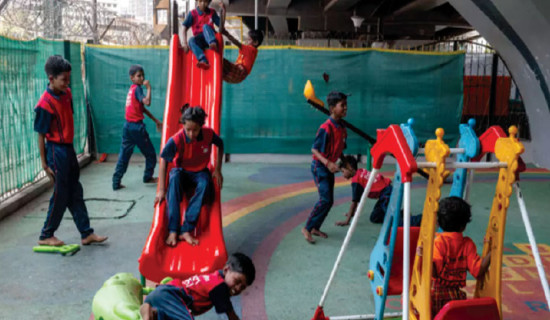
Nepal’s educational institutions are facing a problem that could inflict an irremediable pain on the country’s education future. The teacher shortage is rising as a silent epidemic in Nepal’s schools–both private and government-funded. Private school operators say every year they have to struggle to find competent teachers, because every year one or another teacher quits schools. And since they do not find smart and competent teachers, they have to settle for mediocre ones as well.
The shortage in government-funded schools is even more staggering. A 2024 Education International report showed that Nepal faces a critical shortage of over 65,000 teachers, particularly at lower secondary and secondary levels. Another recent report claims that Karnali Province has over 5,000 teachers' quota left unfulfilled in secondary and basic schools. Besides, there are reports of schools making vacancy announcements for several rounds with attractive offers of perks and pay, and yet not being able to recruit teachers. Schools struggle really hard to find teachers, especially teachers of Math, Science and English.
Alarmingly, what appears like a crisis specific to Nepal is rising as a global problem. UNESCO's 2024 Global report on teachers projects a shortage of 44 million primary and secondary teachers, a situation that could potentially hinder the attainment of quality education for all by 2030.
In Nepal’s case, part of why qualified people don’t want to join teaching is mainly economic. The perks and benefits that an individual receives as a teacher are not attractive enough to bring the best minds into the field. Thus, many get into this profession as a stopgap on the way to doing something better–landing a government job in civil service, pursuing scholarships to go to study or work abroad, or searching for something more lucrative. And since teaching does not bring you fringe benefits, forget under-the-table money, those who look to earn enough by teaching do not make it a preferred job. Most importantly, whatever a teacher earns in salary (those receiving competitive salaries from private institutions make for a tiny minority) is simply not enough for him or her to educate children and provide for the health and livelihood needs of the family. For a university graduate, landing a foreign employment job appears to be more lucrative than working in a school close to his house.
Until the 1990s and up to early 2000s, the primary drive for village youths to go to the university would be job prospects. After graduation, some would go for the Public Service Commission to join the civil service. Others, who did not do so, would return to their birth villages and become teachers. Many others, who did not choose either path, would work in or open private schools and colleges.
As the door to foreign employment opened wider and the trend of urban youths going to the First World for education and jobs gained momentum during the first decade of this century, it ruptured this ecosystem. First, the village youths who would come to universities and colleges in the past, started making passports soon after completing their high school to go to the Gulf and the Middle East. The number of students in university classrooms started to fall. So the cohort from which private and public schools used to get their human resources started to decline at the source. The result has been for us all to see: We have classrooms. We have students. But we do not have enough teachers to teach them.
Reversing the trend
The system to recruit teachers in government schools was rather rigid and exclusionary in the past. For one to join the profession, one first had to pass a licensing test and only those who had a degree from the faculty of education could qualify to take such tests. This kept a majority of non-education graduates (such as social science and science graduates) out of the ring. Now, the recruitment process has been made flexible: A non-education graduate can also take a licensing test and compete for the Teacher Service Commission exam and they can obtain a one-year education degree a few years after being put in service. Apparently, this has not helped much to attract educated youths into the profession.
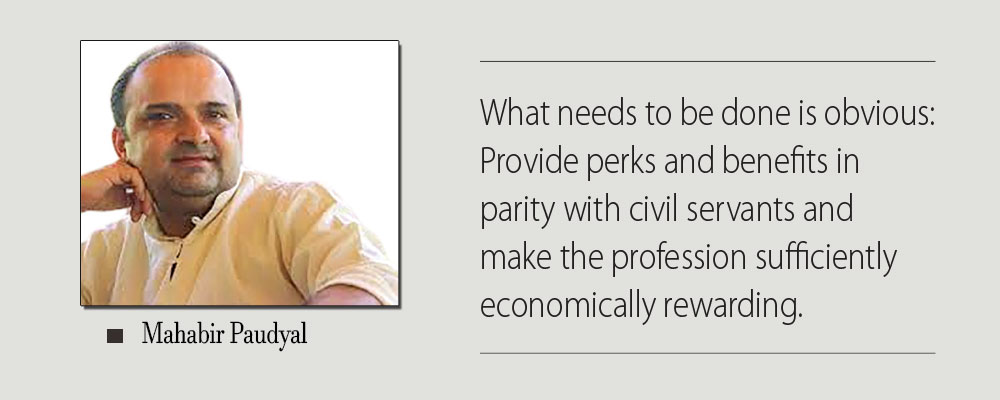
What needs to be done is obvious: Provide perks and benefits in parity with civil servants and make the profession sufficiently economically rewarding. If one can earn a decent living by working as a teacher in a school close to one’s house, one would not opt to go to the Middle East by leaving behind family and children to do the back-breaking jobs.
For sure, this is going to be costly but surely not as costly as when the nation has to leave its children in classrooms without teachers.
(The author is a journalist and educator based in Kathmandu.)