- Friday, 29 May 2026

Smart Governance Thru Digitisation

As the nation prepares to mark the 19th Republic Day on May 29, Nepal stands at an important juncture in its national politics, shaped by the nearly two-thirds majority government of the Rastriya Swatantra Party and the growing use of technology in digital governance. Two decades after the end of the monarchy and nearly a decade after the promulgation of Nepal’s 2015 Constitution, the country is still struggling to make federalism work effectively in practice. In this context, digital governance has emerged as a promising tool to strengthen public administration, enhance transparency, and bring services closer to citizens.
Federalism and digital governance are closely connected. The country's federal structure has three tiers of government: federal, provincial and local levels. The goal is to decentralise power and improve public service delivery. However, coordination among these levels has often been weak. Citizens often face duplication of procedures, inconsistent databases and delays caused by administrative systems. Digital governance can bridge the gap between levels of government.
The country has started several reforms in digital governance, including the Nagarik App, which integrates government services into one digital platform, online passport applications, digital tax systems, electronic procurement systems, and the National Identity card programme, among others. Among them, the Nagarik App has become a symbol of Nepal’s transformation efforts, which supports the idea of a ‘single digital gateway’ for public services. The present government, through this App, plans to integrate passport services, police reports, driving licences and citizens' documents.
The current government, led by Prime Minister Balendra Shah, has put governance at the centre of its reform agenda. After taking office on March 27, 2026, the government announced a 100-point governance reform plan to promote accountability, improve public service delivery and digitise state institutions.
Digital-first governance
The government wants to expand paperless administration, digital monitoring systems and integrated public service delivery. Citizens should only need to submit information once, and government agencies would share verified data through integrated systems. The government has proposed the expansion of paperless administration, digital monitoring systems, and integrated public service delivery. As per the reform blueprint, citizens should eventually be able to submit personal information only once, after which government agencies across different levels would share verified data through integrated systems. In the view of some former civil servants, this proposal directly addresses one of the major weaknesses of the country's federal system: administrative duplication. Under the existing administrative structure, citizens often need to repeatedly submit the same documents to ward offices, district administration offices, provincial agencies, and federal departments.
According to the former senior civil servant officials, a unified digital governance system could significantly reduce bureaucratic inefficiency and improve coordination among the three-tier governments.
The government has also proposed strengthening and designing the Personnel Management Information System (PMIS), a digital platform intended to maintain updated profiles of civil servants, including appointments, transfers, training, and promotions within three months of the governance reform plan of the government.
This initiative is particularly relevant to federalism because Nepal’s new federal structure has created a complex public administration system involving thousands of employees across federal, provincial, and local governments. A coordinated digital personnel management system could improve transparency, reduce political interference, and strengthen institutional accountability.
In addition, the reform agenda emphasises faceless and time-bound public services. The government plans to introduce digital appointment systems, e-signature verification, digital file tracking (no pending file system), and online monitoring of administrative delays. Such measures aim to minimise opportunities for corruption and reduce the culture of excessive paperwork that has historically characterised Nepali bureaucracy.
It would be a feeling of another level and kind of governance in federalism for citizens that if the present government acts as prescribed in their 100-point governance reform agenda, the government manages to set up a 24-hour ‘National Citizen Help and Grievance Management System’ to address citizens’ complaints, suggestions, and service requests across the country in a prompt, effective and result-oriented manner.
Public service App
The government plans to integrate public services into the App, such as birth registration, marriage certificates, driving licences and police reports. According to the Department of National ID and Civil Registration (DoNIDCR), the process of linking national registration data with the App has already begun.
Integration of such a system could transform how citizens interact with the state. Instead of travelling long distances to government offices or waiting in queues for paperwork, people may increasingly access public services directly through digital platforms. Such measures remain particularly important in countries like Nepal with difficult terrain, where remote communities often face barriers in accessing administrative services.
Another unexpected, but a must-do, initiative is the beginning of the call to provide any suggestions and ideas through the online system regarding the formulation of the new fiscal year budget to the Office of the Prime Minister and the Council of Ministers. This open-ended approach published by the present Shah-led government is also an example of a decentralised approach. Further, with a great sigh of relief, the present government has also made it possible to solve a long-standing problem of the distribution and printing of backlog driving licences. Today, completing all the backlog, 1.2 million driving licences have been printed and distributed to the respective vehicle owners. To listen to this piece of information may not sound interesting, but those service seekers, who had been long waiting for their driving licences to get printed in time, maintain a meaning of the presence of a powerful government led by just one single party. Further, the printing of an additional 1.7 M backlog of smart driving licences has also begun from May 6.
Recently, the government has fully digitised its land administration via the Land Record Information Management System (LRIMS) and the Department of Survey’s public portal called 'merokitta.gov.np'. This application allows citizens to view property details, pay revenue fees, and apply for cadastral maps online. This system additionally allows citizens to request the printing of their land maps and verify parcel boundaries online without visiting survey offices. Additionally, LRIMS centralised software is implemented across all land revenue offices that process deed registrations, land transfers, and tax collection digitally. It assigns unique Land-Owner Identification Numbers (LIN) to property owners.
Under the government’s new digital transformation initiatives, the Balendra-led government has proposed to establish an ‘Integrated Citizens Service Portal’ through which integrated online service portals, secure government-wide data exchange, digital lockers and digital identity infrastructure can be accessed. These are crucial for federal governance because they can help all three levels of government share information efficiently.
Challenges ahead
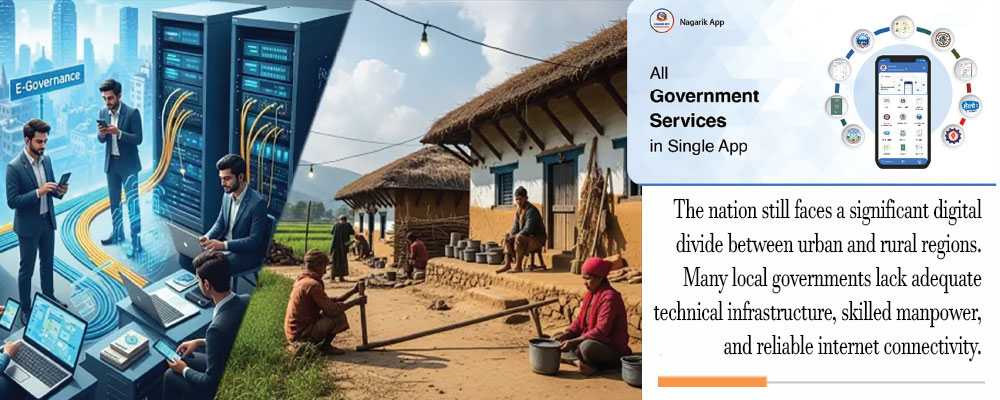
Nevertheless, despite these promising initiatives, major challenges remain. The nation still faces a significant digital divide between urban and rural regions. Many local governments lack adequate technical infrastructure, skilled manpower, and reliable internet connectivity. Digital literacy also remains uneven, particularly among older populations and citizens in remote areas.
Republic Day offers an opportunity to celebrate Nepal’s achievements and reflect on the future direction of governance. The success of Nepal’s system will depend on whether the state can effectively deliver services, ensure accountability and build public trust. Digital governance represents both an opportunity and a test. If implemented inclusively and efficiently, digital transformation can help federalism function effectively. However, without capacity, political commitment and proper implementation, digital reforms risk becoming symbolic announcements rather than meaningful change.
(Khatri is a journalist at The Rising Nepal.)