- Monday, 25 May 2026

NCP unveils election manifesto focusing on economic reform
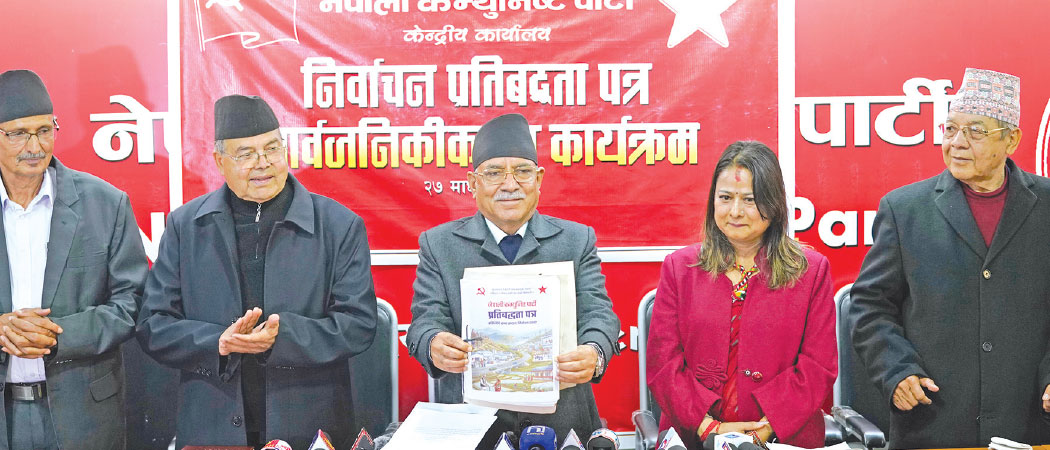

Kathmandu, Feb. 11: The Nepali Communist Party (NCP) has officially unveiled its election manifesto for the upcoming House of Representatives (HoR) elections on March 5, becoming the first party to do so.
The party has placed special emphasis on a new phase of economic reform, targeting a reduction in the multidimensional poverty rate from 20.15 per cent to 5 per cent in five years.
The manifesto was presented on Tuesday at the party’s central office in Parisdanda by party coordinator Pushpa Kamal Dahal ‘Prachanda’.
It outlines measures to address Nepal’s structural economic challenges and lay the foundation for a socialism-oriented economy, aiming to shift the nation from an import-dependent and consumption-based model to a production-driven, self-reliant, and inclusive economic framework.
The document highlights the failures of past economic policies, noting that while neoliberal reforms initially boosted production and employment, they ultimately made the economy import-dependent, non-productive, and unequal.
It stresses the need for reforms to promote employment, financial inclusion, self-reliance, and social justice alongside economic prosperity. The manifesto emphasises transforming Nepal’s economy into a production-led, export-oriented, and self-reliant system. The strategy includes state-supported agriculture and industrial policies, gradual import substitution, promotion of domestic private sector growth, and linking foreign investment to production, technology transfer, and employment.
It also focuses on building a green and digital economy, with complementary roles for public, private, and cooperative sectors, and developing each province as a hub for specific economic activities.
Key priority sectors
The NCP’s key priority sectors focus on transforming agriculture and the rural economy through commercial farming, technology, irrigation, market assurance, and food self-sufficiency; developing energy and infrastructure with hydropower, renewables, and economic corridors; promoting industry, entrepreneurship and SMEs with province-specific initiatives; expanding the digital economy and IT through better infrastructure, e-commerce, and policy reforms; boosting tourism and services, including adventure, cultural, and eco-tourism; and strengthening the social sector with increased investment in education, health, social security, and inclusive development.
Key programmes
The party plans to create 150,000 productive jobs annually through the use of idle public and private land, support returnee migrant workers in entrepreneurship, strengthen private investment, expand collectivism and cooperatives, restructure the economy and boost education and health investment.
It also aims to utilise resources sensibly and leverage federalism through industrial and agricultural corridor development.
Financial reforms will include incentivising banks to invest in productive sectors, revitalising cooperatives, and enhancing transparency through fintech.
Foreign policy
The NCP reaffirms its commitment to strengthening Nepal’s national sovereignty and self-reliance by reducing foreign dependence.
It pledges to maintain a non-aligned foreign policy, prioritise national interests and resolve border disputes diplomatically, including those at Lipulek, Limpiyadhura, and Kalapani.
Nepal will also maintain an active role in multilateral forums such as the UN, SAARC, and BIMSTEC, while prioritising economic diplomacy to attract investment, technology transfer, tourism, and employment opportunities, read the commitment paper.
The manifesto proposes making health insurance mandatory and progressive, establishing it as the core of the country’s health security system, with coverage set to increase from 30 per cent to 100 per cent by 2088 BS.
The party has also forwarded commitments in accordance to the spirit of Gen-Z. It said political stability will be established through balanced governance, simplified elections, a smaller expert-inclusive cabinet and timely enactment of federalism laws.
Sixty per cent of the federal budget will be allocated to provinces and local bodies for implementing fundamental rights and constitutional commissions will be restructured.
Corruption control will be central, with an empowered independent commission to probe officials’ assets and corruption cases within a year, and a high-level watchdog to oversee all anti-corruption bodies.
Administration will be transformed into a citizen-responsive, neutral, transparent, technology-friendly, outcome-focused, and corruption-free system.
The Federal Civil Service Act will be implemented, and administrative structures will be reformed across all levels, with clear standards for appointments, transfers, and promotions to prevent political interference.
Inclusive democracy
The party aims to strengthen the federal democratic republic, promote socialism with equitable prosperity, good governance, social justice, and public accountability.
The party pledges to eradicate hunger, disease, poverty, inequality, and discrimination. It also pledged to safeguard national unity, religious freedom, multicultural respect, and social harmony.

-square-thumb.jpg)