- Tuesday, 9 June 2026

NC wins nine, UML eight in NA election
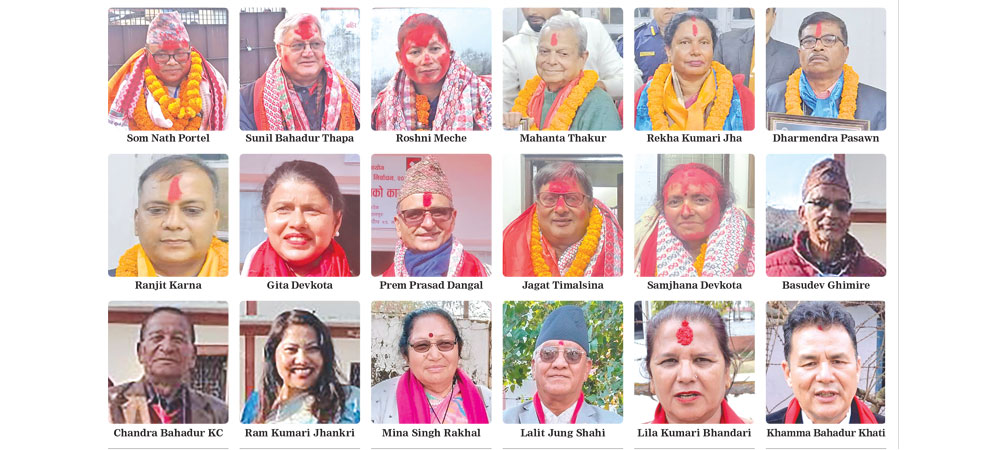

Kathmandu, Jan. 26: The Nepali Congress (NC) and the CPN-UML emerged victorious in the National Assembly (NA) elections held on Sunday.
The two parties won 17 of the 18 seats, which will fall vacant on March 4, while one seat went to the Lokatantrik Samajwadi Party.
According to the final results announced by the Election Commission of Nepal, NC secured nine seats, CPN-UML won eight, and the Loktantrik Samajwadi Party-Nepal (LSP-N) one.
Of the 19 NA members whose terms expire in March, eight each are from the CPN-UML and the Nepali Communist Party (NCP), and one each from the Janata Samajbadi Party-Nepal and the Loktantrik Samajbadi Party. One nominated by the President is also among the retiring members.
In the election, NC won nine seats, while the CPN-UML managed to regain all eight of its previously held seats.
The Nepali Communist Party, which had eight retiring members, lost all its seats due to the alliance between the NC and CPN-UML. The Loktantrik Samajbadi Party-Nepal retained one seat, while the Janata Samajbadi Party-Nepal lost one.
The voting was held for 17 seats on Sunday, as Sunil Bahadur Thapa of the NC was elected unopposed from the Khas Arya category in Koshi Province.
The winning NC candidates include Dharmendra Pasawn, Ranjit Karna, Gita Devkota, Jagat Timalsina, Basudev Ghimire, Chandra Bahadur KC, and Khamma Bahadur Khati.
Paswan secured the Dalit category seat from Madhes Province with 7,904 votes, defeating his closest contender, Sambhu Paswan Hajari of NCP, who garnered 1,376 votes.
Karna was elected from Madhes Province under the Disability/Minority category, receiving 7,423 votes, while his closest rival, Ramnanda Prasad of NCP, received 1,369 votes.
Devkota won the women’s category seat from Bagmati Province with 6,239 votes, while her nearest competitor, Saroj Kumar Jha of NCP, received 2,522 votes. Timalsina secured the “Other” category seat from Gandaki Province with 5,033 votes, defeating Kapil Lama of NCP, who received 1,362 votes.
Ghimire was elected under the Disability/Minority category from Bagmati Province with 6,322 votes, while his closest contender, Sarjan BK of NCP, received 1,601 votes.
KC won the “Other” category seat from Lumbini Province with 5,977 votes, while his closest rival, Brishaspati Adhikari of NCP, garnered 1,832 votes. Likewise, Khati won with 3,969 votes from Sudurpashchi. His closet rival Tikaram Jaisi from NCP got only 1805 votes.
Likewise, among UML candidates, Roshni Meche won the women’s category seat from Koshi Province with 7,173 votes, while her nearest rival, Namita Neupane of NCP, received 2,268 votes.
Som Nath Portel was elected from the Dalit category in Koshi Province with 7,423 votes, defeating Khemrajj Nepali of NCP, who received 2,037 votes.
Similarly, Rekha Kumari Jha secured a seat from Madhes Province under the women’s category with 7,222 votes, while her closest rival, Sahi Kumari Agrawal of NCP, received 1,944 votes.
Prem Prasad Dangal was elected from the “Other” category in Bagmati Province with 6,205 votes, while his closest competitor, Prem Prasad Sapkota of NCP, received 2,541 votes.
Samjhana Devkota won the women’s category seat from Gandaki Province with 5,014 votes, defeating Goma Luintel Ghimire of NCP, who received 941 votes.
Ram Kumari Jhankri was elected under the women’s category from Lumbini Province with 6,303 votes, while her closest rival, Durga Kumari Bhandari of NCP, garnered 1,362 votes.
Mina Singh Rakhal won the women’s category seat in Karnali Province with 3,145 votes, while her closest contender, Anju Mahatara of NCP, received 1,734 votes. Lalit Jung Shahi of NC elected from the Provience.
Lila Kumari Bhandari secured the women’s category seat from Sudurpaschim Province with 3,984 votes, defeating Roji Basnet of NCP, who received 1,676 votes.
Mahanta Thakur, Chairman of LSP-N, was elected in the ‘Other’ category with 7,725 votes, defeating his closest rival, Laxman Paudel of NCP, who garnered 1,805 votes.
Although three candidates from the Janata Samajbadi Party-Nepal registered their nominations, none of them succeeded in securing a seat.
Two candidates from the Nepal Workers and Peasant Party and four from the Rastriya Janamorcha also contested, but none were elected. As a result, there is no representation from Nepal Workers and Peasants Party in the upper house. Only Tul Bahadur Bishwokarma remains as the sole member from the Rastriya Janamorcha in the National Assembly.
NC now largest party in Upper House
The Nepali Congress has become the largest party in the upper house of the federal parliament, the National Assembly. The results of the election held on Sunday for one-third of the members of the NA have changed the party dynamics in the NA.
Previously, the largest party was the NCP. With 17 members, the Maoist Centre had been the largest party until it merged with CPN (Unified Socialist) to form the NCP, which then had 25 members in the National Assembly.
The election held on Sunday has elected 18 members for a six-year term. Article 86(3) of Nepal’s Constitution of 2072 (2015) stipulates that the term of National Assembly members is six years. Under this provision, one-third of the members’ terms end every two years.
In the 59-member NA, Nepali Congress holds 24 seats, NCP has 17, UML has 10, Janata Samajbadi Party-Nepal (JSP-Nepal) has two, one each from LSP-N and Rastriya Janamorcha, there are two nominated members, one seat is vacant due to the passing of NA member Baldev Bohra, and one nominated seat remains vacant.
Voters turnout 95.67 per cent
According to the EC, 95.67 per cent of eligible voters participated in the National Assembly elections.
Voting for the election of members to the National Assembly (NA) was completed peacefully and enthusiastically on Sunday, according to the Election Commission. Voting took place from 9 am to 3 pm on Sunday at designated centres in the capitals of all seven provinces.
The Commission’s spokesperson, Narayan Prasad Bhattrai, reported that the voting process was enthusiastic and peaceful.
Out of 2,011 registered voters across the seven provinces, 1,924 participated. Of these, 1,426 out of 1,482 municipal voters and 498 out of 529 provincial assembly members cast their votes.