- Tuesday, 2 June 2026

National economy reviving amid challenges: NRB
-(1).jpg)

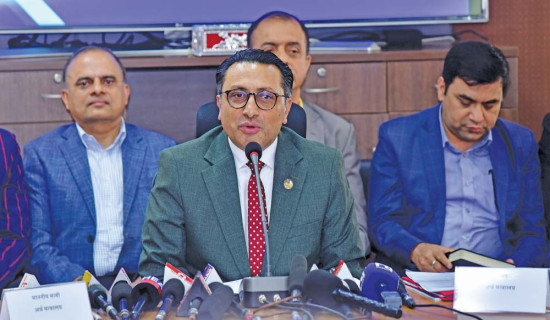
Kathmandu, Mar. 4: The domestic economy is gradually reviving, although the recovery remains uneven across sectors, according to the semiannual macroeconomic report published by the Nepal Rastra Bank (NRB) on Tuesday. The report states that economic growth remains moderate, inflation is relatively stable, and the monetary sector presents mixed trends—characterised by historically low interest rates but sluggish credit growth.
The external sector is robust overall but the performance remains mixed across different indicators, and the fiscal sector is improving despite sluggish capital spending, said the report.
Nepal’s economic growth performance has moderated after facing a decade of extremes with four major shocks to the economy- the 2015 devastating earthquake, the political restructuring in 2015, the COVID-19 pandemic, and the recent Gen Z movement.
The structure of Gross Domestic Product (GDP) is evolving, with expansion in the service sector and contraction in agriculture and industry.
Likewise, aggregate demand continues to be driven primarily by consumption, followed by private investment and government expenditure.
Inflation has stabilised in recent decades, although food inflation remains more volatile than non-food inflation.
The structure of inflation has changed with the share of food and beverages in CPI basket decreasing substantially over the years. Nepal’s inflation displays convergence with Indian inflation, due to the effect of exchange rate peg, high trade linkages and other structural factors, said the report.
Mixed monetary conditions
According to the report, the monetary sector remains mixed, with abundant liquidity in the banking system despite ongoing financial sector challenges.
Financial deepening has expanded significantly since the liberalisation policies of the 1980s and 1990s. Broad money and deposits now exceed Nepal’s GDP, while credit remains close to GDP levels.
Short-term interest rates began declining in mid-2023 in line with the central bank’s monetary policy stance and have now stabilized near the floor of the policy corridor.
Lending rates are at historic lows, while deposit rates have not fallen below 3 per cent. Liquidity absorption has been managed efficiently through a mix of instruments, including the Standing Deposit Facility.
The NRB said that financial access has substantially improved over the last decade and commercial banks' branches have reached all 753 local levels.
Financial stability measures remain satisfactory but challenging, it said.
While the capital adequacy ratio remains above the regulatory threshold with abundant liquid assets, non-performing assets rose significantly over the two years.
Substantial progress has been achieved in the infrastructure, products, and usage of payment systems, with the digitalization of economic transactions, said the report.
External sector remains robust, but not sustainable
The country’s external sector continues to demonstrate resilience, with key indicators showing marked improvement in recent months.
However, underlying structural weaknesses raise concerns about the sustainability of this performance, said the report.
The export growth remains vulnerable due to its dependence on edible oil export. The balance of payments (BoP) is in record surplus, reflected in growing foreign exchange reserves, but this surplus is largely driven by remittance inflows, which itself is vulnerable to external factors, it said.
The exchange rate peg has stabilised trade and investment flows with India, but exchange rate with other currencies remain volatile and continue to face depreciation pressure.
Key fiscal indicators exhibit signs of recovery after the COVID-19 pandemic, but revenue mobilisation remains weak and has not returned to the prepandemic level, said the report.
Likewise, the structure of spending continues to remain a pressing challenge with low capital expenditure and high seasonality in spending.
The persistent negative fiscal balance and a gradual decline in external grants and subsidies have further widened financing needs, it said.
This has resulted in an elevated public debt mobilisation for financing gaps, with total debt rising continuously.
The concentration of debt mobilisation to domestic debts is also a challenge, which usually suffers from interest rate and rollover risks.
However, the overall debt level is still below the regional average and well below the debt sustainability risk, and thus the government has fiscal space for prioritising spending on sectors that enhance economic productivity and employment. The economic outlook remains stable, despite the Gen Z movement leading to political and social unrest in the first quarter of 2025/26.
Consumer price inflation is expected to remain around 4 per cent, lower than the annual projection of 5 per cent. Economic growth is expected to hover around 4 per cent, below the annual target of 6 per cent.
The external sector is projected to remain stable, with both current accounts and BoP in surplus.
The market liquidity is expected to remain high; but the effective liquidity absorption is expected to keep interest rates stable.
Due to the liquidity influx because of high remittance inflows, the money supply is projected to grow in line with annual forecasts.
However, the uptake in credit growth is conditional upon the fiscal performance, including post-election increase in public spending as well as improvements in the overall investment environment with a stable government formation.
The global economy remains broadly resilient, despite elevated geopolitical and trade tensions.
The International Monetary Fund (IMF)'s World Economic Outlook, January 2026 update, shows subdued inflation and stable growth in 2024 and 2025, with similar growth projections for 2026.
Following an easing global economic environment, global output growth and inflation are expected to be 3.3 per cent and 3.8 per cent, respectively
However, risks are emerging, with growing geopolitical tensions heightening global policy and trade uncertainty, and domestic uncertainties due to political transitions.