- Monday, 25 May 2026

Chiefs of major parties in fray from diverse constituencies
Kathmandu, Feb. 13: Top leaders of major political parties are contesting the upcoming House of Representatives elections scheduled for 5 March from different constituencies.
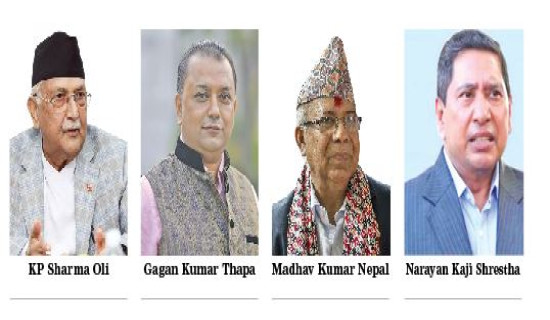
CPN-UML Chairman and former Prime Minister KP Sharma Oli is running from Jhapa-5, while Nepali Congress President Gagan Thapa is contesting from Sarlahi-4. Nepali Communist Party (NCP) Coordinator and former Prime Minister Pushpa Kamal Dahal ‘Prachanda’ is also in the fray. Rastriya Swatantra Party President Rabi Lamichhane is contesting from Chitwan-2, and Rastriya Prajatantra Party (RPP) Chair Rajendra Lingden is running from Jhapa-3.
Gagan Thapa from Sarlahi-4
Gagan Thapa, recently elected President of the Nepali Congress (NC) through the party’s special general convention, has filed his nomination from Sarlahi-4 after the party’s central working committee projected him as a future prime ministerial candidate. His candidacy has intensified the electoral atmosphere in the constituency.
Thapa was elected under the proportional representation system in 2008 and has since won three consecutive elections from Kathmandu-4. However, he has now chosen to contest from Sarlahi-4, a politically sensitive Madhesi stronghold where candidates from the hills have rarely emerged as leading figures. In the last election, NC’s Nagendra Kumar was defeated by the party’s rebel candidate, Amresh Kumar Singh, from the same constituency.
Singh, who won the constituency three consecutive times, twice as an NC candidate and in 2022 as a rebel, is now contesting from the Rastriya Swatantra Party (RSP). In 2022, despite support from the CPN (Maoist Centre) and CPN (Unified Socialist), the NC failed to win any of Sarlahi’s four constituencies.
In Sarlahi-4, Kumar secured 18,253 votes, while Singh won with 20,017 votes. In 2017, Singh had narrowly won as an NC candidate with 29,675 votes against Rakesh Kumar Mishra of the Rastriya Janata Party, who received 28,136 votes.
Singh’s move to the RSP, a party that has attracted significant youth support, particularly after the rise of its prominent leader and former Kathmandu Metropolitan City Mayor Balendra Shah ‘Balen’, has added further challenges to Thapa’s prospects. Nevertheless, Thapa remains popular among both young and older voters.
Although a total of 38 candidates are contesting in the constituency, the main contest is between Gagan Thapa and Amresh Kumar Singh.
Other notable contenders include Amnish Kumar Yadav from CPN-UML, Pradip Kumar Jha from the Rastriya Prajatantra Party (RPP), Rakesh Kumar Mishra from the Janamat Party, and Rameshwor Rai Yadav from the Janata Samajwadi Party-Nepal (JSP-N), among others.
Of the 38 candidates, 14 are representing political parties, while the remaining are independent candidates.
Nation’s attention in Jhapa-5
Oli is contesting the elections from his long-held Jhapa-5, and former Kathmandu Mayor and Rastriya Swatantra Party (RSP) leader Balendra Shah ‘Balen’ has challenged him, making it one of the most closely watched constituencies.
The race, widely framed as “Oli versus Balen,” is seen as more than a local contest, with many viewing it as a test of the country’s future political direction.
Oli is campaigning on his extensive political experience, party organization, and development record, while Balen is positioning himself as a symbol of change, youth aspiration, and anti-establishment politics, relying heavily on direct public engagement and social media outreach.
While the Oli–Balen rivalry dominates national attention, the constituency has 24 candidates in total. The Nepali Congress has fielded Mandhara Chimariya, while the Nepali Communist Party (NCP) has nominated youth leader Ranjit Tamang.
The Rastriya Prajatantra Party and other smaller parties are also in the fray, but they are largely overshadowed by the two frontrunners. Both Oli and Balen have been forwarded as the prime ministerial candidates of their respective parties. Oli is contesting Jhapa-5 for the eighth time, losing only the 2008 Constituent Assembly election.
Following the Gen Z protests on September 8–9, Oli has faced wide criticism and public backlash over the handling of the movement and the death of young protesters, making what was once considered his safest constituency far more competitive.
With 163,379 registered voters, including about 10,000 new ones, the outcome in Jhapa-5 is expected to have political significance well beyond eastern Nepal.
Prachanda in Rukum East
NCP Coordinator and former Prime Minister Prachanda is contesting election from Rukum East, marking another shift in his electoral constituencies.
In 2022, he was elected from Gorkha as chairman of CPN (Maoist Centre). Since entering politics in 2008, Prachanda has contested and won elections from multiple constituencies, including Rolpa, Kathmandu, Siraha, Chitwan, and Gorkha.
Defending his move, he stated that as a national leader he represents the entire country and dismissed allegations of political opportunism.
According to the Election Commission, 11 candidates are in the fray in Rukum East, including Kusumdevi Thapa Magar (Nepali Congress), Leelamani Gautam (CPN-UML), and Lakhan Kumar Thapa (Rastriya Swatantra Party).
While some locals view Prachanda’s candidacy as an opportunity for faster development, rivals argue that the district needs local representation.
Rukum has long been a Maoist stronghold, and its political culture remains shaped by the Maoist era, including its organisation, ideology, history, and legacy of struggle, factors that favour Prachanda.
In the 2022 election, Purna Bahadur Gharti of the then CPN (Maoist Centre), backed by the Nepali Congress alliance, defeated UML’s Kailash Kumar Malla, securing 12,262 votes to Malla’s 5,211.
Lamichhane from Chitwan-2
Rastriya Swatantra Party (RSP) President Rabi Lamichhane is contesting the election from Chitwan-2, where his main rivals are Mina Kumari Kharel of the Nepali Congress (NC), Ashwin Ghimire of CPN-UML, Pratap Gurung of the NCP, and Jagadishwor Adhikari of the RPP.
A total of 30 candidates are contesting the election from the same constituency, including five independent candidates. Lamichhane was first elected to the House of Representatives from Chitwan-2 in 2022, securing 49,261 votes, far ahead of NC’s Umesh Shrestha (15,091) and UML’s Krishna Bhakta Pokharel (14,649). However, he was later suspended over a dual citizenship case.
In the April 2023 by-election, he returned with an even stronger mandate, winning 54,175 votes and defeating his nearest rival by a margin of over 43,000 votes.
Observers believe this decisive victory has reinforced his strong electoral standing in the constituency. Nevertheless, NC candidate Kharel, a women’s rights activist known for her social work, and UML’s under-40 candidate Ashwin Ghimire, who is being promoted for his youth and clean image, are also seen as credible contenders.
RPP Chair Lingden contesting from Jhapa-3
RPP Chair Rajendra Lingden is contesting the election from Jhapa-3, a constituency he has won in the past two elections. In the 2022 House of Representatives polls, Lingden defeated Nepali Congress (NC) candidate Krishna Prasad Sitaula, who was backed by the then ruling alliance including the CPN (Maoist Centre) and CPN (Unified Socialist).
Lingden secured 40,662 votes, while Sitaula received 37,386. He had also defeated Sitaula in the 2017 election. His popularity heightened when he defeated influential NC leader Sitaula in 2017.
A total of 17 candidates are contesting from Jhapa-3 this time, including 15 party candidates and two independents. Key contenders include Hari Bahadur Rajbanshi of CPN-UML, Kumar Ghimire of the NC, and Dharma Laxmi Dulal of the Nepal Workers and Peasants Party, among others.
Likewise, newly formed Ujaylo Nepal Party chairman Kul Man Ghising, who led three ministries in post Gen Z movement government is contesting election from Kathmandu-3. He is contesting the election for the first time.
Harka Sampang, former mayor of Dharan Sub-Metropolitan City and chairman of Shram Sanskriti Party, is in fray from Sunsari-1. This is the first time he is contesting the HoR polls.
Likewise, Janamat Party chair CK Raut is contesting election from Saptari-2. He also contested in the previous election from the same constituency defeating JSP Nepal chair Upendra Yadav.
Similarly, Janata Samajwadi Party-Nepal Chairman Upendra Yadav is contesting election from Saptari-3. He had contested 2022 election from Saptari-2 but was defeated by Raut.