- Monday, 25 May 2026

Eight decades of elections, no party wins twice in row
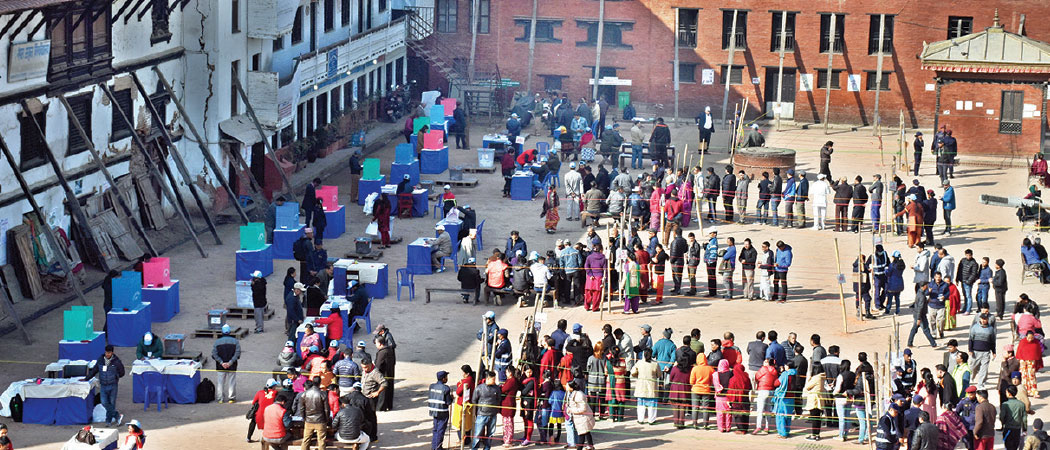
Kathmandu, Feb. 22: Nepalis have been exercising their voting rights for the last 75 years. The first general election was held in 1959 and since then Nepal has conducted nine parliamentary elections, including the two held for Rastriya Panchayat in 1981 and 1986 during the 30-year partyless Panchayat system.
Following the restoration of multiparty democracy in 1990, the country has held seven parliamentary elections and two Constituent Assembly elections. Now, Nepal is preparing for another parliamentary election on March 5, 2026.
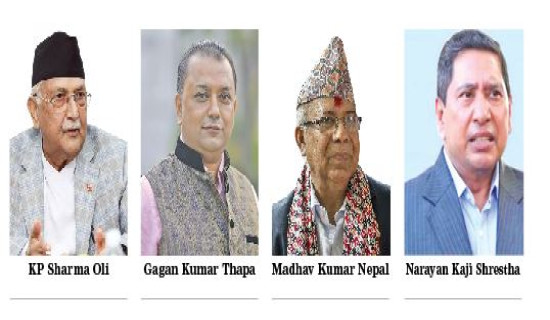
After the Gen Z movement led to fall of the elected government led by Prime Minister KP Sharma Oli, the interim government led by Prime Minister Sushila Karki dissolved the House of Representatives and announced fresh election.
Observers consider this election to be both a challenge and an opportunity in Nepal’s evolving democratic journey.
Looking back at past elections, Nepali voters have consistently exercised their sovereign power to shift mandates either to new political forces or between traditional parties, frequently holding incumbent leaders and ruling parties accountable for unmet promises and governance failures.
This recurring transfer of public trust toward new political parties and leaders reflects the growing political awareness and also determination to reward performance while rejecting ineffective leadership.
The first parliamentary election
The first parliamentary election in Nepal was held from February 18 to March 11 in 1959. The 109-member HoR was elected via direct electoral system. Nine parties fielded their candidates in 109 constituencies.
The Nepali Congress (NC), which played a decisive role in ending the 104-year Rana regime, won 74 seats in the House, with sweeping two-thirds majority. Candidates from six other parties and four independents were also elected. Following the polls, a government was formed under the leadership of NC president BP Koirala.
In that historic vote, Nepalis freely tested their democratic choice for the first time. Observers said NC emerged as a strong force as it had earned trust of the people and symbolised democratic hope and reform. However, their democratic aspirations were short-lived. Just one and a half years later, King Mahendra dissolved the elected government and introduced the partyless Panchayat system.
1991 general elections
It took 30 years for Nepal’s political parties to restore democracy. After the democracy was restored in 1990, the first general election was held on May 12, 1991 to elect 205 members to the HoR.
The majority of the seats of HoR were won by NC with 110 seats and CPN-UML won 69 seats. Total eight parties secured seats in the HoR. In that poll, the UML had emerged an alternative force, consolidating a significant share of popular votes.
Rajendra Prasad Upadhyay, 80, of Bhaktapur, who has been exercising his voting rights since then, said the strong left force emerged after the 1990 People’s Movement restored the multiparty system, with credit for political change shared among multiple forces.
But the government led by NC leader Girija Prasad Koirala dissolved the parliament in July 1994, announcing a mid-term poll. The poll was held in November 1994. Five parties won seats, and the CPN-UML emerged as the largest party securing 88 seats, followed by the NC with 83 seats. UML leader Manmohan Adhikari became Nepal’s first communist Prime Minister after 1994 snap polls.
Upadhyay said internal factionalism and leadership disputes had weakened the NC, harming governance and public trust.
In contrast, the UML built strong grassroots networks, positioning itself as a reform-oriented alternative that appealed to urban voters and youth eager to test a new political force, he added.
General elections 1999
Nepal’s 1999 general election was conducted in two phases on May 3 and 17, with 39 political parties contesting the polls. Representatives from six parties were elected to the House.
The NC again won majority with 111 seats, while the CPN-UML won 71 seats. The Rastriya Prajatantra Party (RPP) won 11 seats, Rastriya Janamorcha and the Nepal Sadhbhawana Party secured five seats each. Samyukta Janamorcha and the Nepal Workers and Peasants Party won one seat each.
First CA election
After a decade-long armed conflict led by the CPN (Maoist), which advanced agendas of social inclusion, proportional representation, gender equality, an end to caste-based discrimination, federal restructuring of the state, land reform and the establishment of a republican system, Nepal abolished the 240-year-old monarchy and moved towards the first Constituent Assembly (CA) election. The first CA election was held on April 10, 2008 to write and promulgate the constitution.
The CA had a total of 601 seats. The then UCPN (Maoist) emerged as the largest party, winning 226 seats and its leader, Pushpa Kamal Dahal, became the Prime Minister.
Following mergers with smaller parties, the Maoist tally increased to 240 seats (40%). The NC and UML secured 109 and 103 seats respectively. Originally, 19 parties were represented in the CA, which later expanded to 32 due to splits among minor parties.
Krishna Bahadur Tamang, 75, originally from Nuwakot and now residing in Dhumbarahi, Kathmandu, said that he and many others had trusted the Maoists and voted for the party with the hope of bringing meaningful social and political transformation to the country.
However, he added that despite high expectations, the party failed to fulfil people’s aspirations.
The CA was ultimately dissolved in 2012 after failing to fulfil its mandate of drafting a new constitution.
Second CA election
The second CA election took place on November 19, 2013. NC emerged as the largest party with 196 seats, while the UML and Maoist party came second and third after winning 179 and 80 seats respectively. The Maoist, which had emerged as the largest party in the first CA election, later lost 146 seats and were reduced to the third-largest party. Sushil Koirala of NC who became the Prime Minister with the support of the UML, succeeded in promulgating the constitution in 2015.
2017 general election
The first parliamentary poll under the 2015 Constitution was held in two phases on November 26 and December 3, 2017. Total 55 political parties took part in the elections of 275-member House. The UML emerged as the largest party securing 121 seats, while the NC came second with 63 seats. The Maoist party secured 52 seats. Altogether 10 parties reached the House.
Soon after the elections, the UML and Maoists merged to form the Nepal Communist Party (NCP), the largest communist force in Nepal’s political history with simple majority of 173 seats.
KP Oli then became the Prime Minister. Despite initial unity, internal disputes and leadership rivalries between UML and Maoist escalated. The Supreme Court later invalidated the merger and amid political turmoil and faction disputes, PM Oli dissolved the lower House twice (first in December 2020 and again in May 2021).
His move was widely criticized and considered politically motivated. In both times, the Supreme Court reinstated the parliament, terming the move as unconstitutional. NC president Sher Bahadur Deuba became the Prime Minister again for the fifth time.
Menuka Rana, 57, of Lazimpat, said the NCP-led government failed to meet public expectations despite holding a majority.
Frequent cabinet reshuffles and parliamentary dissolutions, along with unfulfilled promises on reforms, development, and social services, fueled public frustration and declining trust in traditional parties, she added.
Second general election
The second general election of HoR was held on November 20, 2022. This election resulted in a hung parliament, with no single party securing an outright majority, leading to coalition negotiation among major and minor parties. NC won 89 seats, CPN-UML 78 seats, CPN (Maoist Centre) 32 seats, Rastriya Swatantra Party, 20 seats, Rastriya Prajatantra Party 14 seats, Janata Samajwadi Party 12 seats, CPN (Unified Socialist) 10 seats, Janamat Party six seats and Loktantrik Samajwadi Party, Nepal four seats. During this election, the new political force, RSP led by Rabi Lamichhane emerged as the fourth largest party in the parliament.
In that election, parties such as the NC, UML and Maoist Centre formed electoral alliances largely based on political convenience. The practice of securing power through partnerships among major parties and dividing key positions among themselves had by then become well established.
Ninth parliamentary election
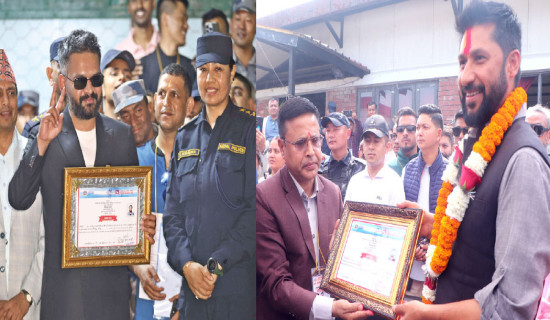
The 9th parliamentary election is slated for March 5. This year’s election is expected to be tougher, with growing public frustration toward traditional parties, particularly among younger voters influenced by the Gen Z movement. The emergence of alternative forces like the RSP boosted by Balen Shah’s candidacy, Ujyalo Nepal Party-led by Kul Man Ghising and Shram Sanskriti Party-led by former Dharan Mayor Harka Sampang, has made the contest even more competitive. Traditional political parties and their leaders are facing widespread criticism and public backlash over poor governance and corruption. Constituencies that were once considered safe strongholds for established party leaders have now turned into highly competitive battlegrounds.
Electoral mandate and accountability
Political science professor Krishna Pokharel said an electoral mandate fundamentally rests on performance.
“When a party wins an election and delivers on its promises, or at least moves meaningfully towards fulfilling them, voters are likely to endorse it again,” he said.
However, he noted that failure to honour electoral commitments pushes voters to seek alternatives. “In any democratic system, when one party fails to deliver, people begin to think another might. That is the basic reason mandates change from one election to another.”
Nepal’s repeated shift in public mandate
Referring to Nepal’s political history, Pokharel said the pattern is evident. “In 1991, the NC won a comfortable majority but internal disputes weakened its governance, leading to a mid-term poll in which the UML rose to power. The UML, too, later faced internal splits, and in 1999 the NC returned. Yet it also struggled with factionalism.”
According to him, voters have repeatedly alternated between major parties, testing new leadership when previous governments failed to meet expectations.
After the Maoist insurgency, the Maoists emerged as the largest force in the first CA election. However, due to the mixed electoral system, they did not secure an outright majority.
Later, the Nepali Congress became the largest party and the constitution was promulgated. Subsequently, the UML and Maoists merged, forming a dominant force close to a two-thirds majority.
“Had they properly utilised that mandate and preserved unity, the political trajectory might have been different,” Pokharel said. “Instead, internal divisions resurfaced, leading to another split.”
Pokharel described the coalition between the two largest parties NC and UML in Oli-led government as politically unusual.
“In most democracies, either the largest party forms a coalition with smaller parties or the second-largest does so. Here, the two largest parties joined hands.”
He added that although a seven-point agreement, including constitutional amendment, was announced, it later appeared to be politically motivated, particularly in relation to the Bhutanese refugee scandal.
Restrictions on social protest movements, especially those linked to the Gen Z revolt, further fuelled public dissatisfaction, ultimately creating the present extraordinary electoral situation.
Rise of alternative forces
According to Pokharel, the current electorate is visibly disillusioned with established parties. “Many voters are again thinking that if traditional forces failed, perhaps a new one might succeed.”
However, Pokharel cautioned that even if a new party secures dominance in the lower house, the absence of representation in the upper house would create structural challenges.
“What is required now is collective wisdom, a shared responsibility among political leaders to preserve the integrity and viability of the democratic system,” he said.
If parties demonstrate such maturity and move forward on a common national agenda, he noted, the post-election political course could remain stable. Otherwise, Nepal risks entering yet another phase of uncertainty and public disillusionment.
-original-thumb.jpg)