- Wednesday, 6 May 2026

Young, excited voters likely to drive up turnout this time
.jpg)

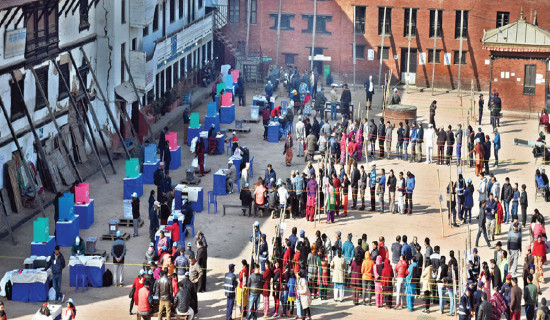
Kathmandu, march 1: Sangita Acharya, 23, of Kushadevi, Panauti is set to vote for the first time and says she is excited to take part in the March 5 poll.
Currently working in Kathmandu, Acharya has decided to cast her ballot this time. Though her name had been on the voter list prior to the 2022 general election, she did not participate at the time, citing work commitments and lack of motivation to participate.
“But this time the situation is different. The election fever has gripped everyone, even those who used to dislike politics. Like me and my young sister, many of my friends, some of whom were aboard, are also keen to cast their ballots following the youth led Gen Z movement,” she shared.
Sharing her excitement, 20-year-old Sujata Acharya, Sangita’s sister, said many young people across the country are eager to vote. “I have seen that Nepalis working abroad are returning to Nepal to cast their votes and they have been sharing this on social media platforms.”
“If people living abroad can spend so much just to cast one vote, then why should I miss the chance to exercise my right to elect those who shape the country’s future?” said Sujata.
Like Sujata noted, many TikTok, Facebook users, as well as Vloggers, among others are sharing their photos and videos of their journeys back to country to vote, often spending thousands of rupees just to participate.
The topic of conversation has also shifted among the younger generation. The young people who previously spent their time discussing non-political topics, are now talking about politics, candidates, their commitments and their manifestoes. Unlike previous elections, older and middle-aged people are also actively engaged with election candidates, questioning their commitments and agendas.
Observers say there is growing interest among the voters, particularly among younger generation, about their democratic rights to cast the votes. They are projecting that the voters’ turnout in this election will rise compared to the previous elections.
Voter turnout in Nepal varied across different elections. In the first parliamentary election held in 1959, it was 42.18 per cent, 65.15 per cent in the 1991 general election, 61.70 per cent in the first Constituent Assembly (CA) election in 2008, and 78.34 per cent in the second CA election in 2013. The highest voter turnout was recorded in the 2013 CA election.
EC expects higher voter turnout
The Election Commission (EC) has projected an increase in voter turnout for this election compared to previous polls.
EC’s Joint-Secretary and Spokesperson Narayan Prasad Bhattarai said voter turnout is expected to be higher this time, while the number of invalid votes is expected to decrease.
He added that the Commission has made all necessary preparations to welcome every voter, including ballot papers, election materials and deployment of staffs.
“We have printed extra ballot papers, around seven per cent more than the expected number of voters. To encourage participation, volunteers have also been deployed at the ward level for voter’s education. They are guiding people on how to cast votes correctly and without errors,” he said.
The Commission is also using its official social media account to promote voter participation and has established a digital voter education unit to carry out this work.
“Even if turnout is slightly higher than usual, we are fully prepared for 100 per cent participation,” he said adding, “That is why we are ready to welcome all voters.”
Acting Chief Election Commissioner Ram Prasad Bhandari highlighted several factors contributing to an expected increase in voter’s turnout for this election.
He said on the eve of the election, the number of young voters has increased by tens of thousands. “Enthusiastic volunteers have been going door to door, across neighborhoods, providing voters education and encouraging people to go out and cast their votes."
He further stated that the election is being held under unique circumstances, prompting the Commission to expect active participation from all voters.
“For these reasons, we predict that the number of voters will rise,” he said. “As turnout increases, the number of invalid votes is likely to decrease. We hope to achieve close to 100 per cent participation.”
Political analyst Puranjan Acharya commented on increased political interest of new generation ahead of the election.
“Previously, younger generations showed little interest in politics, but now they are increasingly engaged and motivated,” Acharya said.
Acharya, who recently visited Jhapa, Morang and Sunsari, said the enthusiasm and participation of young voters is very high. “So, there is no doubt that youth voter turnout will increase.”
He added that while voter participation among older age group will also rise, it is the younger and senior citizens who are likely to drive the biggest change. “However, middle-aged voters have been tied to party structures for a long time, so they tend to be less flexible and predictable. Their participation will not make a significant difference compared to the younger generation and senior citizens,”
he said
Acharya said senior citizens are often influenced by the children and grandchildren, while younger voters are driving change with a positive and energetic mindset. “Even though only a few days remain until the election, the older parties may try to magnify support, and overall voter turnout is expected to rise significantly,” he added.
A total of 18,903,689 citizens are eligible to cast vote in the upcoming March 5 poll. The updated tally shows an increase of 915,119 voters compared to the 2022 election. After the Gen Z movement, additional 837,000 new voters were registered in voters’ roll. This is a significant indicator of the country’s changed political dynamics.
-square-thumb.jpg)


-original-thumb.jpg)
-original-thumb.jpg)