- Tuesday, 2 June 2026

Consensus Key To Peace, Development

In an uncivilised culture, decision-makers may attempt to settle an issue autocratically, but in a civilised state, we expect a shared understanding among political parties, concerned authorities, and stakeholders on issues with potential repercussions. In this sense, national consensus is a matter of grave importance. Such an important matter, though it is considered, we cannot say exactly what the national consensus is. We often talk about national consensus without properly understanding what it means.
National consensus cannot be defined in an absolute sense. Nothing is absolute because everything is subject to change, and even change is not absolute. Any issue can be debated from multiple perspectives. An obvious example can be cited from modern American history. We often say Columbus discovered America. But this statement is made by European migrants. On the contrary, Native Americans argue that Columbus encroached upon America. We cannot easily say for sure whether America was discovered or was encroached upon. It depends on our angle of vision. Perspectives thus matter a great deal when looking at something. In this sense, national consensus is often a relative concept that we assume we agree upon.
Shared attitudes
The next reason for the impossibility of absolute consensus is the heterogeneity of ideas. When there are different voices, a unanimous decision is unlikely. There might be discordant voices among the opposing groups in a heterogeneous society. There might as well be some people who are non-conformist by nature and express different opinions and behave differently. In this sense also, national consensus remains an unsettled debate. Therefore, things done amid the debates and controversies may yield undesirable consequences. In the absence of a common understanding and shared attitudes among the concerned people, we say there is no national consensus.
But it is essential that there be a national consensus, albeit relative, for the country's peace and development. How, then, can we build national consensus? Is it something that the opposing forces unconditionally agree upon policies and plans forwarded by the ruling party, or does the leader of the ruling party have to work rigorously to build consensus? Ours is a country that has been demanding national consensus on areas such as political ideology, international relations, and national development, yet no consensus has ever been reached.
Despite some efforts, our country has not reached a consensus on the political ideology that guides its politics and governance. Ten years after the democracy was established in 1951, it was forcibly confiscated by King Mahendra, which caused serious political conflict for three decades. Soon after democracy was restored in 1990, political turmoil resumed, culminating in the establishment of the republican system of governance and the country's federal restructuring. Even after that, political forces are disputing over the political ideology in Nepal. Some communist political forces are still talking about scientific socialism, albeit to a fainter degree.
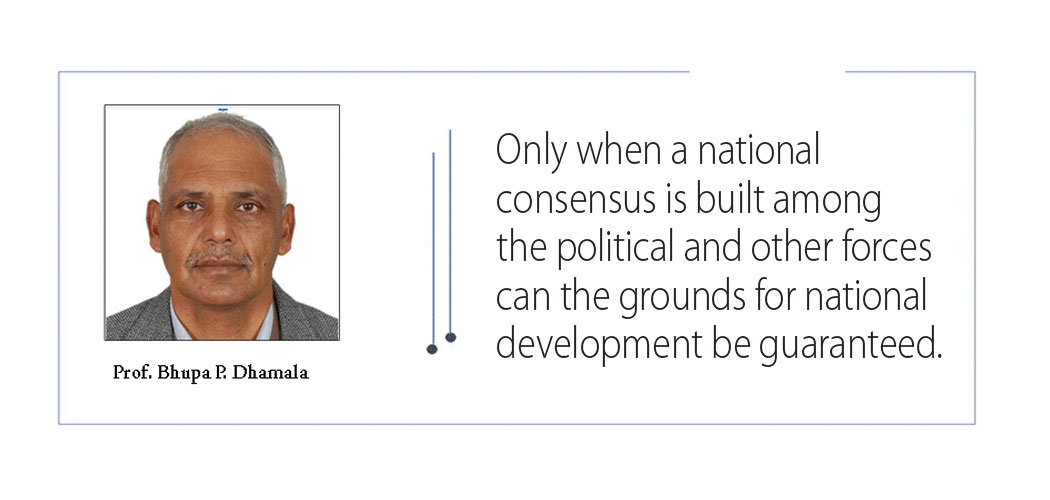
Another issue is the foreign policy of neutrality toward the warring countries and non-alignment in other countries’ internal affairs, while maintaining balanced diplomacy in international affairs. Despite official declarations, political groups respond differently based on their contextual interests. Moreover, there are hushed-up accusations that no party can form and sustain the government without getting support from a particular international power. Let this not happen at all if that is true. National consensus in foreign relations is essential, irrespective of whether one party wins or another. Only when a national consensus is built among the political and other forces can the grounds for national development be guaranteed.
The next issue is the system of governance. Almost all parties that formed governments in the past allowed various employee organisations representing different political ideologies, even particular political parties, to operate under the guise of trade unions. Employees from different sectors claim the right to organise and form trade unions, as guaranteed by the Constitution. Those sectors range from industry to academia to the civil service, let alone students’ organisations, which claim they have every right to be organised into unions because they are not appointed as employees and do not receive payment from the government or non-government agencies.
During the autocracies of the Rana and Shah regimes, student organisations were organised around political ideologies. To the democratic fighters, it was beneficial because the political parties were banned. Revolutionary political activities were manifest through those student organisations. But even after the restoration of democracy, the students’ organisations and employees’ associations continued to operate their unions on a political basis without modifying their roles. Although voices against this issue were sporadically raised by some political forces, they were differently reinterpreted when they were in power. Policies and attitudes towards organiations were intermittently raised without a clear vision. This was an example of the double standard regarding the employees’ organisations and students’ unions.
Pyramidal structure
Many state activities were affected by such ad hoc policies and practices. In many cases, the employees were loyal to the political parties they represented and were more active in political activities than in assigned tasks. In some cases, the order of the pyramidal structure was also disrupted because a lower-ranking employee was reluctant to follow the senior officer's command, as the senior officer belonged to the minor political party while the junior employee belonged to the major political force, even the ruling party. Not only were that, but the wrongdoers in official actions also exempt from punishment. As a consequence, impunity reigned, pushing the system of reward and punishment to the background.
An unfailing policy to correct this situation was essential through national consensus, but to no avail. Recently, the incumbent Prime Minister has introduced a policy on this issue, but again without a national consensus. While employees are disgruntled about the ban on their organisations, students are agitated to launch their protests against the government's move. Angry reactions are emerging, which may lead to disasters if the issue is not carefully resolved. The government's rhetoric may become a mere fallacy if no national consensus is built on this debatable issue. A national consensus can be built at both open and tacit levels. If the major political forces are unwilling to openly accept others' views, policies, and actions, they can at least develop a tacit understanding on the common issues they also have to settle in their turns.
(The author is the chairman of Molung Foundation. bhupadhamala@gmail.com)