- Monday, 25 May 2026

Former prime ministers facing tough contenders
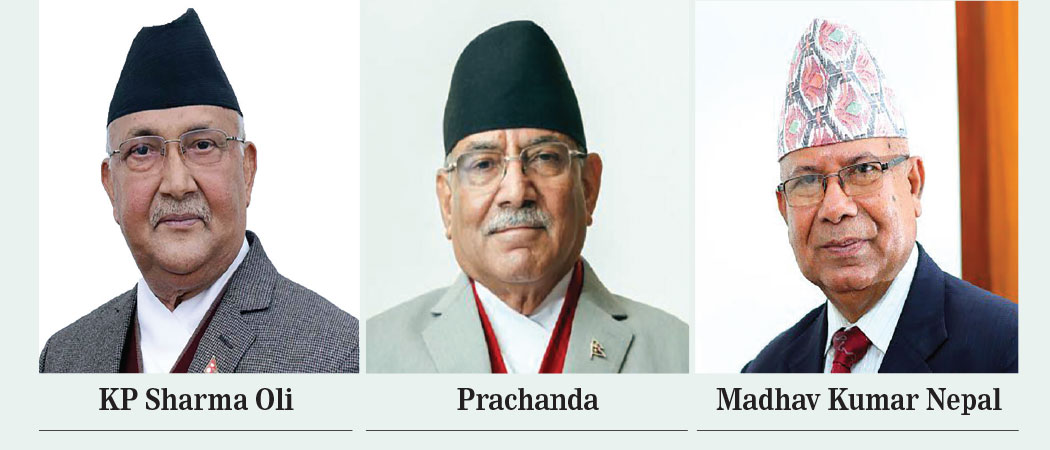
Kathmandu, Feb. 6; Three former Prime Ministers are in the race for the upcoming House of Representatives elections scheduled for March 5.
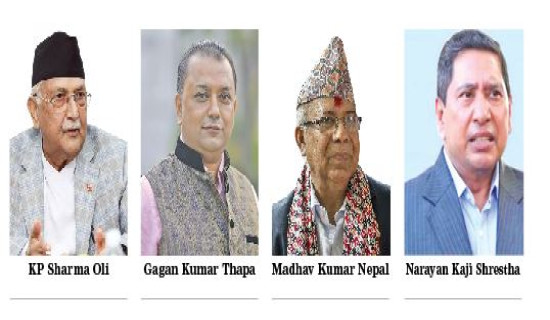
CPN-UML Chairman and former Prime Minister KP Sharma Oli, Nepali Communist Party (NCP) Coordinator and former Prime Minister Pushpa Kamal Dahal ‘Prachanda’, and NCP Co-Coordinator and former Prime Minister Madhav Kumar Nepal are contesting the elections. Oli is running from Jhapa-5, Prachanda from Rukum East, and Madhav Nepal from Rautahat-1.
Former Prime Minister and Pragatisheel Loktantrik Party leader Dr. Baburam Bhattarai had initially filed his candidacy from Gorkha-2, he withdrew it later. Two other former Prime Ministers, Sher Bahadur Deuba and Jhalanath Khanal, are not contesting. Deuba, who won seven elections from 1990 to 2002, was denied an election ticket, while Khanal has chosen not to stand in the polls.
Nation's attention in Jhapa-5
Oli is contesting the elections from his traditional Jhapa-5, and former Kathmandu mayor and Rastriya Swatantra Party (RSP) leader Balendra Shah ‘Balen’ has challenged him, making it one of the most closely watched constituencies.
The race, widely framed as “Oli versus Balen,” is seen as more than a local contest, with many viewing it as a test of the country’s future political direction.
Oli is campaigning on his extensive political experience, party organization, and development record, while Balen is positioning himself as a symbol of change, youth aspiration, and anti-establishment politics, relying heavily on direct public engagement and social media outreach.
While the Oli–Balen rivalry dominates national attention, the constituency has 24 candidates in total. The Nepali Congress has fielded Mandhara Paudel, while the Nepal Communist Party (NCP) has nominated youth leader Ranjit Tamang. The Rastriya Prajatantra Party and other smaller parties are also in the fray, but they are largely overshadowed by the two frontrunners.
Both Oli and Balen have been forwarded as the prime ministerial candidates of their respective parties. Oli is contesting Jhapa-5 for the eighth time, losing only the 2008 Constituent Assembly election. Following the Gen-Z protests on September 8–9, Oli has faced wide criticism and public backlash over the handling of the movement and the deaths of young protesters, making what was once considered his safest constituency far more competitive.
With 163,379 registered voters, including about 10,000 new ones, the outcome in Jhapa-5 is expected to have political significance well beyond eastern Nepal.
Prachanda in Rukum East
NCP Coordinator and former Prime Minister Prachanda is contesting election from Rukum East, marking another shift in his electoral constituencies.
In 2022, he was elected from Gorkha as chairman of CPN (Maoist Centre). Since entering politics in 2008, Prachanda has contested and won elections from multiple constituencies, including Rolpa, Kathmandu, Siraha, Chitwan, and Gorkha.
Defending his move, he stated that as a national leader he represents the entire country and dismissed allegations of political opportunism.
According to the Election Commission, 11 candidates are in the fray in Rukum East, including Kusumdevi Thapa Magar (Nepali Congress), Leelamani Gautam (CPN-UML), and Lakhan Kumar Thapa (Rastriya Swatantra Party). While some locals view Prachanda’s candidacy as an opportunity for faster development, rivals argue that the district needs local representation.
Rukum has long been a Maoist stronghold, and its political culture remains shaped by the Maoist era, including its organisation, ideology, history, and legacy of struggle, factors that favour Prachanda.
In the 2022 election, Purna Bahadur Gharti of the then CPN (Maoist Centre), backed by the Nepali Congress alliance, defeated UML’s Kailash Kumar Malla, securing 12,262 votes to Malla’s 5,211.
Nepal faces tough rival in Rautahat-1
NCP co-coordinator and former Prime Minister Nepal is contesting the election from Rautahat-1, the same constituency he won in 2022.
His main rivals include Ajay Kumar Gupta of CPN-UML, Anil Kumar Jha of Nepali Congress, and Rajesh Chaudhary of RSP. The constituency has a history of supporting candidates from multiple parties, making the race highly competitive.
In 2022, Nepal had won with 33,522 votes, defeating Gupta, who received 26,922 votes, benefiting from a five-party alliance including the Nepali Congress.
Gupta, a two-term former mayor of Gaur Municipality, had narrowly lost the 2013 election under the Madhesi Janadhikar Forum.
Jha, who had won Rautahat-1 in 2017 representing the Rastriya Janata Party, joined the Nepali Congress just before filing his nomination.
RSP candidate Rajesh Chaudhary, a former Nepali Congress leader, is seen as a strong contender in the constituency, following a rise of RSP.
However, the RSP had performed poorly here in the 2022 election, when its candidate Suryadev Koirala secured only 163 votes.
Nepal’s political journey has seen both wins and losses; he won Rautahat-1 in 1999 but lost Rautahat-6 and Kathmandu-2 in the 2008 Constituent Assembly election. With four major candidates in the fray this time from the Rautahat-1, the contest is expected to be closely fought.
This year’s election is expected to be tougher for all former PMs, with growing public frustration toward traditional parties, particularly among younger voters influenced by the Gen Z movement. The emergence of alternative forces like the RSP boosted by Balen Shah’s candidacy, Ujyalo Nepal Party-led by Kul Man Ghising and Shram Sanskriti Party-led by former Dharan Mayor Harka Sampang, has made the contest even more competitive.
-square-thumb.jpg)