- Tuesday, 9 June 2026

Women lead in census, lag in voter list


Kathmandu, Jan. 30: Women outnumber men in every national census, but male voters are higher than female voters in each election.
This demographic deviation is intriguing, and no one has an accurate reason for this phenomenon.
According to the national census 2021, the female population stands at 14,911,027 (51.13%) and the male at 14,253,551 (48.87%).
As per the census, Nepal has 657,476 (2.26 %) more women than men. But the latest voter list made public by the Election Commission shows otherwise.
The number of women voters is less by 423,227. Women voters account for 48.88 per cent of the total 18,903,689 eligible voters in the March 5 House of Representatives election, while men make up 51.12 per cent of the electorate.
Nepal has total 18,903,689 voters eligible to vote in the March 5 elections to the House of Representatives. The number of male voters has reached 9,663,358, while women 9,240,131 and 200 are listed under the ‘other’ category. Women voters are about 4.38 per cent fewer than male voters.
While women make up a higher proportion of Nepal’s population, the ratio is reversed in the voter list, with men outnumbering women among registered voters.
Trends of 2013, 2017, and 2022 elections
The gender gap in voter registration is not new in Nepal. In the second Constituent Assembly election of 2013, out of 12,147,865 registered voters, 5,980,881 were male, and 6,166,829 were female.
The percentage of female voters in 2013 (50.77%) closely reflected their share in the population (51.44%), according to the 2011 National Census.
However, in the 2026 elections, the share of female voters has dropped to 48.88 per cent, even though women constitute 51.13 per cent of the total population, indicating a widening gap between the female population and voter registration over the years.
In the 2017 general election, the total number of registered voters increased to 15,427,938, including 7,776,628 men (50.41%), 7,651,143 women (49.55%), and 167 others.
The 2022 general election further expanded the electorate to 17,988,570, of whom 9,140,806 were male (50.81%), and 8,847,579 were female (49.17%), with men outnumbering women by 293,227.
Since then, the voter number has increased by 915,119, with 522,552 more male voters, 392,552 additional female voters, and 15 others, bringing the 2026 electorate to 18,903,689.
Province-wise voter distribution
Looking at the number of voters and female representation, Koshi Province has a total of 3,574,310 voters, including 1,828,213 males, 1,746,073 females, and 24 others.
Madhes Province has 3,636,414 voters, with 1,972,964 males, 1,663,374 females, and 76 others.
Bagmati Province has 3,682,310 voters, comprising 1,852,378 males, 1,829,905 females, and 27 others.
Gandaki Province has 1,870,065 voters, including 914,535 males, 955,516 females, and 14 others.
Likewise, Lumbini Province has 3,386,680 voters, with 1,715,163 male, 1,671,479 female, and 38 others.
Karnali Province has 1,037,250 voters, comprising 527,886 males, 509,361 females, and three others, whereas Sudurpaschim Province has 1,716,660 voters, including 852,219 males, 864,423 females, and 18 others.
Provinces with highest and lowest female voter share
Among the provinces, Gandaki has the highest proportion of female voters at 51.12 per cent, followed closely by Sudurpaschim with 50.34 per cent women. Koshi (48.8%), Bagmati (49.67%), Lumbini (49.37%), and Karnali (49.13%) have nearly similar male-female voter ratios.
In contrast, Madhes has the lowest share of female voters at 45.73 per cent, indicating the largest gender gap in voter registration.
Factors contributing to low female voter registration
Talking about this gender gap in the voters’ list of women and men, Acting Chief Election Commissioner Ram Prasad Bhandari said that the commission cannot explain the reason for the deviation. “We cannot point out the exact cause of this gap,” he noted. The commission has taken the matter into consideration and has forwarded a study to identify the reasons. Once the study is complete, the Commission plans to provide clarification on the issue.
Although no formal research has been conducted on voter numbers, women activists attribute the persistent gap between the female population and registered female voters to insufficient voter education and limited access to information and technology.
Rita Sah, a women activist and a member of Intergenerational Feminist Forum, pointed out several factors that contribute to this.
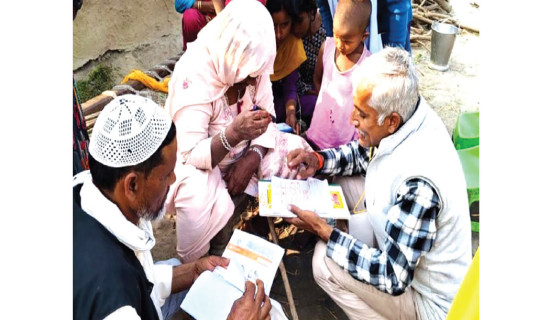
“Literacy and familiarity with the online registration system remained major challenges for women and marginalised groups. Many women, especially in Madhes, are illiterate or have limited ability to navigate digital platforms and often require assistance to register. Even when information about voter registration is available,
access is not always guaranteed, and some women are unaware of deadlines, procedures or registration locations, she added.
“Voter education also plays a key role. Many women do not fully understand the importance of voting, the process, or the purpose of elections. Political disillusionment further discourages participation, as some choose not to register due to dissatisfaction with political parties,” said Sah.
“Another critical factor is citizenship documentation. Particularly among Dalit communities in Madhes, many women lack citizenship certificates, which prevents them from appearing on the voter list,” she claimed.
She also attributed communication barriers as a key factor limiting women’s participation, particularly among Madhesis.
“Limited access to mobile phones and digital technologies further restricts their ability to receive information,” she said, adding, “Other contributing factors include foreign employment migration, with many women and youth working abroad, often illegally, particularly in neighbouring countries, preventing them from registering or participating in elections.”
-square-thumb.jpg)