- Saturday, 2 May 2026

'Prolonged Gulf conflict may have chilling effect on economy'
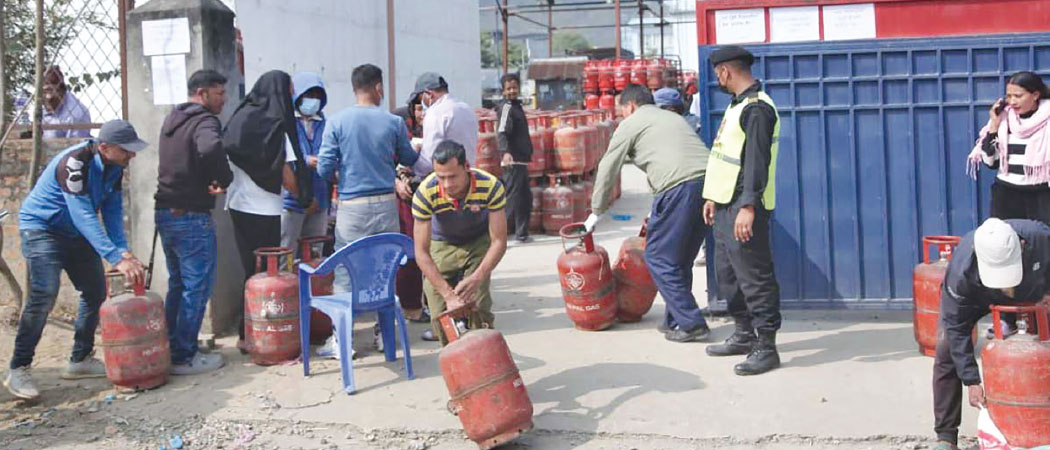
Photo: TRN Consumers collect gas cylinders as fears of shortage spread following the US and Israeli attack on Iran.

Kathmandu, Mar. 14: Experts have warned that the escalating conflict in the Gulf region could have multifaceted impacts on Nepal’s economy, ranging from fuel supply disruptions and labour issues to rising inflation and a slowdown in economic activity.
Speaking at a programme on 'Middle East problems and their impact on the Nepali economy' organised by the Society of Economic Journalists Nepal (SEJON) on Friday, they said that the conflict in the Gulf region would have both direct and indirect consequences for Nepal’s economy.
Economist Dr. Gunakar Bhatta said that multiplier effect will be seen in Nepal's national economy if the conflict in the Gulf region continues for a long time.
“When tensions rise in the Gulf region, the first thing affected is the supply of petroleum products and liquefied petroleum gas in the international market,” he said. “Its direct impact is on countries dependent on energy imports, and Nepal is not immune to it.”
Former executive director of Nepal Rastra Bank Dr. Bhatta said that rise in fuel prices in the international market will be reflected in the prices of petroleum products, transportation costs, and daily consumer goods in Nepal.
“When oil and gas prices rise, transportation costs increase, which then affects the prices of everything from food to construction materials,” he said. “This risks increasing the overall inflation rate and may also cause a contraction in economic activity.”
Citing an International Monetary Fund study, he said, "A 10 per cent increase in the price of crude oil per barrel increases inflation by 0.4 percentage points and reduces economic growth by 0.15 percentage points."
According to him, if the conflict continues for a long time, economic risks will increase worldwide, including Nepal.
He added that the construction sector will also be affected, which could slow down economic activities and hinder economic growth.
He said that the price hike will hit the lowest-income groups the hardest, and that it will further increase poverty and income inequality.
According to him, the negative impact of the war will also be felt in the transportation, wholesale and retail trade, tourism, and import-export sectors, which contribute significantly to the country's economy.
Stating that the half of the total chemical fertilisers imported into Nepal come from Middle Eastern countries, he said that agricultural production is certain to decline as soon as there is an interruption in the supply of fertilisers. Dr. Bhatta said that increasing uncertainty in the global market will also affect the trade and investment environment.
“The Gulf region is a major centre of global energy supply,” he said. “Conflict there brings instability to the international market, the impact of which is ultimately seen in small economies like Nepal.”
On the other hand, he said that the conflict could also affect foreign employment and remittances.
“Millions of Nepalis are working in the Gulf region,” he said. “If the conflict continues for a long time, both employment and remittances may be affected.”
“If the conflict is resolved soon, there is a possibility that reconstruction and economic activities will increase there,” he said. “In such a situation, employment opportunities for Nepali workers may even rise.”
Dr. Bhatta said that the government should now focus on reducing the consumption of imported fuel, making its distribution systematic, and increasing the use of electricity for cooking as well.
Stating that the Nepal Oil Corporation has adopted the concept of half-filled gas cylinders from today, he said that consumers should cooperate with such initiatives.
However, he said that the government should increase fuel storage capacity, reduce dependence on imported food, and increase reserves, keeping in mind that such problems may recur in the future.”
On the occasion, Labour migration researcher Rameshwar Nepal said that the government should immediately rescue Nepali workers currently in various Middle Eastern countries.
He said that many Nepalis want to return home and that the government should not delay rescuing those who wish to come back because the conflict is ongoing.
He said that so far around 70,000 Nepalis have already registered their names on the government portal, saying they feel unsafe.
He added that the number could be even higher because many Nepalis working illegally are not included in government records.
According to him, many people who went abroad for work illegally are hesitant to register their names on the portal due to fear of legal complications.
He commented that although the government’s efforts are positive, the rescue operation has not been carried out effectively.
He said that pregnant women, undocumented Nepalis, and those living in high-risk areas should be rescued immediately based on priority.
He also noted that migrants often suffer the most during conflicts, as countries usually focus on protecting their own citizens while paying little attention to the safety of foreign nationals.
He said, “People are extremely panicked. The number may not be very large, but many are demanding rescue. Around 70,000 have already been listed, and if we include those staying illegally, the number could be much higher.”
He added that the government has failed to provide clear and sufficient security-related information to people.
According to him, the government is only advising people to “stay safe,” but not explaining how to stay safe or what the actual situation is.
He stressed that Nepalis there should be given real-time updates about the situation two to three times a day.
-original-thumb.jpg)
-square-thumb.jpg)
-original-thumb.jpg)
-square-thumb.jpg)