- Thursday, 4 June 2026

Book Review: AI adoption essential to transform journalism

By Narayan Prasad Ghimire, Kathmandu, March 3: Artificial intelligence (AI) is holding sway in most of the sectors at present. It is growing so pervasive and invasive that we cannot ignore but are forced to get adapted to it.
Irrespective of the location of its developers and controllers, the AI products are global consumption, for we are already in a digital and hyper-connected world. It is natural that those resourceful reap better benefits, while those behind the race chase it.
Whether it is health or education, or the journalist or tutor, how AI is risking traditional skills and jobs or facilitating the professionals for further convenience and product optimization is a pressing issue. AI levers the strength, eases work load and amplifies dissemination. It is in a deed a boon for the journalists to hone reporting skills, produce news contents, and augment visibility of stories. However, outsourcing AI for final products and giving it sole responsibility is devastating. It is not human, but an essential tool to reinforce human performance by whetting skills. AI therefore complements to boost journalism and empower journalist.
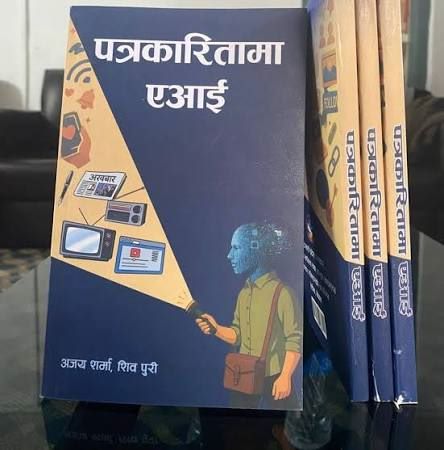
As AI is impacting journalism across the globe and Nepali journalism is no exception, knowing about the facts and experience of Nepali journalists and how news rooms and related academia are utilizing this technology counts much to evaluate the stage of Nepali journalism in the face of AI wave. In this connection, the book under review, "Patrakaritama AI (AI in Journalism)" counts much. The book is co-authored by Ajay Sharma and Shiva Puri.
The book, though brief, dwells on the national and international contexts of AI, giving a journalistic lens. It has adequate glimpse on Nepali journalism and Nepali newsrooms on how they are adopting AI. It has finely brought numerous international references- research and survey results on AI adoption, expert views and recommendation, countries' AI policy and preparation, media houses and news agency's use of AI for reporting, news production and news dissemination.
The book is divided into eight chapters. The first chapter has a brief mention on AI's introduction, principles, types of AI and evolution of AI, while the second chapter centres on AI in journalism, why AI is needed in journalism, and challenges of AI adoption in journalism. The third chapter talks about AI in newsrooms.
Similarly, the fourth chapter relates to laws, policies and strategies on AI in various countries, while the fifth chapter is on Nepal's experience- AI in Nepali newsroom. Crime, cyber security and AI are the topics in chapter six. The technical terminologies like machine learning, algorithm, agentic AI and digital foot prints feature the seventh chapter and useful tips of journalists in the last, eighth chapter.
Chapter two is exploratory section to inform on the AI incursion in journalism. The needs, benefits and challenges of AI in journalism are explained vividly in this chapter. In the point why AI is required or useful in journalism, the writers argue it allows journalists efficiency in works. Automation is equally significant, which helps in preparing news on financial reports, sports event summarization and designing breaking news.
AI's use helps journalist prepare such news quickly and easily. Similarly, information collection and analyses is made further convenient for news rooms with the help of AI. Finding the trending news and contents from social networks, website, YouTube and Podcast are beneficial for journalists to prepare and serve news to public.
Customized content and audience mapping, human-machine collaboration, investigation and data journalism, cost and resource management, fact checking and curb on false information, translation and storytelling etc are mentioned as salient features of AI which the journalism can be benefitted.
The writers repeatedly caution the downsides of letting the AI alone to act on the above tasks, which they argue, would not provide ultimate truth, facts and credibility all times which are essentials of journalism. So, giving human touch to AI-assisted product is reminded time and again by them.
The adoption of AI by the various international media such as Forbes, The Wall Street Journal, New York Times, Los Angeles Times, The Guardian, BBC and news agencies like Xinhua, Reuters, The AP and AFP. These media have long adopted AI not simply as technological tool but for sustainable development and competition.
The writers have taken interviews and done mini surveys with Nepali editors and journalists to know on their concept and use of AI. Most of them have said AI would not replace journalists' works, but help transform their profession. They stressed the urgency of learning more about AI to reap full benefits. Some media have begun applying AI for summarizing news stories, and getting required data from humungous report/statistics.
Some journalists have expressed worry over source (how true, credible) of AI generated contents and even on the loss of human creativity. Acting Chief Editor at The Rising Nepal, Bishnu Gautam, said his media adopts AI tool to ascertain whether the opinion piece submitted to the daily is original or written with AI. Similarly, Pavan Acharya, Chief Editor at Radio Kantipur, shared with the authors, "The use of AI in newsroom is posing a risk of misinformation in future."The constraints of AI adoption in journalism are also described by the authors.
The writers have brought a very useful book to build knowledge on AI in journalism. It is a good resource for teachers and students and even those who are interested in AI. The book encourages journalists to adopt and use AI as a tool not as a writer. Truth, balance and credibility in news must not be compromised by this modern technological convenience, AI, the book underscores. It is published by Office of Media Registrar in Bagmati Province Government.(RSS)
-square-thumb.jpg)