- Monday, 25 May 2026

EC is all set to hold polls at one go

Photo: Manoj Ratna Shahi/Keshab Gurung

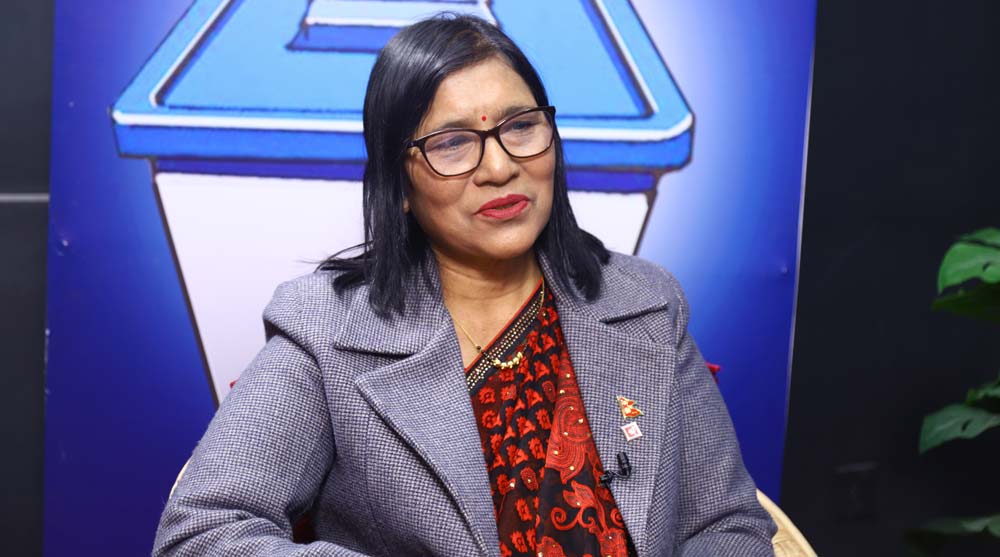
The election of members of the House of Representatives is fast approaching. Political parties and candidates have already begun their campaigns. Concerns have been raised about voter influence, breaches of the election code of conduct, and the spread of misinformation and disinformation, which are expected to intensify in coming days. On these issue and the commission's preparedness to conduct the election in a peaceful manner, Election Commissioner Janaki Kumari Tuladhar spoke with Manjima Dhakal of The Rising Nepal and a Gorkhapatra team. Excerpts:
In the context of the House of Representatives election scheduled for March 5, what major tasks has the Commission completed so far?
All activities related to election management are carried out by dividing them into different phases and implementing them according to a prepared timetable. The Election Commission remains in a constant state of preparedness even after completing elections, as elections may need to be conducted at any time depending on circumstances.
This time, the election of members of the House of Representatives is going to be held in a changed context. For the election, only a few managerial tasks remain. The printing of ballot papers for the proportional representation system has been completed, and printing for the direct election is in its final stage. Necessary managerial work for the procurement and transportation of polling materials has been completed. In reality, the election process has already reached voters’ doorsteps.
Polling locations and polling centres have been updated, and a total of 10,967 polling stations and 23,112 polling centres have been designated nationwide. The voter registration and update process has been completed, and the final voter list of 18,903,689 voters has been published on the Commission’s website and printed copies have been sent to the respective election offices.
Final lists of candidates under both the first-past-the-post and proportional representation systems have been published. Under the proportional representation system, a final closed list of 3,135 candidates has been published, while under the direct election lot, candidacy has been registered in all 165 constituencies, with a total of 3,408 candidates nationwide.
Similarly, 77 Chief Election Officers and 88 Election Officers have been appointed and orientation has been provided. Necessary budget arrangements have been made for the operation of election officers’ offices.
The Election Code of Conduct, 2082, has been enforced, and required laws, procedures, and guidelines have been formulated. Permission has been granted to four international and 37 national organizations for election observation.
The Commission has established a call centre, Joint Election Operations Centre, Election Information Communication and Coordination Centre, Information Integrity Promotion Unit, Voter Education Unit, and Media Centre. Most activities outlined in the election timetable have already been implemented.
As election activities have reached all 165 constituencies, what major challenges might arise?
Once election officers’ offices are established and candidacy registration is completed in all constituencies, decentralisation of election activities is natural. During this process, challenges may arise in security management, resource management, voter education and information dissemination, enforcement of the code of conduct, coordination, and facilitation.
However, based on experiences from previous elections, the Commission has already made arrangements for timely resource management, ensuring compliance with the code of conduct, and coordination and facilitation. For remote districts and constituencies, ballot papers and election materials are printed and transported earlier than in city areas.

Monitoring officers have been appointed in every district, and through the Joint Election Operations Centre, monitoring of the code of conduct, information collection, and immediate decision-making have been arranged.
As political parties and candidates engage in campaign activities, conflicts, disputes, or false allegations among them must not occur. Ensuring full implementation of the Commission-issued code of conduct remains a challenge. Correct information must be delivered to voters.
What are the strengths and challenges of this election compared to previous ones?
Experiences of past elections are highly useful for this election. Since the laws, technology, and organisational structure applied during the 2079 elections largely remain same, there are many similarities in election management.
However, some important improvements have been made. The voter registration system has been linked with the National Identity Card system, making voter registration easier. Election-related directives and procedures have been revised or newly formulated as needed, which is a strong point.
Considering the risk of misinformation, disinformation, and hate speech spreading through social media in this election, an Election Information Communication and Coordination Centre has been established. Since this is not a regular periodic election, there was pressure in terms of time and circumstances, but the Commission has completed the necessary preparations.
With rapid technological development, digital threats to elections are increasing. Based on good practices learned from previous elections, the Commission is striving to implement even better practices in this election. Misinformation, disinformation, and hate speech spread through social media remain key challenges.
How has the voter education programme been implemented in this election?
Voter education refers to education conducted by the Election Commission and other organisations with its approval to prepare voters to vote correctly.
Voter education teaches voters the correct voting method and informs them about the importance of voting. It is linked to the election programme and aims to increase voter participation. The Commission conducts voter education extensively through print media, radio, television, door-to-door campaigns, public outreach programmes, social media, and even ringtone messages to reach all voters.
The Commission has given high priority to voter education and adopted a multidimensional strategy, collaborating with local governments, media, and online platforms. Through the Media Centre and Digital Voter Education Unit, voter education materials are regularly produced, published, and broadcast.
The Commission continuously urges voters to trust only official information. Information is disseminated through social media, election e-bulletins, and press releases. Policy decisions have also been made to enhance voter education and awareness through volunteers at the local level.
What efforts are being made through digital media for voter education and promoting electoral integrity?
Considering the growing influence of digital media, the Commission has made institutional arrangements for voter education and information integrity promotion. Information about the voting process, date, polling stations, and ballot usage is being shared through social media, the website, and other digital platforms.
To control misinformation and rumours, fact-checking is conducted and accurate information is disseminated. The code of conduct is promoted through digital media, and efforts are being made to prevent violations through online complaint and monitoring systems.
Through monitoring officers and volunteers, voter education is being provided door-to-door by election focal persons at the local level. The Commission continues to provide voter education through its official website and social media pages, and voter education programmes will also be conducted through mass media.
What are the Commission’s efforts to reduce misinformation and disinformation on social media?
Misinformation and disinformation are violations of the Election Code of Conduct and prevailing laws. The Commission has adopted a policy of taking strict legal action against such violations.
Discussions and understandings have been reached with social media platforms (such as TikTok and Meta) to reduce misleading information and promote voter education. Through the Information Integrity Promotion Unit, fact-checking is conducted, and relevant cases are referred to the Cyber Bureau, Nepal Telecommunications Authority, and Press Council Nepal for necessary action.
Voters are also urged to trust only official information.
What efforts has the Commission made to ensure inclusiveness and gender-friendliness in elections?
The Commission has been continuously working in accordance with its gender and inclusion policy and strategic plan. Special attention has been given to constructing polling centres that are friendly to women, senior citizens, and persons with disabilities.
Priority voting arrangements have been made for persons with disabilities, and separate queues for women have been arranged. Voter education is also provided in local languages. Female volunteers are mobilised, and at least one female staff member is ensured at each polling centre .
All Commission activities are evaluated from a gender and inclusion perspective, and necessary arrangements are made accordingly.
In earlier elections, only 60 per cent of voters cast their votes. What strategies have been adopted to increase voter turnout and reduce invalid votes?
To increase voter participation, emphasis has been placed on voter education and awareness. Simple and clear ballot design, practice through sample ballots, voter education campaigns, and information dissemination through press and online media have been prioritized.
Materials have been prepared in various local languages, and voter education, awareness, and publicity efforts are ongoing. Content targeting young voters has been broadcast through social media, with the expectation of reducing invalid votes and increasing participation.
The Commission has made special arrangements to encourage voter participation, conduct elections in a clean, free, fair, credible, and economical manner, prepare informed voters, promote meaningful participation, reduce invalid votes, emphasize the value of each vote, and support the selection of capable representatives.
How is coordination with the government being carried out for election security?
Since election security is the responsibility of the Government of Nepal, the Commission has requested the government to make necessary arrangements. Policy-level and operational coordination is ongoing with the Ministry of Home Affairs and security agencies.
As representatives from the Ministry of Home Affairs and all four security agencies participate in the Joint Election Operations Centre, real-time coordination, decision-making, and implementation are possible. Central and district-level security committees are also active.
To conduct elections in a free, fair, impartial, and fear-free environment, the Joint Election Operations Centre coordinated by the Secretary of the Commission includes representatives of the Ministry of Home Affairs, Nepali Army, Nepal Police, Armed Police Force, and other agencies at the level of first-class gazetted officers.
All election related activities conducted by Chief Election Officers, Election Officers, district and provincial election offices are reported to the centre, which prepares reports and submits them to the Commission through the Secretariat. The centre also evaluates the situation, analyses incidents, facilitates problem-solving, and provides recommendations to the Commission and relevant agencies.
What are your priorities to further strengthen public trust in the Commission?
The Commission’s vision is to conduct clean, free, fair, and inclusive elections. High priority is given to transparency in decision-making, impartial implementation, and regular, fact-based information dissemination.
By emphasizing enforcement of the code of conduct, controlling misinformation, expanding civic education, and effectively utilizing national and international observation, the Commission aims to further strengthen public trust.
Finally, what message would you like to give to political parties, candidates, and voters for the March 5 election?
The March 5 election is not merely a process of selecting members of the House of Representatives; it is a test of our collective commitment to democracy. The election takes place across the country in a single phase.
I urge political parties and candidates to engage in healthy competition within the framework of law, the code of conduct, and democratic values. I call upon all voters to use their valuable vote and contribute to strengthening democracy.
As the Election Commission has completed full preparations for a clean, free, fair, and credible election, I encourage everyone to participate in the election with confidence.