- Sunday, 3 May 2026

Cold weather pushes Himalayan pigeons into human settlements
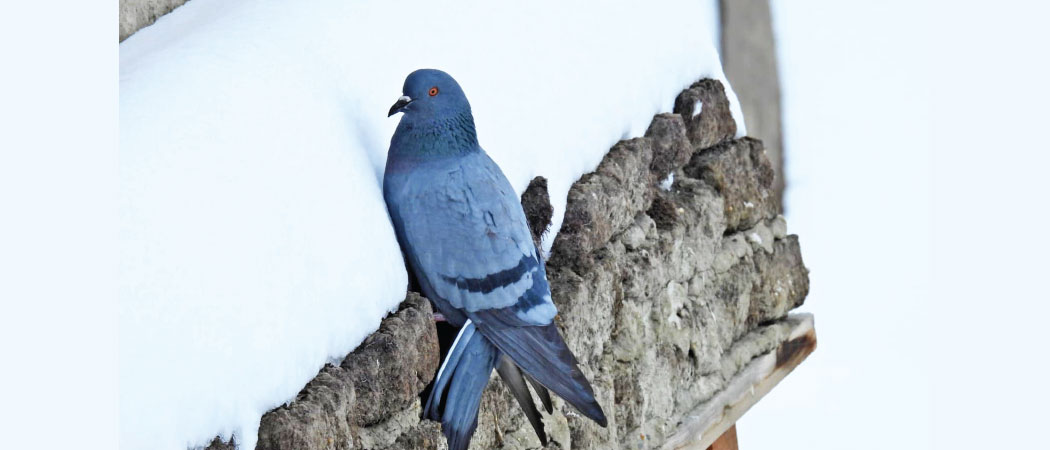

By Harikrishna Sharma,Muktinath (Mustang), Feb. 5: Himalayan pigeons have been facing increasing difficulty in finding food and shelter in Upper Mustang as temperatures fall below freezing.
In Lomanthang Bazaar of Lomanthang Rural Municipality-5, pigeons have been spotted entering houses in search of warmth and food, with their numbers rising in human settlements during extreme cold.
Following heavy snowfall in the Lomanthang area last week, the birds’ main food sources -- green shoots and leaves -- were buried under snow. As a result, the pigeons migrated temporarily in search of food and suitable shelter.
During extreme cold and heavy snowfall, Himalayan pigeons are often seen in settlements, but they usually return to their natural habitats once weather conditions improve.
Himalayan pigeons typically build nests in livestock sheds and rocky cliffs above settlements. However, as they are vulnerable to predatory birds in such areas, human settlements are considered relatively safer temporary shelters during harsh weather conditions.
Winter is particularly challenging for the species, as they wander through populated areas seeking food and shelter amid frequent human activity.
Umesh Paudel, chief of the Area Office of the Annapurna Conservation Area Project (ACAP) in Lomanthang, said Himalayan pigeons mainly feed on grains and plant matter, although they also consume insects as supplementary food.
“The Himalayan pigeon prefers clean environments and usually remains close to its natural habitat. Cold weather poses a serious challenge to this species,” he said.
Paudel stressed the need to conserve Himalayan pigeons, saying that they resemble domestic pigeons found in hilly regions and are also attractive to tourists.
He added that ACAP has been raising awareness among local residents to minimise human harm to the birds when they move closer to settlements in search of warmth during winter.
The Himalayan pigeon has a compact body, short legs and strong wings suited for sustained flight. Its wings are generally greyish with mixed tones and show two dark bars, similar to pigeons found in the hills and plains, though with some differences.
Compared to domestic pigeons, Himalayan pigeons are faster flyers and capable of longer journeys, and they are usually found in flocks. Pigeons are considered social and intelligent birds.
During winter, Himalayan pigeons are found at elevations of around 2,000 metres above sea level, while in summer they can be seen at altitudes of up to 5,500 metres.
In Upper Mustang, they are commonly sighted around settlements in Lomanthang and the Lho-Ghekar Damodar Kunda area. Their habitats and nesting sites are often located in the areas easily accessible to humans, as well as in some rocky terrain.
ACAP Lomanthang said that if sufficient food is ensured around their habitats and populations are allowed to thrive, Himalayan pigeons could also become an attraction for tourists, making conservation efforts essential.
In Mustang, ACAP works in the areas of wildlife and livestock conservation, forest and environmental protection, and livelihood support.
-original-thumb.jpg)