- Sunday, 3 May 2026

Army mobilised to guard key installations and secure polls
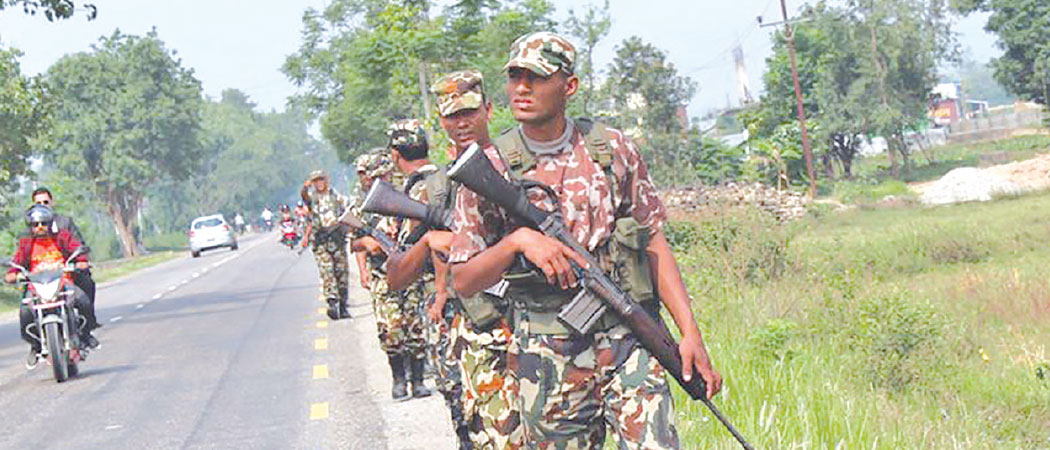

By A Staff Reporter,Kathmandu, Feb. 5: With exactly one month remaining until the elections, the Nepali Army has been formally deployed on the streets from Wednesday following approval by President Ramchandra Paudel.
The deployment was authorised on November 27 on the recommendation of the Prime Minister and a decision of the Council of Ministers to mobilise the Army for election security.
In line with the Integrated Election Security Plan-2082, all four security agencies have been mobilised under the coordination of the Nepali Army from Wednesday to ensure that the elections are conducted in a free, fair, impartial and independent environment.
According to the Nepali Army Headquarters, the approved integrated security plan provides for deployment in three phases. In the first phase, the Nepali Army will carry out patrols on roads and in settlements and will be assigned to protect vital physical infrastructure, including airports, historical monuments, monasteries and temples and security of the printed ballot papers.
In the second phase, covering the period immediately before and the polling day, the Army will operate in the third or outermost security ring. Its responsibilities will include aerial rescue if required, transportation of ballot boxes, protection of voters, candidates, political parties and election officers during the polling, according to Brigadier General and Spokesperson for the Directorate of Public Relations and Information Rajaram Basnet.
The third phase will focus on post-election security, including safeguarding ballot boxes, ensuring their secure transportation and providing security at locations outside vote-counting centres.
For election purposes, the Nepali Army has been deployed across all 165 electoral constituencies from Wednesday, the Army said.
Army has said that different bases would be established as required, with joint patrols conducted on the basis of necessity to strengthen election security.
A total of 3,406 candidates are contesting the upcoming elections. The Election Commission has enforced the election code of conduct from Magh 4. For this election, there are 18,903,689 registered voters, including 9,240,131 women, 9,663,358 men and 200 voters listed under other categories.
Nationwide, 23,112 polling centres have been established at 10,967 polling locations. Nepal Police will deploy 77,000 personnel for election duties. As existing police strength was deemed insufficient, an additional 133,000 ‘election police’ personnel have been recruited. Electoral areas have been categorised as highly sensitive, sensitive and normal, with security arrangements made accordingly.
Of the total polling locations, 2,845 have been classified as normal, 4,442 as sensitive and 3,680 as highly sensitive. Police said regular deployments have already been made to strengthen security at these sites.
From the Armed Police Force Nepal, 34,576 personnel along with 15,110 election police, totalling 49,686—will be mobilised. The Armed Police Force said a high alert has been maintained to prevent any untoward incidents, with units deployed in such a way that they can reach any incident site within 10 minutes. In total, there will be 338,890 forces in the field.
-original-thumb.jpg)