- Sunday, 3 May 2026

Pokhrel's verses find voice in Russian
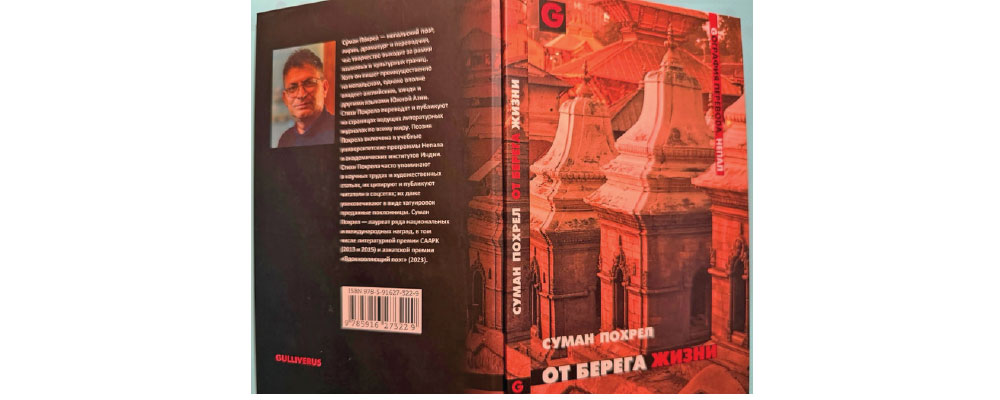

By A Staff Reporter,Kathmandu, Jan. 12: Russian Gulliver, a renowned publishing house based in Moscow, has published a collection of poems by Nepali poet Suman Pokhrel in Russian, titled 'Ot Berega Zhizn.'
The book comprises 41 poems translated from Nepali into Russian by 11 distinguished translators, Vadim Mesyats, Igor Sid, Zhanna Sizova, Guerman Vlasov, Maria Bregman, Amarsana Ulzitujevs, Aleksey Ostudin, Yuri Vasiman, Anna Sharapova, Uliya Krylova, and Veta Telegina.
Published in January 2026 in Moscow, the publisher states that the book represents a significant literary bridge between Nepali and Russian poetic traditions.
"Suman Pokhrel’s poetry moves effortlessly between the intimate and the universal," the publisher has written, "His poems speak of love and loss, silence and resistance, childhood and memory, war and pandemic, nature and metaphysics. Rooted in the lived realities of South Asia yet resonant far beyond geography, these verses question the meaning of humanity, compassion, faith, and survival in a fractured world."
The publisher further observes that Pokhrel’s voice is meditative, restrained, and deeply humane, often philosophical yet grounded in everyday imagery such as markets, trees, windows, rain on statues, and candles in darkness.
Highlighting the collaborative nature of the translation, the publication states that the diversity of translators lends the collection a rich polyphony while preserving its emotional clarity and moral urgency. Together, the translations create a cohesive journey from the inner shoreline of personal experience to the vast horizon of collective human destiny.
“This collection invites Russian readers into a contemplative dialogue with one of the most compelling voices in contemporary Nepali poetry,” the publisher writes, describing the book as both culturally expansive and profoundly intimate.
Poet Pokhrel shared his happiness to have learnt the news. "I am hesitant, yet I hope these poems will find a place in the hearts and minds of Russian-language readers shaped by one of the most profound literary traditions in history," he said.