- Saturday, 9 May 2026

Why Putin Warned The Way He Did

Two weeks before its presidential elections, Vladimir Putin warned the United States-led West not to venture troops into Ukraine and risk a nuclear conflict: “Russia has the world’s largest stock of nuclear weapons.” Indeed, Russia boasts 5,900 nuclear heads as against 5,250 in the United States’ arsenal.
In power since more than 23 years, with a four-year interlude as prime minister to comply with the then constitutional ceiling of two presidential tenures, Putin enjoys the overall longest innings in office in the Western world. He recently signed into law his country’s withdrawal from the ratification of a treaty, banning nuclear weapons tests. It underscored the message that Moscow wants its detractors to weigh the dimensions of the new move. A nuclear test now would mean the first since 1990.
Medvedev Dmitry had switched to the presidency for a term while Putin donned the premier’s hat in 2008. However, in 2020, the mandatory clause was amended in a clear signal that the incumbent executive head was certain to seek yet another term in office. Under the new provision, a single tenure in office now carries six years. Hence Putin could be in power until 2036.
Pushed to the brink, Putin feels, all options should be actively mulled to live opponents gravely guessing. He makes it clear that things should not be allowed to overstretch; no breaking point can be left untended. The designed communication seems to have had the intended message transferred with the desired seriousness.
Restrained reaction
The restrained reaction from Washington echoes caution to avoid accusing Moscow of engaging in a nasty bluff or sabre-rattling. In any case, “bluff” is a word rarely minted in such matters of gravity. Even North Korea is not dismissed with such a tag. Putin’s announcement has not been countered as “aggressive” posturing, which otherwise would embarrassingly expose the West’s inaction. China’s news agency Xinhua confidently analysed that Russia would not resort to nuclear testing, notwithstanding any retreat by Moscow regarding the comprehensive nuclear test ban treaty. In fact, Russian Spokesman Dmitry Peskov hurriedly tried to allay fears of an escalation or imminent threat.
At the same time, of note is Moscow’s announcement in October that it has developed a new generation strategic missile. That was four months before the war in Ukraine entered into third year. Clearly, the latest development is one the firm warning not invoked to promote any aggravation but to signal that relentless strategic imbalance against an emerging new world order will not be taken lying down. Power equation is changing but not being replaced by one set of powers by another.
Multiple alliances and regional groupings will be the new scenario. In the whirlpool of change, Europe, too, is likely to undergo major shifts in alliances and influence-sharing. Multiple groups will vote for own strategies with an outlook hitherto restricted by a narrow definition of Europe-first emphasis. An outcome of post-World War I, the League of Nations began hobbling from its very inception. The US abstention left a gaping hole in the institution that ironically was enthusiastically supported by war time American President Woodrow Wilson at the beginning. The US Congress pursued a policy of relative isolation and prevented the country from joining the word body.
This might have prevented the new organisation from functioning effectively. And within two decades, World War II started affecting more people and more territories, and for nearly twice the number of years than in the previous conflagration. Successor to the failed League, the United Nations in 1945 took off with bigger promises and greater scope of activity. At almost 80 years, the UN has propelled to be a forum for global discussions and contributed to exercising restraint by its member nations on many occasions. But to give all credits to the UN for preventing World War III so far would be an exaggeration at its extreme.
Over the decades, hundreds of local armed conflicts have occurred, killing millions, wounding and maiming yet more and inflicting horrendous destructions. The UN could not prevent or end them early on. In fact, some of its “veto” powers were involved in wars at various spots bypassing the world body that accords them the exclusive power of quashing decisions at the Security Council. The world is fragmenting, which inspires those palpably unhappy with ages of foreign hegemony, economic exploitation and overbearing domination in agenda setting, ostensibly designed to address global interests.
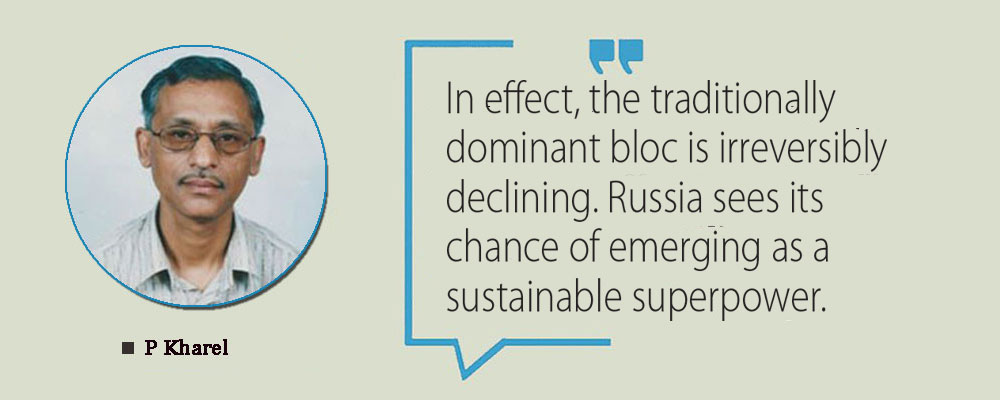
In effect, the traditionally dominant bloc is irreversibly declining. Russia sees its chance of emerging as a sustainable superpower. China — the other superpower sharing with Russia a common border of more than 3,500 km —p lays its card less in words and more in action-orientated initiatives. Its approach is generally the most subtle in the superpower club of three.
Strong combination
Rich in vast, untapped natural resources, Russia can bank on the technologically more advanced China to strike a mutually beneficial fusion fetching rich rewards while keeping their opponents in check so that the red line is not crossed by other competing forces. Putin and his Chinese counterpart Xi Jinping are heading towards a direction that erodes the strength of the traditional hegemons.
Not all nuclear powers are committed to no-first use of n-weapons, let alone discouraging the quest for more lethal weapons with more killing power and greater precision. Such a strategic frame and dubious use of force in toppling regimes and installing meek rulers while extracting disproportionate share of local resources sow seeds of discord that are like to raise their heads sooner or later. Technological advance proves to be a tremendous advantage, applied fully by the big powers. The situation today is, however, dicey from the conditions that prevailed two decades ago.
If an authoritarian streak balances on the stilts of constant push and turns into a shove, the result would be seething anger just below the surface, harboured by the underdog. Against the above background, Putin talks tough and sound serious. As for his election prospect starting this week, Putin is almost certain to win another term, what with the latest opinion poll indicating a public approval rating of 85 per cent, which is twice the public support his American counterpart Joe Biden maintains at home.
(Professor P. Kharel specialises in political communication.)