- Sunday, 31 May 2026

Rethinking Nepal’s Health Literacy

According to World Health Organisation (WHO), health is a state of complete physical, mental and social well-being and not merely the absence of disease or infirmity. The enjoyment of the highest attainable standard of health is one of the fundamental human rights of every human being without division of race, religion, political belief, economic or social condition. In this context, WHO defines health literacy as representing the personal knowledge and competencies that accumulate through daily activities, social interactions and across generations.
Health literacy is necessary in accelerating progress to enhance health equity and social justice. In doing so, we need to consider a range of social, cultural, economic, political and environmental factors contributing to people’s participation in health literacy interventions.
For more than two decades, the persistent issues of inequities in health status, inclusive access to quality health care remain unaddressed at scale. My own experiences working in the health sector has given me a unique perspective about Nepal’s federal health systems, and more importantly, a crucial need to make health literacy a high priority agenda for action.
Anthropological perspective
Interestingly, there is increasing focus on anthropology that shines a lens on many aspects of health literacy. An anthropological perspective helps us look at more closely how humans develop and enact their perceptions, beliefs, traditional practices and cultural norms in their daily lives. Quite simply, health literacy must count rituals of healings, social sufferings, adaptive wisdom, cultural symbolism, taboos of health and stigma. However, it is deeply frustrating that health literacy is not considered as a shared responsibility and accountability yet.
Everyone has the right to health information that helps them make informed decisions. Thus, enhancing health literacy means people have the capacity to access information and understand health services which are needed to make appropriate decisions in their socio-political and cultural contexts. Indeed, placing a stronger focus on health literacy brings both depth and humanity.
And to be fair, there is still limited health literacy in Nepal’s rural health care. As a result, this profoundly affects people of all ages, incomes, castes, social groups, ethnic and indigenous minorities in accessing health care. Moreover, people’s health behaviours are closely linked with their health outcomes. However, evidence suggests that many of the studies related to health literacy interventions are small in size. For instance, there is limited evidence on effectiveness of doctor-patient communications, written or pictorial materials, social media, video and relevant documentaries.
More importantly, there is limited interdisciplinary analysis on relevance, effectiveness and sustainability of health literacy interventions. There is still a missed opportunity to explore how cultural beliefs, language and communication style influence on understanding and interpretation of health information in people’s everyday life. Therefore, one of the creative ways is to look at how societies construct understanding of health and illness. Considering the socio-political and geographical diversity of populations and their vast needs, a central question still remains: Are health information, communication and education services culturally and linguistically appropriate within and across communities? There is little known about the social, cultural and linguistic dimensions of health literacy at large.
Reportedly, health literacy is a strong predictor of people’s health status. Limited health literacy among children, adolescents, youths and mothers and adults is more likely to reinforce existing inequalities in health care services. On the other hand, health literacy in the digital era is becoming more important than ever before. Relying more on online information and digital technologies is both a challenge and opportunity in health care management at local level.
In essence, digital health literacy primarily aims to enable people to use existing health information systems, telehealth services, electronic health records, mobile health apps and other smartphones, engage in decision making processes and manage health conditions at large. To end persistent inefficiencies in health literacy interventions, capacity building of health workers, service provides and communities is crucial to address the widening barriers in fully capitalising the benefits of digital technologies.
While Nepal’s Health Policy, 2019 and subsequent strategic plans have given stronger emphasis on the emerging needs of health literacy, implementation part is not fully effective. The role of National Health Education, Information and Communication Centre (NHEICC) is crucial for all health promotion, education and communication services including multi-sectoral initiatives. During COVID-19 pandemic or immunisation campaigns, sharing authentic information is helping people adopt positive practices that benefit their families.
Accountability
Building on trust, accountability and social justice, an enabling environment is essential to promote people’s willingness to seek health information and ensure optimal use of it. Understandably, the experiences from public health interventions clearly show how health literacy shapes the lives of communities in their everyday life. The countless conversations with community people and health workers hint a welcome reminder that simple human stories, if told well, greatly add value to health literacy.
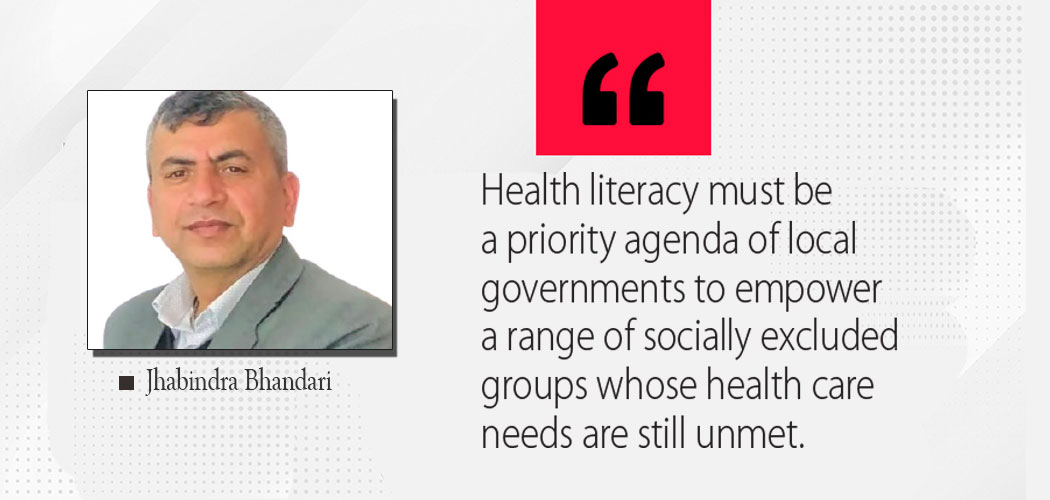
In a dynamic political milieu, rethinking Nepal’s health literacy is crucial in achieving universal health coverage and health-related Sustainable Development Goals (SDGs). Despite remarkable contributions of female community health volunteers, health literacy must be a priority agenda of local governments to empower a range of socially excluded groups whose health care needs are still unmet. Thus, the scenario of retelling stories rooted in rural communities carries a distinct social sensibility featuring community voices striking and powerful in terms of nuanced perspectives on people’s interest and trust towards health literacy from their worldview.
Bhandari is a health policy analyst interested in anthropology.