- Friday, 29 May 2026

Cultural Capital Boosts Democracy And Development

Individual disposition is the product of a culture. It gives a shared meaning of life, liberates people from the state of nature and makes diverse life-form norm-governed, cooperative, tolerant and trustful. Nepali culture arose out of the chrysalis of collective memory and consciousness of its people. The ancient Nepali nation and its modern democratic polity can endure so long as its varied cultures can get along and effortlessly transmit the historical spirit to diverse generations of people. Cultural transmission spurs continuity of community and adaptation to technological evolution. Memories refuse to accept the nasty trends of the past where power struggle has abused the cultural differences of the nation. It has thinned the sanity of unity of diversity, incubated extremism to dent the middle path and spawned the recess of the center. It has disabled the gift of democracy to marshal the connectors of society.
Nepal’s political landscape is disjointed while the culture is not. The former is driven by promises disinformation and manipulation while the latter is serene, decent and sublime alluring to the soul of the national community. Cultural capital matters for community, democracy and development. Civic culture seeks to address the grievances of people by fairness and justice. What roles Nepali civil society play in the creation of civic culture and community? Democracy thrives in a civic culture where people are educated in the native tradition of enlightenment to cooperate with each other, critically debate in the free public sphere about ideas, laws, public policies and lend priority to public goods, not spin to political correctedness, habitual rationalise of regime and convert society in the image of creed or market as an end in itself.
Market excess
The market excess causes the atomisation of individuals and communities and erosion of culture. It cuts the spirit of community, a spirit central to socialisation, solidarity and cooperative action. As democracy blooms in the state its ability to set up Nepali state’s raison d’ etre in areas of safety, rule of law, tone of voice and civic engagements is vital. While the state and the market nurture impersonal trust, civil society is expected to hone interpersonal trust while polity yearns for intra- and inter-political beam. Trust is the basis for healthy conformity to cultured communities founded in civic competence.
Most project-tied modern Nepali civil society is organically linked to the international regime. They are historically and culturally ignorant about the national values of enlightenment and, therefore, apply idioms and tools less familiar to people’s experience. Driven by rational choice, they are less aware with charity like Paropakar but eager to throng in activism and eternal regime change strategy. In Nepal, the boundary between civil society and political class is slim. Vernacular media and organic civil society as a part of cultural industries have to evolve civic culture sensitive to natural links with the people. Both are supposed to serve as democratic counterweights to power and wealth and remove the barriers to communication, civic participation and mediation between the system and the life-world.
Otherwise people become passive consumers and victims of the market's bent to cripple culture, atomise public life and undercut the prospect of building the capacity of Nepalis for self-rule. A variety of intermediary associations of Nepal can link individuals to the community and serve a bulwark of people’s spirit in worthy action and their legitimate desire for social transformation. As the information revolution grew, the political landscape in Nepal became more fluid, plural, personal and participatory with multiple choices. Nepali state has to coordinate across social and cultural diversity for cohesive nation building.
The community in Nepal is ancient. Individuals and their families have learnt to live in harmony with each other, communicated their aspirations, built mutual understanding, fulfilled each other’s rights and expectations and created institutions to satisfy their survival and emotional needs, desires and aspirations. This has enabled the adaptation of individuals in community, society, the state and the larger context of the world and acquired a template for worldview. Nepalis have spontaneously created authorities with the duties to defend them and the national sphere to escape the gravity of geopolitical pull. Their settlement pattern is neither confined to territoriality nor parochial nationality. Its soft power of Shivaism and Buddhism rippled outward in the global sphere. In this sense its nationalism can be civic and cosmopolitan.
Wherever they live, build character, earn livelihood or acquire citizenship they sentimentally identify with Nepaliness, express their love for language, culture and bond with the land. Those who have developed materialistic culture and those clinging to symbols and culture must be bridged by a good dose of civic education. The materialism has liberated the old establishment from national history, culture and spirituality as they were trapped by the regime change strategy of geopolitical forces and thus deprived Nepalis’ engagement in law and policy making on vital matters enabling them to exercise sovereignty. As a result, people’s struggle against exploitation, domination, alienation and migration for livelihood remain unfinished.
Social change occurred when young generation had internalised new values, knowledge, traits and technologies which turned the existing prejudices and habits old-fashioned while society remained dynamic and the state recovered from de-capacitation and erosion of sovereignty from above by globalisation, below by political parties and non-state actors and sideline by geopolitical predators. New government, led by Prime Minister Balendra Shah, has laid emphasis on building a national integrity system through transparency, accountability and decentralisation of power can be said to recover Nepal from democratic recession and development retardation.
Cultural change springs from the ability of people and communities to modernise themselves as per the spirit of new cognition, affection, affinity, contact and conduct and the structure of production, exchange and circulation. Nepal has adopted Nepalisation of language and Sanskritisation of non-Sanskritik groups so that modernity does not breed disruptive effects but adore the sanity of national culture which shored up the freedom-loving character of the nation and people. In no way the processes of Nepalisation and Sanskritisation amount to homogenisation and hegemonisation of subcultures or global sub-culture of elites. They only aim is to upscale the national perspective affirming unity in diversity.
Awareness of one’s own culture is not a self-seeking dead-end but an avenue to open to outside cultures. Nepali culture does not stress on crass individualism, obsessive materialism or positivism. Its ancient scholarship, which expressed timeless values of wisdom, favoured simple life, personal freedom and rhythm with the eternal flow of nature. The order of culture matched with the order of nature, not its commodification, colonisation or self-alienation. The elegance of civic culture is averse to an asylum to post-modern consumerism. Wisdom of culture does not die so long as people rejoice its rituals and memories remain relevant, resilient and resonating despite cynics and ideological zealots' tendency to seek conformity to what they believe the best regardless of its aptness. This attitude is deemed as cultural cringe— self-lowliness of one’s own culture and nationalism and gravitation to a great society gyrating on geopolitical struggle and techno-centric civilisation.
Nepal’s cultural retreat is reverted by new leadership under Prime Minister Shah who found decency in national tradition shaped by Hinduism-Buddhism and defended its path for national renewal from the irrevocable euthanasia of lingering legacy of sterile politics and settling of scores devoid of any positive outcome for Nepalis. His vision is shifting from confused incandescence to vivid, vocal and coherent ones who want to build a multicultural nation rooted in national experience and historically refined national values, not misrepresentation of outside. His party repented to Dalits and marginalised groups for the agonies they had painfully undergone in history through unwritten rule and promised to chart an inclusive future. This has shifted invisible law-enforcement to its completely visible invocation capable of taking action against criminals, deep state and thieves of state.
His interest to revive the collapsing public morality in politics and public admin, justice, education, health, economy and the state system radiate a flicker of hope. Is this the beginning of a new moral order in Nepal out of lingering spiritual decadence? Obviously, this moral order can be built on new solidarity built on rational reflexivity. Right to information embedded in Nepali constitution and accountability to the people have opened the nation to a new cultural code of transparency enlivened by a robust public sphere. In no way they are crafted to replace the tradition which is vital to set an interface of Nepali state and society. Yet the fear of old political classes about the loss of their gains has not dissipated. They are vainly planning to catapult themselves to protect them through habitual stirs.
Cultural demise marks the death of the nation. Nepalis have navigated adroitly to keep its syncretic culture and avoided multi-cultural excess by developing overlapping values and celebrating each other’s festivals, rituals and ceremonies. The existence of enormous ethnic and caste groups, languages and cults can be attributed to the nation’s heritage of tolerance and fending off extremism of ideologies, religion, ethnicity, territorialism or the market. Vigorous use of welfare measures can easily mediate the class interests in Nepal, prevent its instrumentalisation by radical forces and respect diversity, equity and inclusion espoused by the constitution. Inequality in these realms can linger the constitutional promises unfulfilled and the polity imperfect. Culture of Nepal has grown with shared tradition, values and grit of people to endlessly nurture them as a part of their adaptation strategy. It has forged a bond with the community of a common future.
Cultural patterns
Nepalis instinctively internalise the cultural patterns derived from Hindu-Buddhist values and countless cults and perform rituals for strengthening the shared bond of community. Buddha stressed on Sangha, the art of association while Hindus have evolved a culture of sat sangha, essential practice of meeting with like-minded and debating on shared knowledge and experience and social and spiritual path of living and thriving together. These processes denote the culture of re-moralisation of society, economy and polity and ending the spiral of silence. Both help to overcome an imposter syndrome where people undergo a process of anxiety, self-doubt and anxiety disorder owing to atomized life.
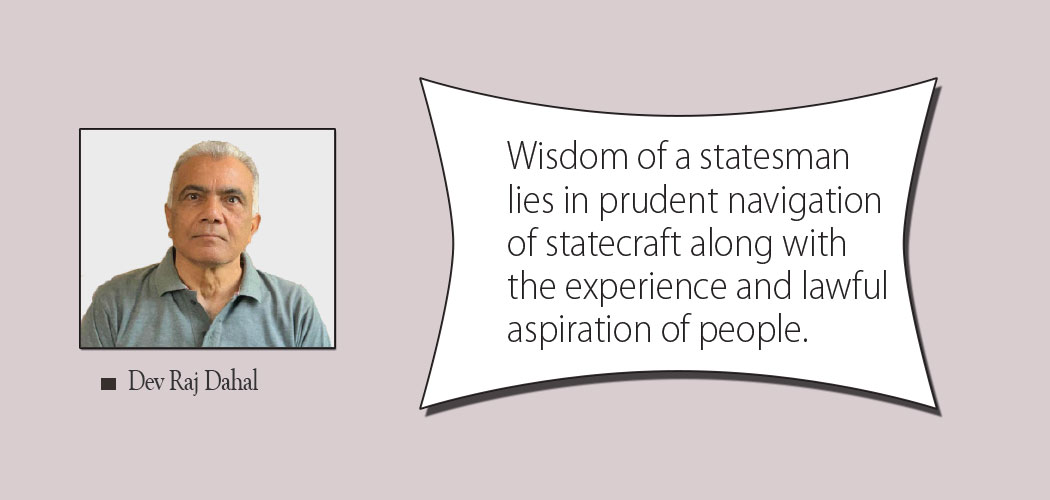
The current social media craze is responsible for inflating the passion and prejudice of unadjusted social and political classes. They report the strength of mob mentality and spoilers driven by grievances than properly optimise them in the national values and sanity of tradition of patience, empathy, humility and reciprocity. It is vital to cultivate cultured citizens infused with the ability to respect each other’s reputation and dignity and undertake social cooperation to realize life’s possibilities and national responsibilities. Wisdom of a statesman lies in prudent navigation of statecraft along with the experience and lawful aspiration of people.
(Former Reader at the Department of Political Science, TU, Dahal writes on political and social issues.)