- Sunday, 31 May 2026

Recalling Victory Day
 Ram Bindu Shrestha
Ram Bindu Shrestha
Ram Bindu Shrestha
Since the beginning of human civilisation, many wars and battles have been fought. Among them, World War II was the largest. This war caused widespread destruction. In terms of sacrifice, the Soviet Union suffered the most in World War II. Twenty-seven million Soviet citizens sacrificed their lives to free the world from the clutches of fascism. The American writer Ernest Hemingway once said, “…Anyone who loves freedom owes such a debt to the Red Army that it can never be repaid…”
World War II began on September 1, 1939, when Germany invaded Poland. The Nazi coalition advanced rapidly, capturing Denmark in 6 hours, Luxembourg in 1 day, Holland in 5 days, Yugoslavia in 11 days, Belgium in 18 days, Greece in 24 days, Poland in 27 days, France in 42 days, and Norway in 61 days.
Thus, the fascist power, which had conquered most of Europe, on June 22, 1941, at 4 a.m., before sunrise attacked Soviet territory without warning. The Nazis adopted the most barbaric, inhumane, and destructive methods of warfare. Millions of homes and citizens, hundreds of cities were reduced to ashes. Within three months of the invasion, they came close to the capital, Moscow. The Wehrmacht, had even announced that they would hold a victory march on Red Square on November 7, 1941.
The security situation was extremely critical, but Moscow did not give up. More than 1.1 million people participated in defending the city. In this battle the Soviet people showed their determination for victory. They sent a message that they could defeat the enemy, whom many had considered invincible. More than a million Soviet soldiers died in this battle.
A similar fierce battle took place in Stalingrad, which lasted for 200 days and 200 nights. About half a million Soviet soldiers sacrificed their lives in this battle. In recognition of the great sacrifice made by the Red Army, King George VI of Great Britain sent Stalin a ceremonial sword - “…In the name of the citizens of Stalingrad, strong as steel…”. Through their sacrifices, the Soviets not only liberated their own country but also freed European countries. For this, they paid with the lives of about two million soldiers. Amid the tragedies of World War II, the Nazis established around forty thousand concentration camps across Europe. Many of them were liberated by the Soviet army.
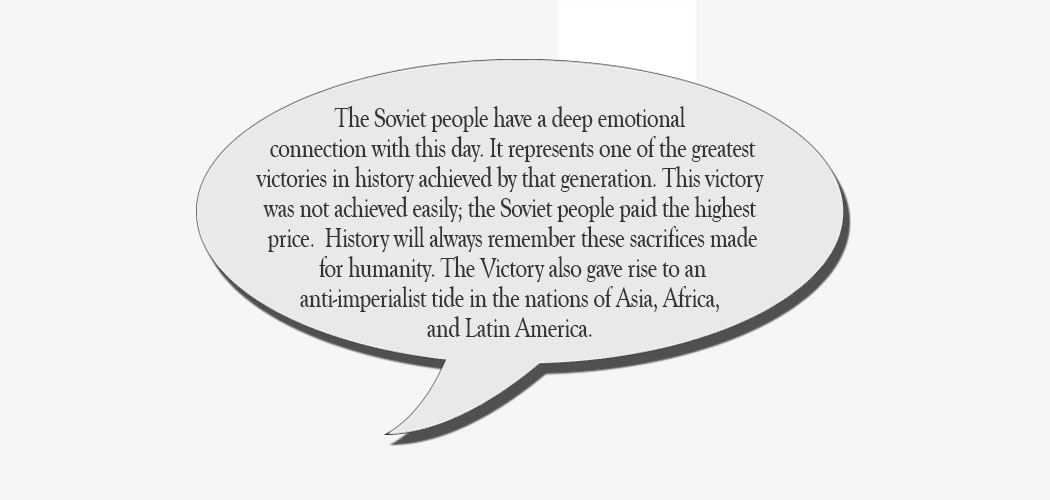
Finally, on May 8, 1945, the German army signed the unconditional surrender and May 9 is marked as Victory Day. The Soviet people have a deep emotional connection with this day. It represents one of the greatest victories in history achieved by that generation. This victory was not achieved easily; the Soviet people paid the highest price. History will always remember these sacrifices made for humanity. The Victory also gave rise to an anti-imperialist tide in the nations of Asia, Africa, and Latin America.
Today, neo-fascism is raising its head again in the world. Today, in one way or another, attempts are being made to distort and rewrite the glorious history of victory. After the collapse of the Soviet Union and the fall of the Berlin Wall, it was envisioned that the era of ideology and the Cold War would end, and with it, a lasting peace. On the occasion of Victory Day, it is important to remember the sacrifices made against cruelty and oppression. If humanity forgets history, such tragedies can happen again. Therefore, it is necessary to speak about this victory, the cost of peace, and pass these memories to future generations.