- Saturday, 30 May 2026

Psychological Bias And Illusion Of Free Thought

As individuals, everyone prefers to think of themselves as being in control of their decisions and essentially their life. And to some extent people are the drivers of their own destiny. But there exist multiple phenomena whose close study reveals that individuals' lives and their decisions are shaped by outside influences, knowingly or unknowingly. One of such phenomena is propaganda, which means the dissemination of ideas with the motive of influencing public opinion. While the term is generally used in political context, it has expanding ramifications upon a closer inspection of its constituent elements that aid to its effectiveness.
One of the elements that makes individuals susceptible to propaganda is the phenomenon known as the illusory truth effect. It refers to the psychological act of believing repetitive information as true regardless of the factual accuracy of the information. This is utilised by organisations through the use of mass media campaigns where the same message is put onto the sensorium of individuals over and over. The effect has a basis because of the fact that the human brain prioritises information that feels familiar, as it can process it easily, which leads to such information being falsely flagged as true. Likewise, confirmation bias also makes individuals prone to propaganda and misinformation.
Cognitive bias
It is a type of cognitive bias that describes a person’s act of searching for information and societal cues that confirm their existing beliefs. It obstructs individuals from forming new opinions and perspectives and leaves them open to propaganda, as they do not critically analyse any new information that they receive and only just facilitate beliefs that correspond to their current thoughts. This coupled with information that perpetuates extreme emotions leaves people vulnerable to manipulation. When human beings are in an extreme emotional state, they tend to rely more on heuristics rather than logically processing any information, which makes them believe in simple and sensationalized stories.
People also tend to gravitate towards conspiracy theories and other forms of propaganda during moments of uncertainty and tension. Furthermore, a kind of culture has been established, as of late, which prioritizes the surficial over the nuanced. This can go on to create a dangerous environment where information is served within echo chambers and individuals are socially coerced into limiting their reasoning in order to serve the in-group ideals. The addition of social media to this concoction exaggerates the situation that the youth face in deciphering the messages that are presented to them.
Social media, by design, facilitates the participation of individuals from all backgrounds and ideologies and thus in principle allows for the existence of platforms where anybody is free to share any rhetoric. This model allows an excellent space for exploiting users' understanding of an issue by the use of targeted ad campaigns and repetitive content strategies. Although the social media companies have been aware of these loopholes in their system, they have shown reluctance in finding an effective and permanent solution to the issue, as that forms a formidable part of their income from the platform.
Amidst all this, an individual can never be sure if their thoughts are of their own or if they have been modeled by the subconscious messaging that they receive on a day-to-day basis. This creates extreme stress upon awareness, creating a need for alleviation of the problem. It is only upon conscious awareness that individuals can differentiate between the messages that they receive. However, this presents a problem in itself, as the human brain prefers to function on heuristics, which are mental shortcuts that the brain utilizes to come to a quick decision when any decision requires significant cognitive load. Heuristics depend upon the past experiences and decision-making of an individual, and thus over time, people become more accepting of any messaging they receive that they have already had recognised in the past. This works on the concept of advertising and brand creation.
Biological human design
When a brand diffuses a certain image of its product or itself, the public learns to associate the image and quality of the brand, and over time both of these become synonymous with one another. Much farther than the world of marketing and advertising, this biological human design is also made use of by political campaigners, politicians, and political parties. Carefully designed rhetoric is presented to the general public in attempts to influence public support in the face of radical policy decisions or to gather support for a political candidate for an election.
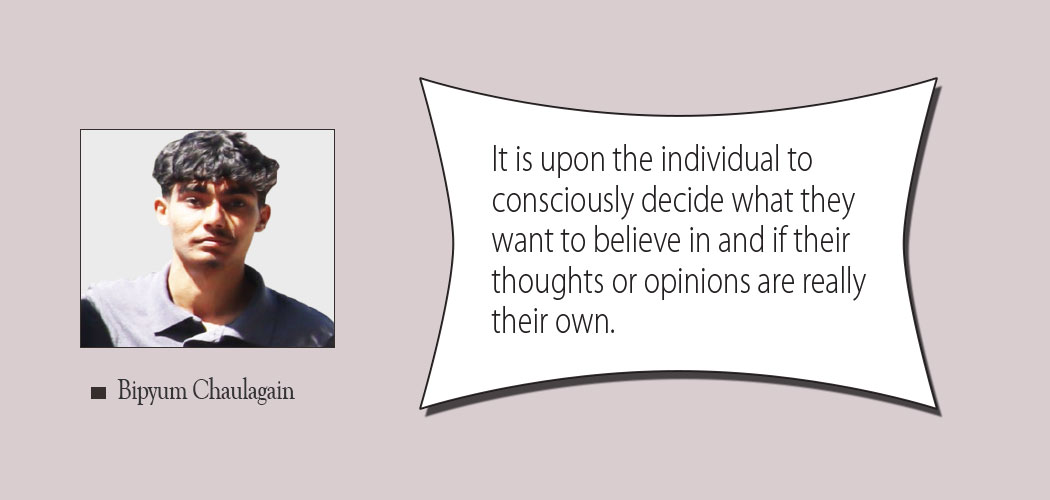
In light of these facts, a simple deduction can be made that individuals are not infallible in their judgements, thus creating a need for consciousness awareness. It is upon the individual to consciously decide what they want to believe in and if their thoughts or opinions are really their own. It is only upon deliberate analysation of the information that one receives, one can find the true intentions behind them. So in essence the question really is if an individual wants to be the driver of their self or is content with being according to the complex system driven by every facet of the society.
(Chaulagain is a psychology student at St. Xavier's College, Maitighar.)



-original-thumb.jpg)
-square-thumb.jpg)