- Sunday, 10 May 2026

Ukraine’s Ugly, Unequal War

In the two years of war so far, Ukraine remains awash in chaos and destruction since Russian troops entered Europe’s second-largest country. With the $100 billion dollars in weapons, equipment and other material supplies from NATO nations, it could clearly be collapsing. Going by the prevailing situation, historians could term the war as the charade of victory that never was. Things might have been different if NATO had stepped in with troops to counter the Russians in direct confrontation.
Some political leaders and analysts assess the Ukraine war as not in Europe’s interests but that of the United States. Washington’s strategy of sanctions against Moscow has had sharp economic repercussions on Europe. Supply stoppage of Russian gas has soared production costs and contributed to higher inflation rates than recorded in previous decades.
Propaganda campaign through various channels, including prominent news outlets, fed their audiences throughout 2022 that Russians were fighting “World War II weapons” and were in overall short supply of men and material. This misled the general public. The pattern spilled over with relative effect for the first half of 2023, too. Since last summer, the misleading march got exposed. It has dawned on millions of people not only in Europe but billions elsewhere that Kyiv is not winning the war that is getting decisive in its destructive nature. Ukraine is seen as being the eventual loser.
Lone on ground
Notwithstanding the billions of dollars’ worth of weapons and other supplies, Ukraine is visibly on the back foot. It is the lone warrior when it comes to fighting the next-door superpower that views Kyiv’s cosying up with NATO membership as a grave security threat. Moscow senses alarming bells against its security interests, given that Ukraine’s joining the military alliance would allow NATO troops to be deployed along its 2300 km border with Russia.
From the very beginning, it was a losing battle between a superpower neighbour and a far weaker nation cajoled by NATO leaders that dangled heavy and sophisticated weapons at Zelensky. Early efforts at peace agreements were derailed, widely believed to be at Washington’s intervention. Promises more in terms of war reparations to be extracted from the invading neighbour, Zelensky had heady ideas of emerging as a hero against what he saw as Goliath in Russian President Vladimir Putin. But things did not turn out quite that way.
Ukraine’s powerful supporters stand unwilling to fight alongside the troops they back with aid and assistance does not contribute to a level playing field. Blatant underreporting by the mass media in the West that give thread bare reportage on Russian weaknesses and speculations quoting dubious sources misinform the public within and outside the borders of the warring sides. To borrow a noted remark on fooling people, propagandists can make all the people believe untruths for some time; they can make some people believe in false information all the time; but they by no means succeed in making all the people fall for the false all the time.
In the closing weeks of December, Zelensky wanted fighting age youth back from countries that shelter them as refugees. Nearly two months later, the response has been dismal. The army needs 500,000 more troops, even as the president’s January 1 message claimed that Ukraine has become “stronger”. The statement might have been easy to deliver but extremely hard to convince Ukrainian people, let alone the rest of the world.
Two years of an ugly, unequal war has divided not only Ukrainians but also their key foreign backers on either side of the Atlantic. It has divided Europe and NATO. Nation first is slowly but clearly gaining ground with renewed vigour in the West. Worried about being flooded with ethnic/religious minorities that do not “integrate” in Danish way of life and culture, Denmark expects refugees to return to their country after the war. They will not be given permanent visa, as they are “completely different from Danes”.
The Danish outlook seems to be shared by many of its first cousins in Europe. It echoes in the fact that NATO member Turkey is not aboard the European Union. However, the war in Ukraine did not prevent Turkey from saving $2 billion in oil imports from Russia while Germany, NATO’s economic backbone, had to pay $1 trillion more. Turkey-first policy worked better since EU mandate does not apply to Turkey.
In December, NATO Secretary-General Jens Stoltenberg alerted the Western military alliance to be prepared for bad news from the Ukrainian war front. He, however, hinted that continued support on an increasing scale would enable Kyiv to ultimately land in victory. The optimism that, if adequately equipped, Ukraine’s victory is a distinct probability sounds far-fetched. On the other hand, Finland admitted that the West had overestimated its forces, and acknowledged Moscow’s capability of waging a long war. Germany’s naval chief resigned after declaring that Putin “deserves respect”.
Probing questions
Zelensky faces probing questions from many sections in his country. They could have been at least spared the prolonged personal and collective pains they suffer in a highly unequal war. Power equations have distinctly changed in the new millennium. New alliances are emerging for real. Although they could have been coming slowly, the Ukraine war cautioned many governments against the traditional world order that gave a disproportionate edge to US-EU combine. They realise the need for asserting themselves by seeking options and being able to have their say in greater measure than they had been able to do in the post-World War II decades.
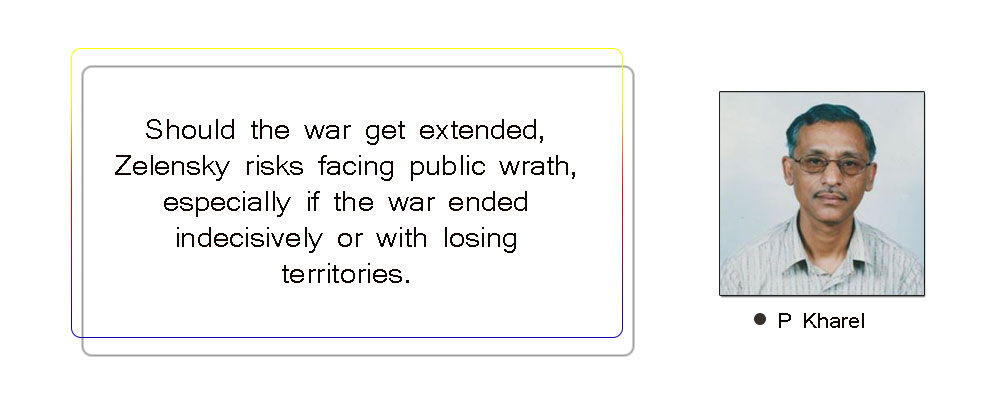
How long will the agonising armed conflict last? Some powers might not want the immediate stakeholders in a conflict to smoke any peace pipe. Putin claims that 125,000 Ukrainian troops had been killed in the first 22 months of the war. Should the war get extended, Zelensky risks facing public wrath, especially if the war ended indecisively or with losing territories. One of Europe’s poorest and among the most corrupt nations listed as 116th out of 180 countries, Ukraine will take years to rebuild what it has already lost. Honest efforts at bringing peace are called for. The ball could be in Washington’s court.
(Professor Kharel specialises in political communication.)