- Monday, 11 May 2026

Threat Of Lead Contamination In Nepal

In the everyday life of Nepal, the conversation about lead, a potent heavy metal used in a variety of items, is often sidelined. The comprehensive understanding of this metal is limited, and its adverse health effects are not widely acknowledged. When we talk about heavy metals, we often think about materials like aluminium and steel. However, it is crucial to understand that lead is as much a part of our lives as gold, silver, and other metals that we use for different purposes. Unlike these metals, the long-term health implications of lead have been increasingly recognised in recent times, prompting global initiatives and government regulations to curb its use.
Lead is a hazardous, heavy metal that can be as tender as wax. In the “Periodic Table of Elements,” lead is categorised under heavy metals. While lead is a naturally found, it doesn’t provide any benefits to our bodies; instead, it can cause harm. Despite this, lead continues to be prevalent in our lives in various forms. Even if we lack knowledge or awareness about lead, its presence is everywhere, and its long-term effects on public health are becoming increasingly apparent.
The adverse impact of lead on human health, particularly children, has been a subject of scientific research. However, in Nepal, the hazards of lead have not been seriously considered despite efforts by international organisations, governments, and non-governmental organisations to mitigate its impact on public health.
Lead can exist in various forms and can easily pollute the environment. It is used in the production of items such as paints, cosmetics, toys, furniture, and food items and can be found in soil and water. Recent studies on lead in Nepal have raised concerns about the products available in the local market. If these products are readily available, how can we ensure that lead has not infiltrated our homes and bodies? This is a critical question because the effects of lead on the body may not be immediately visible but can manifest over time.
The impact of lead extends beyond immediate health effects; it can remain in the body for an extended period due to its high stability as a heavy metal. If you were exposed to lead 10 or 20 years ago, it might still be present in your body today, causing gradual damage.While most countries have imposed restrictions on the use of lead, there is no complete ban on its use. For instance, there are partial regulations on the use of lead in paints in Nepal. However, due to lack of enforcement and regulation, some paints still contain lead. Nepal must conduct research and raise awareness to effectively address this issue.
In under-developed countries like Nepal, where economic factors might encourage the consumption of low-cost products containing lead, it’s important to understand that these cheap products may come at a high cost to health.
Historical Perspectives
The use of lead and its impacts on human health were recognised over two thousand years ago. The ancient Egyptians were among the first to discover lead. During the Roman era, lead found various applications, including in water pipes, pottery, cosmetics, beauty products, and coins. Ancient texts even hint at Roman concerns about a potential link between lead and mental disorders, although the exact relationship between lead exposure and their decline remains a mystery.
Some theories propose that the widespread use of lead in Roman society may have contributed to the weakening of the Roman Empire. Dr. Jerome from the Canadian National Water Research Institute supports the hypothesis that lead poisoning from extensive lead use may have played a role in the downfall of the mighty Roman Empire, but this theory is not universally accepted.
Human bones from the Roman era have been found to contain significant amounts of lead. This suggests that the Romans were exposed to lead, possibly through consuming wine stored in lead containers. In Nepal, lead has been used for printing letters and blocks in certain publications for about two decades, although documentation on this practice is scarce.
In Ayurveda, lead is used in the preparation of some medicines, but it is believed that these medicines should only be administered after the lead has been purified to eliminate its toxicity. The regulatory bodies need to monitor such practices closely. Ayurveda refers to lead as “nag” and categorises it under "dhatu." While modern science classifies lead as a heavy metal, Ayurveda suggests that it can be used after purification but should only be used for specific medicinal purposes following thorough research and processing.
Lead, in its raw form, is highly toxic and not safe for ingestion. Ayurvedic practices aim to convert lead into a less harmful state through specific procedures, but adherence to these strict guidelines may vary among practitioners.
In the 1920s, lead was commonly used as an additive in petroleum fuels. The practice of adding tetraethyl lead to gasoline became widespread until the 1970s. However, starting in the 1980s, many developed countries began to phase out the use of lead in gasoline. In Nepal, the distribution of lead-free gasoline commenced in 1995.
Health Hazards
In South Asia, there is a rising concern about lead exposure, particularly concerning lead in food products. About a decade ago, a leading multinational company in India, Nestle, was found to have exceeded the permissible limits of lead in their Maggi noodles. This incident ignited widespread concerns about consumer rights, public health, and legal issues related to lead contamination, leading to a strong outcry against lead contamination. Lead can infiltrate our bodies through inhalation, ingestion, or skin contact. It’s not just any substance; even minute amounts of lead can significantly impact our bodies. Lead primarily affects the blood and can lead to various health issues. Long-term exposure can accumulate in bones, especially in children’s bones, where it can have lasting effects.
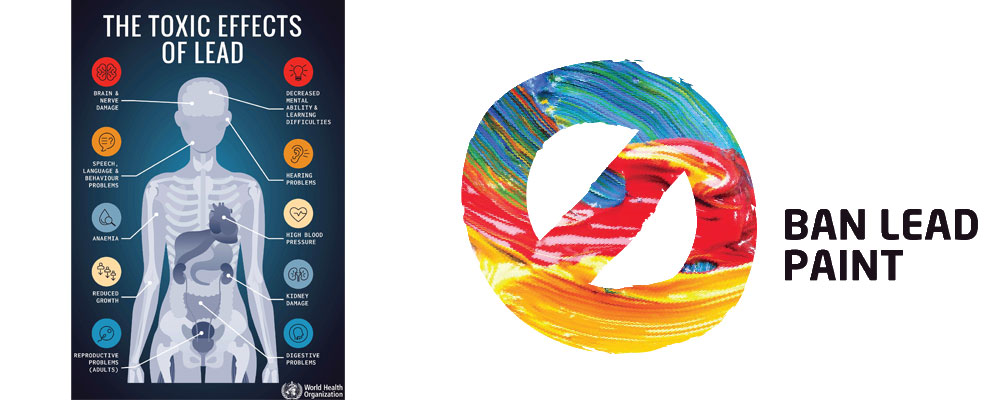
Lead exposure extends beyond physical harm; it can also interfere with brain development and the nervous system. Symptoms of lead toxicity can vary and may include abdominal pain, fatigue, constipation, insomnia, headaches, irritability, and skin disorders. In severe cases, lead exposure can lead to neurological disorders, and prolonged exposure could even result in sterility.
A study conducted in 2010 by the Harvard School of Public Health and Children’s Hospital in the United States raised concerns about the impact of lead on Indian-origin children living in the USA. The research found that Indian-origin children had higher lead levels, particularly in food items like chilli powder, fenugreek, and cardamom collected from Indian grocery stores.
Lead exposure has also been linked to cancer. One source of lead exposure in our homes is lead-based paint. Scented candles containing lead can be particularly harmful to our health. When burned, lead in candles can be released into the air and can be inhaled or ingested, leading to various health problems, including potential
cancer risks.
Lead affects almost all parts of our body, particularly the bones. It can cause damage to the brain, developmental problems during childbirth, and damage to the bone marrow. Even in small quantities, lead can weaken our bodies. It can increase the risk of high blood pressure, depression, and anxiety. Lead exposure during childhood can result in behavioural
problems and attention deficit hyperactivity disorder (ADHD).
Lead exposure can affect women’s reproductive systems and even harm developing foetuses in pregnant women. Breastfeeding can also transmit lead to infants. The World Health Organisation recognises “lead-caused mental retardation” as a valid condition, suggesting
that lead exposure can weaken cognitive abilities in humans.
The WHO has also highlighted the impact of lead on global public health. Lead affects various systems in our bodies, including the neurological, haematological, gastrointestinal,
cardiovascular, immune, and renal systems. In particular, children exposed to lead can experience neurotoxic effects. Even small
amounts of lead can have significant effects on children’s health.
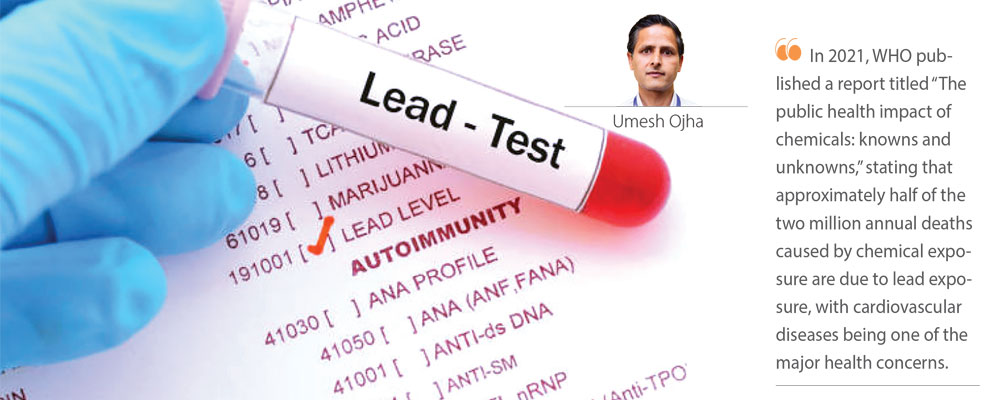
In 2021, WHO published a report titled “The public health impact of chemicals: knowns and unknowns,” stating that approximately half of the two million annual deaths caused by chemical exposure are due to lead exposure,
with cardiovascular diseases being one of the major health concerns.
Lead exposure
In Nepal, lead has been detected in a variety of products, such as toys, cosmetics, and paints, often exceeding the allowable levels. A study conducted in 2011 by Greenpeace and other international organisations on toys available in the Nepali market revealed that some toys contained lead levels exceeding the limits. This discovery raised concerns about the safety of children. However, despite such findings, the issue of lead exposure and its health implications have not been adequately addressed in Nepal.
Lead is notably present in cosmetics used to enhance women’s beauty. Lipsticks, one of the most widely used cosmetic products, often contain substantial amounts of lead. Regular use of cosmetics containing lead can cause health complications, including gastrointestinal issues, nerve damage, and even cancer.
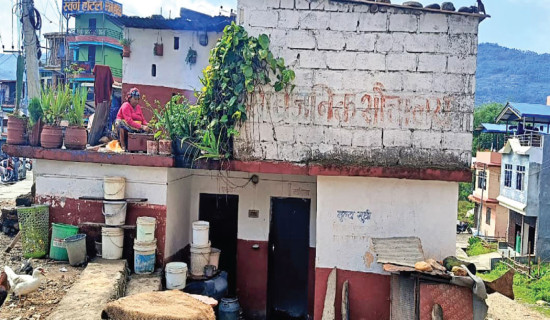
Paint is another common source of lead exposure in households, particularly from the colourful walls. Painted walls can emit lead into the air, which, when inhaled, can pose health risks. The enforcement of international and national standards for lead content in paints has been conflicting in Nepal, and there is a lack of awareness among consumers and workers about the danger of lead.
In 2014, Nepal’s Ministry of Forest and Environment issued a notice in the national gazette, setting a deadline of 181 days from July 2014 for the implementation of lead content standards in paints. However, it seems that this regulation has not been effectively enforced by the government.
Progress
The Centre for Public Health and Environmental Development (CEPHED) has been actively engaged in research and has been collecting paint samples across Nepal. The findings of the research conducted by CEPHED from July to August 2021 have been less than satisfactory, indicating that Nepal has not fully implemented the standard for lead content in paints.
This underscores the need for strict enforcement of standards and quality control in the production of goods.
The tests have revealed that even brands bearing the National Standard “NS” certification may contain lead levels that exceed the national standard's 90 ppm limit. As such, it is imperative to mandate the disclosure of lead content on the labels of paint cans. Furthermore, a strict system for regular monitoring and quality control of products should be in place, along with severe penalties for companies that fail to comply with lead content standards.
In conclusion, lead continues to pose significant health threats in Nepal despite existing regulations. The use of lead is driven by economic factors, especially in developing nations like Nepal, and can be found in everyday items. While there are restrictions on lead use globally, a complete ban is not yet in place. In Nepal, lead is still found in some paints due to inadequate regulation and enforcement. Nepal must conduct research and raise public awareness about lead. The government and non-governmental organisations need to take action by enforcing regulations to minimise lead exposure. Lead exposure, especially in children, can pose serious health issues. Therefore, strict regulation of lead content in products, public education, and government measures to ensure consumer product safety are essential.
(The author is the Editor of Yuvamanch monthly.)