- Friday, 15 May 2026

The Growing Popularity of Electric Vehicles in Kathmandu
The Earth's climate is undergoing change and will continue to do so in the coming years, the extent of which will depend on the amount of greenhouse gases (CO2) emitted globally, as per United Nation limiting these emissions to keep the rise in global temperatures to 2°C or less, while failure to do so could result in an increase of 5°C or more by the end of the century and impact human health, agriculture and food security, water supply, transportation, energy, and biodiversity and ecosystems. The transportation sector is responsible for a significant amount of global CO2 emissions. According to the International Energy Agency, transport has the highest reliance on fossil fuels in any sector and accounts for 37% of CO2 emissions from end-use sectors by 2021. According to U.S. Environmental Protection Agency, the transportation sector is the largest source of greenhouse gas emissions in the United States, accounting for 28% of total emissions. The research on comparison of vehicular fuel consumption and CO2 emission before and during the covid-19 pandemic in Kathmandu valley revealed that in FY 2019/20, the Kathmandu Valley area produced 914,352 tons of CO2 emissions from the transportation sectorfrom the corresponding 292,260 kiloliters of fuels. Transport accounts for approximately one-fifth of global carbon dioxide (CO2) emissions, and road transport accounts for three-quarters of transport emissions.
The use of electricity
in the transport sector can reduce the dependency on imported Petroleum, Oil,
and Lubricants, resulting in a reduction in CO2. During the 8th
Kathmandu Sustainable Urban Mobility Forum, the urgent need to reduce carbon
emissions from the transport sector in Nepal was emphasized.
Electric vehicles (EVs) are becoming increasingly common in Kathmandu owing to concerns about the environment and sustainability. The Nepali market has seen an increase in the number of electric two-wheelers and four-wheelers on roads, driven by the lower fuel costs and environmental benefits of EVs. As more companies introduce electric vehicles into the market, prices gradually decrease, making them more affordable for Nepali customers. The government has also implemented initiatives to promote the use of EVs, including reducing customs duties on EVs and their related components. The growing popularity of EVs in Kathmandu can be attributed to increasing demand for sustainable and eco-friendly transportation. As people become more aware of their impact on the environment, they are looking for ways to reduce their carbon footprints. Electric vehicles (EVs) are an effective way to reduce greenhouse gas emissions and contribute to global warming. The use of fossil fuels in traditional vehicles has caused negative environmental impacts such as air pollution and global warming. The transportation sector is a major contributor to greenhouse gas emissions; therefore, replacing fossil-fuel-based vehicles with electric vehicles is crucial in reducing emissions.
Nepal is making significant progress towards achieving energy independence through the development of hydropower, which has a low environmental impact and produces no emissions. With an estimated hydropower potential of 83,000 megawatts, the country is well positioned to leverage this sustainable energy source. This shift towards hydropower is not only crucial for energy independence but is also indirectly linked to the promotion of electric vehicles (EVs). As EVs rely on electricity as their main power source, transitioning to cleaner and more sustainable methods of electricity production such as hydropower can effectively reduce greenhouse gas emissions from the transport sector. Furthermore, a greater reliance on hydropower can lead to increased availability of electricity for charging EVs, thereby further promoting their widespread use. In line with these efforts, the Nepali government has set a target to fully transition to electric vehicles by 2031, with hydropower playing a vital role in achieving this goal.
Several brands and types of EV are available in Nepal, including international brands such as Nissan, Hyundai, Tata Motors, Mahindra, BYD, and Kia, as well as local companies. The popularity of specific brands may vary depending on factors, such as price, features, and availability. The price range of popular electric car brands in Nepal varies depending on the brand and model, with prices ranging from Rs. 37.99 Lakhs.Regarding the availability of charging stations in Kathmandu, there are more than 20 electric vehicle charging stations in Kathmandu, Pokhara, and other major cities in Nepal. The construction of 30 charging stations was completed, with 25 already in operation. Electric Vehicle Nepal reports that there are 72 electric charging stations in Nepal, and more than 500 EV charging stations will be installed in various locations in the coming years. Several platforms, such as Esabda and Charging Stations Nepal, provide lists of charging stations in Nepal, making it easier for users to find charging facilities.
However, challenges still need to be addressed for the widespread adoption of electric vehicles in Kathmandu. Road congestion is one of the pressing challenges faced by the adoption of EVs in Nepal. Despite the growing number of EVs on the streets of Kathmandu, the new EV policy has failed to address the issue of traffic congestion, which continues to plague the city. This poses a significant obstacle for the smooth integration of EVs into transportation systems. Another major hurdle is the lack of a charging infrastructure. The availability of charging stations remains limited, making it inconvenient for EV owners to charge their vehicles, particularly on long journeys. To encourage widespread adoption of EVs, it is crucial to develop a robust network of charging stations throughout the country. Furthermore, a shortage of EV batteries owing to global supply chain disruptions has hindered the accessibility of EVs to the Nepali population. The limited availability of batteries makes it challenging for potential buyers to purchase electric vehicles. Addressing this issue and ensuring a stable supply chain for EV batteries are crucial for the sustainable growth of the EV market in Nepal. The relatively higher purchase price of EVs compared with traditional internal combustion vehicles is another barrier to their widespread adoption. While the cost of EVs has gradually decreased with the entry of various brands into the market, it remains a significant deterrent for many potential buyers. Implementing effective financial incentives and subsidies can help bridge the price gap and make EVs affordable for consumers. Additionally, poor long-term planning and goal setting for EV development have hampered the progress of the sector in Nepal. A comprehensive and strategic approach to EV infrastructure development and policy implementation is necessary to ensure the successful integration of EVs into transportation systems.
Although EVs are
environmentally friendly during their use, the disposal of their batteries can
cause significant waste and pollution problems if not done properly. In China,
for example, the country responsible for half of the world's electric vehicles,
approximately 50% of retired batteries are not disposed of properly. Nepal must
take measures to ensure the proper disposal of EV batteries to avoid these
problems.
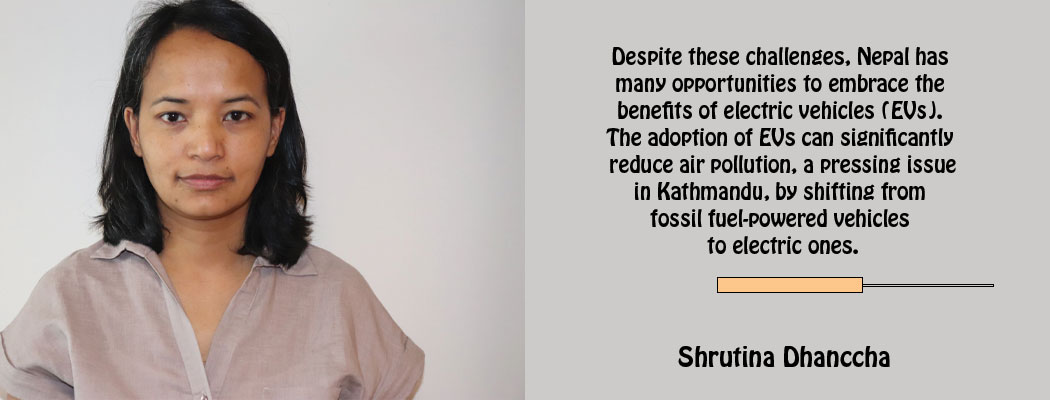
Despite these
challenges, Nepal has many opportunities to embrace the benefits of electric
vehicles (EVs). The adoption of EVs can significantly reduce air pollution, a
pressing issue in Kathmandu, by shifting from fossil fuel-powered vehicles to
electric ones. This transition would lead to cleaner air and improved public
health. Nepal's vast hydropower resources can be harnessed to generate clean
electricity for EVs, further reducing the country's carbon footprint and
promoting transportation sustainability. The recent announcement of tax cuts
for EVs is a positive step towards their adoption, making them more affordable
and contributing to the overall reduction in air pollution. Additionally, the
introduction of electric buses and taxis in major cities and the entry of
international and local brands like eScooter Nepal and Yatri Motorcycles into
the Nepalese EV market further demonstrate the growing interest and potential
for EVs in Nepal.
( Dhanchha, MPhil Scholar of Development
Studies at Kathmandu University, School of Education)











---Copy-original-thumb.jpg)