- Friday, 15 May 2026

High prices draw Ilam youth to cardamom
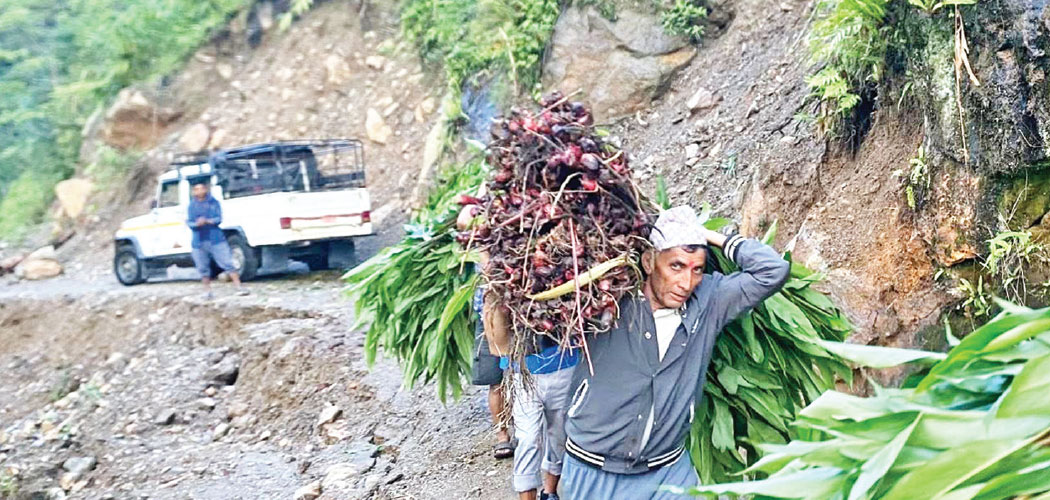
Photo: Kokila Dhakal/TRN Farmers carrying cardamom on their backs in Ilam for selling.

By Kokila Dhakal,Ilam, May 15: Youth in Ilam are showing enthusiasm for cardamom farming, which contributes significantly to foreign currency earnings. As cardamom has been fetching between Rs. 90,000 and Rs. 100,000 per mann (about 40 kg) since the beginning of this season, youths have been increasingly encouraged to expand cardamom cultivation due to the promising income it generates.
This is also the ideal season for planting cardamom saplings. The months of May to August are considered the best time for planting. Farmers said this opportunity not only allows them to plant new saplings but also to earn a good income from selling them.
Mahesh Sapkota, a farmer from Maijogmai–5 in Ilam, says that selling cardamom saplings has become a lucrative source of income this season as well. Sapkota, who sold cardamom saplings worth Rs. 2.2 million last year, said he is preparing to sell 150,000 saplings this year.
He said that this year the Bharlang variety of cardamom has been supplied as far as Khotang, Panchthar and Taplejung, with demand also coming from western districts.
“There has been no disease, and demand from outside districts has been very high. Production here was excellent both last year and this year,” said Sapkota. “I estimate that next year I may produce around 50 manns of cardamom.” Sapkota is cultivating cardamom on 70 ropanis of land.He sold 14 manns of cardamom last year, and 25 manns this year. “There is no lack of income potential in villages, but what is lacking is the workforce, and among that workforce, the drive and enthusiasm,” he said.
Likewise, another young farmer, Lila Dahal of Sandakpur–2, has also established an impressive cardamom orchard. He has planted cardamom on 40 ropanis of land, and sold eight manns of cardamom last season. He estimates that production will reach 20 manns next year once the new plantation also begins yielding.
Dahal said that after landslides triggered by last year’s monsoon caused cracks in most of the land in the Maimajhuwa area, there were few alternatives left for farming.
“Much of the land here has cracked, putting many houses at risk. There is even the compulsion to relocate homes. It is not possible to cultivate other crops on such cracked land. Cardamom is our only option here,” Dahal said.
Alongside the necessity of cultivating cardamom, the income generated from it has further boosted farmers’ morale.
Sukmaya Rai, another farmer from Sandakpur-2, now dreams of building a good house by selling cardamom. Around eight to ten years ago, her family leased land on interest and began cultivating cardamom. Since then, the family has managed to acquire 28 ropanis of land.
“At first, we took land on interest, and with the income from cardamom grown there, we managed to buy 28 ropanis of land here. Now, including both owned and leased land, we have nearly 40 ropanis under cardamom cultivation,” Sukmaya said. “This year we produced around 18 manns of cardamom. We bought land with that income, and now we dream of building a good house.”
Recently, the entire Yangma village has come to be identified as a ‘cardamom village’. As far as the eye can see, cardamom lines the terraces and even reaches the edges of courtyards throughout the village.
As production in the village has increased, cardamom exports have also risen in recent times. According to statistics from the Mechi Customs Office in Jhapa, cardamom worth more than Rs. 10 billion was exported through the office during the first nine months of the current fiscal year 2025/26.
The statistics show that cardamom exports during the current fiscal year increased by 41.58 per cent compared to the same period of the previous fiscal year 2081/82.
As cardamom has begun generating good income, farmers have also been expanding its cultivation. According to the Cardamom Development Centre in Ilam, cardamom farming has now spread across 14,383.5 hectares of land nationwide.